



 Chat with AI
Exam 5: Accounting for Receivables and Inventory Cost Flow

Exam 1: An Introduction to Accounting101 Questions
Exam 2: Accounting for Accruals and Deferrals77 Questions
Exam 3: Accounting for Merchandising Businesses105 Questions
Exam 4: Internal Controls, Accounting for Cash, and Ethics79 Questions
Exam 5: Accounting for Receivables and Inventory Cost Flow120 Questions
Exam 6: Accounting for Long-Term Operational Assets97 Questions
Exam 7: Accounting for Liabilities126 Questions
Exam 8: Proprietorships, Partnerships, and Corporations94 Questions
Exam 9: Financial Statement Analysis108 Questions
Exam 10: An Introduction to Management Accounting111 Questions
Exam 11: Cost Behavior, Operating Leverage, and Profitability Analysis124 Questions
Exam 12: Cost Accumulation, Tracing, and Allocation103 Questions
Exam 13: Relevant Information for Special Decisions104 Questions
Exam 14: Planning for Profit and Cost Control117 Questions
Exam 15: Performance Evaluation116 Questions
Exam 16: Planning for Capital Investments116 Questions
Select questions type


On December 31, Year 1, the Loudoun Corporation estimated that 3% of its credit sales of $112,500 would be uncollectible. Loudoun uses the allowance method of accounting for uncollectible accounts. In February of Year 2, one of Loudoun's customers failed to pay his $1,050 account and the account was written off. On April 4, Year 2, this customer paid Loudoun the $1,050. Which of the following answers correctly states the effect of the December 31, Year 1 adjusting entry for uncollectible accounts on the financial statements of the Loudoun Corporation?

(Multiple Choice)
4.9/5  (66)
(66) The Yankee Corporation has recently begun to accept credit cards. On July 7, Yankee made a credit card sale of $600. The credit card company charges a fee of 3%. Which of the following correctly shows the effects of the sale on July 7? Assume that the credit card fee is recorded on the date of sale.
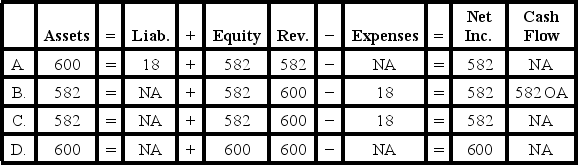
(Multiple Choice)
4.9/5 (89)
(89) If prices are rising, which inventory cost flow method will produce the lowest amount of cost of goods sold?
(Multiple Choice)
4.9/5 (84)
(84) The Griffin Corporation accepted a credit card for a sale of $3,000 on December 16, Year 1. The credit card company charges a fee of 4%. On January 5, Year 2, Griffin received payment from the credit card company. Indicate whether each of the following statements is true or false.
_____ a) Griffin should record $2,880 revenue in Year 1 when the sale is made.
_____ b) Griffin should record a credit card receivable account receivable of $3,000 on December 16, Year 1.
_____ c) The sale has no impact on the statement of cash flows in Year 1.
_____ d) The collection of cash increases total assets in Year 2.
_____ e) The entry on December 16, Year 1, increases total revenues and total expenses on the Year 1 income statement.
(Essay)
4.8/5 (76)
(76) On December 31, Year 1, the Loudoun Corporation estimated that 3% of its credit sales of $112,500 would be uncollectible. Loudoun uses the allowance method of accounting for uncollectible accounts. In February of Year 2, one of Loudoun's customers failed to pay his $1,050 account and the account was written off. On April 4, Year 2, this customer paid Loudoun the $1,050. Which of the following answers correctly states the effect of Loudoun Company's February Year 2 entry to write off the customer's account?

(Multiple Choice)
4.8/5 (74)
(74) In a period of rising prices, use of the FIFO cost flow method would cause a company to pay more income taxes than would use of LIFO.
(True/False)
4.8/5 (80)
(80) Generally accepted accounting principles do not allow the cost flow pattern for merchandise inventory to differ from the physical flow of merchandise within the business.
(True/False)
5.0/5 (87)
(87) When a company accepts a credit card payment for a sale, the amount of sales revenue to be recorded is reduced by the amount of the credit card company's fee.
(True/False)
4.9/5 (76)
(76) Domino Company uses the aging of accounts receivable method to estimate uncollectible accounts expense. Domino began Year 2 with balances in Accounts Receivable and Allowance for Doubtful Accounts of $76,500 and $5,800, respectively. During the year, the company wrote off $4,640 in uncollectible accounts. In preparation for the company's Year 2 estimate, Domino prepared the following aging schedule: 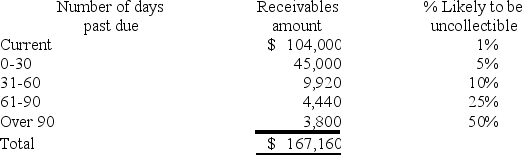 What will Domino record as Uncollectible Accounts Expense for Year 2?
 (Multiple Choice)
4.8/5 (82)
(82) The primary reason for a business to allow customers to purchase goods or services on account is to:
(Multiple Choice)
5.0/5 (94)
(94) Koontz Company uses the perpetual inventory method. On January 1, Year 1, the company's first day of operations, Koontz purchased 400 units of inventory that cost $7.50 each. On January 10, Year 1, the company purchased an additional 600 units of inventory that cost $9.00 each. If Koontz uses a weighted average cost flow method and sells 550 units of inventory, the amount of inventory appearing on balance sheet following the sale will be approximately:
(Multiple Choice)
4.9/5 (94)
(94) Hoover Company purchased two identical inventory items. The item purchased first cost $33.00. The item purchased second cost $35.00. Then Hoover sold one of the inventory items for $62.00. Based on this information, the amount of:
(Multiple Choice)
4.7/5 (79)
(79) Indicate whether each of the following statements is true or false.
_____ a) To compute cost of goods sold under the weighted average method, it is necessary to first compute the weighted-average cost per unit.
_____ b) The weighted average cost per unit is computed by dividing the total cost of goods purchased by the number of units sold.
_____ c) Under the FIFO method, each time units are sold the unit cost of the oldest inventory is applied to the number of units sold.
_____ d) Under a perpetual inventory system, it is not possible to use the LIFO method of cost flow.
_____ e) A U.S. company can use LIFO for income tax purposes only if it also uses LIFO for financial reporting purposes.
(Essay)
4.9/5 (81)
(81) Glebe Company accepted a credit card account receivable in exchange for $1,100 of services provided to a customer. The credit card company charges a 5% service charge. The collection of cash from the credit card company when it settles the account receivable balance will act to:
(Multiple Choice)
4.9/5 (84)
(84) On January 1, Year 2, Grande Company had a $16,000 balance in the Accounts Receivable account and a zero balance in the Allowance for Doubtful Accounts account. During Year 2, Grande provided $104,000 of service on account. The company collected $97,000 cash from accounts receivable. Uncollectible accounts are estimated to be 2% of sales on account. The amount of uncollectible accounts expense recognized on the Year 2 income statement is:
(Multiple Choice)
4.8/5 (91)
(91) During a period of rising prices, a company's cost of goods sold would be higher using the LIFO cost flow method than with FIFO.
(True/False)
4.8/5 (92)
(92) The Internal Revenue Service allows a company to use LIFO for income tax purposes only if it also uses LIFO for financial reporting.
(True/False)
4.8/5 (69)
(69) One of the disadvantages of the specific identification inventory cost flow method is that it can allow managers of a business to manipulate the amount of income the business reports.
(True/False)
4.8/5 (87)
(87) Chase Co. uses the perpetual inventory method. The inventory records for Chase reflected the following  Assuming Chase uses a FIFO cost flow method, the ending inventory on January 31 is:
 (Multiple Choice)
4.8/5 (71)
(71) Accepting credit cards is usually more costly to a business than offering credit directly to customers.
(True/False)
4.8/5 (80)
(80) 
Filters
- Essay(0)
- Multiple Choice(0)
- Short Answer(0)
- True False(0)
- Matching(0)