



 Chat with AI
Exam 5: Accounting for Receivables and Inventory Cost Flow

Exam 1: An Introduction to Accounting101 Questions
Exam 2: Accounting for Accruals and Deferrals77 Questions
Exam 3: Accounting for Merchandising Businesses105 Questions
Exam 4: Internal Controls, Accounting for Cash, and Ethics79 Questions
Exam 5: Accounting for Receivables and Inventory Cost Flow120 Questions
Exam 6: Accounting for Long-Term Operational Assets97 Questions
Exam 7: Accounting for Liabilities126 Questions
Exam 8: Proprietorships, Partnerships, and Corporations94 Questions
Exam 9: Financial Statement Analysis108 Questions
Exam 10: An Introduction to Management Accounting111 Questions
Exam 11: Cost Behavior, Operating Leverage, and Profitability Analysis124 Questions
Exam 12: Cost Accumulation, Tracing, and Allocation103 Questions
Exam 13: Relevant Information for Special Decisions104 Questions
Exam 14: Planning for Profit and Cost Control117 Questions
Exam 15: Performance Evaluation116 Questions
Exam 16: Planning for Capital Investments116 Questions
Select questions type


Houff Company uses the allowance method to account for uncollectible accounts. An account that had been previously written-off as uncollectible was recovered. How would the recovery affect the company's accounting equation?
(Multiple Choice)
4.8/5  (79)
(79) The inventory records for Radford Co. reflected the following  Determine the amount of gross margin assuming the FIFO cost flow method.
 (Multiple Choice)
4.8/5 (96)
(96) The practice of reporting the net realizable value of receivables in the financial statements is commonly called the:
(Multiple Choice)
4.8/5 (81)
(81) The net realizable value of accounts receivable is the amount of receivables a company expects to collect.
(True/False)
4.9/5 (76)
(76) On June 1, Year 2, Carolina Company collected a $24,000 note receivable that had been issued on June 1, Year 1. The note carried a 6% interest rate. The interest revenue recognized on the maturity date is $1,440.
(True/False)
5.0/5 (96)
(96) In most businesses, the physical flow of goods occurs on a FIFO basis, but a different cost flow method is allowed under generally accepted accounting principles.
(True/False)
4.9/5 (86)
(86) When the cost of purchasing inventory is declining, which inventory cost flow method will produce the highest amount of cost of goods sold?
(Multiple Choice)
4.8/5 (83)
(83) On January 1, Year 2, Grande Company had a $16,000 balance in the Accounts Receivable account and a zero balance in the Allowance for Doubtful Accounts account. During Year 2, Grande provided $104,000 of service on account. The company collected $97,000 cash from accounts receivable. Uncollectible accounts are estimated to be 2% of sales on account. Based on this information, the amount of cash flow from operating activities that would appear on the Year 2 statement of cash flows is:
(Multiple Choice)
4.9/5 (73)
(73) Blake Company purchased two identical inventory items. The item purchased first cost $16.00, and the item purchased second cost $18.00. Blake sold one of the items for $24.00. Which of the following statements is true?
(Multiple Choice)
4.8/5 (72)
(72) Poole Company purchased two identical inventory items. One of the items, purchased in January, cost $4.50. The other, purchased in February, cost $4.75. One of the items was sold in March at a selling price of $7.50. Assuming that Poole uses a LIFO cost flow, which of the following statements is correct?
(Multiple Choice)
4.8/5 (73)
(73) The year-end adjusting entry to accrue interest on a note receivable is an asset source transaction.
(True/False)
4.9/5 (81)
(81) The Yankee Corporation has recently begun to accept credit cards. On July 7, Yankee made a credit card sale of $600. The credit card company charges a fee of 3%. Which of the following answers correctly describes the effect of the collection of cash from the credit card company on the financial statements of Yankee Corporation?
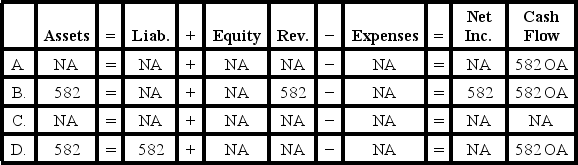
(Multiple Choice)
4.8/5 (81)
(81) Collection of a credit card receivable is an asset source transaction.
(True/False)
4.7/5 (75)
(75) The percent of receivables method to estimate uncollectible accounts expense is also known as:
(Multiple Choice)
4.8/5 (88)
(88) Indicate whether each of the following statements is true or false.
_____ a) A benefit of making credit card sales is that there is no cost to the merchant.
_____ b) A benefit of accepting credit cards is that increased sales may be generated.
_____ c) Recording a credit card sale increases total assets and increases total liabilities.
_____ d) Recording the collection of cash from the credit card company increases cash and increases revenue.
_____ e) The income statement is not affected at the time the cash receipt is recorded.
(Essay)
4.7/5 (83)
(83) Melbourne Company uses the perpetual inventory method. Melbourne purchased 500 units of inventory that cost $4.00 each. At a later date the company purchased an additional 600 units of inventory that cost $5.00 each. If Melbourne uses a LIFO cost flow method, and sells 800 units of inventory, the amount of ending inventory appearing on the balance sheet will be:
(Multiple Choice)
4.7/5 (85)
(85) Which inventory costing method will produce an amount for cost of goods sold that is closest to current market value?
(Multiple Choice)
4.7/5 (83)
(83) On January 1, Year 2, Kincaid Company's Accounts Receivable and the Allowance for Doubtful Accounts carried balances of $31,000 and $500, respectively. During the year Kincaid reported $72,500 of credit sales. Kincaid wrote off $550 of receivables as uncollectible in Year 2. Cash collections of receivables amounted to $74,550. Kincaid estimates that it will be unable to collect one percent (1%) of credit sales. The amount of uncollectible accounts expense recognized in the Year 2 income statement will be:
(Multiple Choice)
4.8/5 (74)
(74) When a customer's account, previously written off as uncollectible, is reinstated, the net realizable value of Accounts Receivable increases.
(True/False)
4.9/5 (89)
(89) 
Filters
- Essay(0)
- Multiple Choice(0)
- Short Answer(0)
- True False(0)
- Matching(0)