



 Chat with AI
Exam 5: Accounting for Receivables and Inventory Cost Flow

Exam 1: An Introduction to Accounting101 Questions
Exam 2: Accounting for Accruals and Deferrals77 Questions
Exam 3: Accounting for Merchandising Businesses105 Questions
Exam 4: Internal Controls, Accounting for Cash, and Ethics79 Questions
Exam 5: Accounting for Receivables and Inventory Cost Flow120 Questions
Exam 6: Accounting for Long-Term Operational Assets97 Questions
Exam 7: Accounting for Liabilities126 Questions
Exam 8: Proprietorships, Partnerships, and Corporations94 Questions
Exam 9: Financial Statement Analysis108 Questions
Exam 10: An Introduction to Management Accounting111 Questions
Exam 11: Cost Behavior, Operating Leverage, and Profitability Analysis124 Questions
Exam 12: Cost Accumulation, Tracing, and Allocation103 Questions
Exam 13: Relevant Information for Special Decisions104 Questions
Exam 14: Planning for Profit and Cost Control117 Questions
Exam 15: Performance Evaluation116 Questions
Exam 16: Planning for Capital Investments116 Questions
Select questions type


The Miller Company earned $190,000 of revenue on account during Year 2. There was no beginning balance in the accounts receivable and allowance accounts. During Year 2, Miller collected $136,000 of cash from its receivables accounts. The company estimates that it will be unable to collect 3% of its sales on account. The net realizable value of Miller's receivables at the end of Year 2 was:
(Multiple Choice)
4.8/5  (77)
(77) A company uses a cost flow method (such as LIFO or FIFO) to allocate product costs between cost of goods sold and beginning inventory.
(True/False)
4.9/5 (77)
(77) Generally accepted accounting principles restrict or limit a company's freedom to change accounting methods from one year to the next.
(True/False)
4.7/5 (83)
(83) A company that uses the allowance method to account for uncollectible accounts:
(Multiple Choice)
4.8/5 (79)
(79) Barton Corporation uses the aging of accounts receivable method of accounting for uncollectible accounts. As of December 31, Year 1, prior to estimating uncollectible accounts expense, Barton's balance of accounts receivable was $68,900, the balance of allowance for doubtful accounts was $2,500, and total sales for Year 1 were $875,000. On December 31, Year 1, Barton aged its receivables and determined the following:
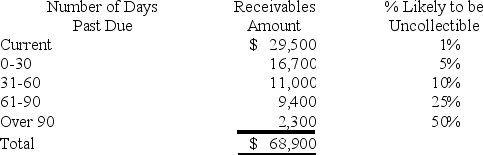 Indicate whether each of the following statements is true or false.
_____ a) Barton will report Net Realizable Value of Accounts Receivable equal to $63,170 on its December 31, Year 1 balance sheet.
_____ b) Barton will report Uncollectible Accounts Expense of $5,730 on its Year 1 income statement.
_____ c) The December 31 adjusting entry related to uncollectible accounts will increase liabilities and decrease equity by $3,230.
_____ d) The method Barton uses to account for uncollectible accounts is known as the balance sheet approach.
_____ e) Write-offs of uncollectible accounts in Year 2 will reduce Barton's net realizable value of receivables.
Indicate whether each of the following statements is true or false.
_____ a) Barton will report Net Realizable Value of Accounts Receivable equal to $63,170 on its December 31, Year 1 balance sheet.
_____ b) Barton will report Uncollectible Accounts Expense of $5,730 on its Year 1 income statement.
_____ c) The December 31 adjusting entry related to uncollectible accounts will increase liabilities and decrease equity by $3,230.
_____ d) The method Barton uses to account for uncollectible accounts is known as the balance sheet approach.
_____ e) Write-offs of uncollectible accounts in Year 2 will reduce Barton's net realizable value of receivables. (Essay)
4.9/5 (83)
(83) On June 1, Delaware Co. had one unit in beginning inventory that cost $10.00. During June, Delaware paid cash to purchase two additional inventory items. Delaware purchased the first item for cash at a cost of $10.00, and the second at a cost of $12.00. Delaware Co. sold two inventory items for $24.00 each, receiving cash. Based on this information alone, indicate whether each of the following items is true or false.
_____ a) The amount of ending inventory will be $10 assuming the LIFO cost flow was used.
_____ b) Cost of goods sold would be $24 assuming the weighted average cost flow was used.
_____ c) Cash flow from operating activities in June would be $28 assuming a FIFO cost flow was used.
_____ d) Cash flow from operating activities in June would be $26 independent of what cost flow assumption was used.
_____ e) The amount of gross margin would be $26 assuming the FIFO cost flow was used.
(Essay)
4.8/5 (84)
(84) On December 31, Year 1, the West Corporation estimated that $6,000 of its receivables might not be collected. Before adjusting entries, the balance of Accounts Receivable and the Allowance for Doubtful Accounts respectively was $150,000 and zero on December 31, Year 1. On February 1, Year 2, West wrote-off of a delinquent account from one of its customers. West Corp. uses the allowance method of accounting for uncollectible accounts. Indicate whether each of the following statements is true or false.
_____a) The net realizable value of accounts receivable (after the appropriate adjusting entry on December 31, Year 1) was $144,000.
_____b) The write-off of the account on February 1, Year 2, did not affect the net realizable value of West's accounts receivable.
_____c) The adjusting entry on December 31, Year 1, had no effect on West's total assets.
_____d) The write-off entry on February 1, Year 2, had no effect on West's total assets.
_____e) The write-off entry on February 1, Year 2, decreased net income for Year 2.
(Essay)
4.7/5 (78)
(78) If a company uses the percent of receivables method to estimate uncollectible accounts, the company will first determine the required ending balance in Allowance for Doubtful Accounts, and Uncollectible Accounts Expense will be the difference between that amount and the current balance in the allowance.
(True/False)
4.8/5 (75)
(75) The last-in, first-out cost flow method assigns the cost of the items purchased first to ending inventory.
(True/False)
4.9/5 (82)
(82) The best estimate for the amount of cash a company expects to collect from its accounts receivable is the face value of the receivables.
(True/False)
4.9/5 (85)
(85) The adjusting entry to recognize uncollectible accounts expense does not affect the net realizable value of receivables.
(True/False)
4.9/5 (76)
(76) The Miller Company earned $190,000 of revenue on account during Year 2. There was no beginning balance in the accounts receivable and allowance accounts. During Year 2, Miller collected $136,000 of cash from its receivables accounts. The company estimates that it will be unable to collect 3% of its sales on account. The amount of uncollectible accounts expense recognized on the Year 2 income statement was:
(Multiple Choice)
4.9/5 (82)
(82) For a company that uses the allowance method, the write-off of an uncollectible account receivable is an asset use transaction.
(True/False)
4.8/5 (72)
(72) If a company estimates uncollectible accounts based on a percentage of receivables, the resulting estimate will be presented on the balance sheet as the ending balance in Allowance for Doubtful Accounts.
(True/False)
4.9/5 (86)
(86) During a period of rising prices the LIFO cost flow method will result in higher total assets than FIFO.
(True/False)
4.7/5 (71)
(71) Vargas Company uses the perpetual inventory method. Vargas purchased 400 units of inventory that cost $15.00 each. At a later date the company purchased an additional 800 units of inventory that cost $18.00 each. Vargas sold 500 units of inventory for $27.00. If Vargas uses a FIFO cost flow method, the amount of cost of goods sold appearing on the income statement will be:
(Multiple Choice)
4.8/5 (79)
(79) At a time of declining prices, which cost flow assumption will result in the highest ending inventory?
(Multiple Choice)
4.9/5 (80)
(80) Most companies report receivables on their balance sheets at the net realizable value.
(True/False)
4.8/5 (89)
(89) Indicate whether each of the following statements is true or false.
_____ a) Loaning cash to another company is considered a financing activity on the statement of cash flows.
_____ b) The major difference between treating the extension of credit to a customer as accounts receivable and treating it as notes receivable is the existence of interest.
_____ c) In a promissory note, the payee issues the note to the maker.
_____ d) Interest rates are always stated on an annual basis, regardless of the length of the note.
_____ e) Accruing interest on a note receivable is considered an asset use transaction.
(Essay)
4.9/5 (80)
(80) The inventory records for Radford Co. reflected the following  Determine the amount of ending inventory assuming the FIFO cost flow method.
 (Multiple Choice)
4.8/5 (94)
(94) 
Filters
- Essay(0)
- Multiple Choice(0)
- Short Answer(0)
- True False(0)
- Matching(0)