



 Chat with AI
Exam 7: Accounting for Liabilities

Exam 1: An Introduction to Accounting101 Questions
Exam 2: Accounting for Accruals and Deferrals77 Questions
Exam 3: Accounting for Merchandising Businesses105 Questions
Exam 4: Internal Controls, Accounting for Cash, and Ethics79 Questions
Exam 5: Accounting for Receivables and Inventory Cost Flow120 Questions
Exam 6: Accounting for Long-Term Operational Assets97 Questions
Exam 7: Accounting for Liabilities126 Questions
Exam 8: Proprietorships, Partnerships, and Corporations94 Questions
Exam 9: Financial Statement Analysis108 Questions
Exam 10: An Introduction to Management Accounting111 Questions
Exam 11: Cost Behavior, Operating Leverage, and Profitability Analysis124 Questions
Exam 12: Cost Accumulation, Tracing, and Allocation103 Questions
Exam 13: Relevant Information for Special Decisions104 Questions
Exam 14: Planning for Profit and Cost Control117 Questions
Exam 15: Performance Evaluation116 Questions
Exam 16: Planning for Capital Investments116 Questions
Select questions type


Flora's Flower Market sells eight potted petunias to a customer for $50.00, plus 5% sales tax. Flora's will recognize $52.50 in sales revenue.

Free
(True/False)
4.8/5  (70)
(70) Correct Answer: Verified
False
Which of the following is a claims exchange transaction?
Free
(Multiple Choice)
4.7/5 (76)
(76) Correct Answer:Verified
VerifiedA
Jones Company issued bonds with a $200,000 face value on January 1, Year 1. The five-year term bonds were issued at 97 and had a 7½% stated rate of interest that is payable in cash on December 31st of each year. Jones amortizes the bond discount using the straight-line method. Based on this information: The amount of interest expense shown on Jones's December 31, Year 1 income statement would be:
Free
(Multiple Choice)
4.9/5 (72)
(72) Correct Answer:Verified
VerifiedA
If a company has issued bonds at a premium, the amount of interest expense reported on the income statement each year will be greater than the amount of cash paid to bondholders for interest.
(True/False)
4.9/5 (78)
(78) The effective interest rate method of amortizing bond premium or discount results in a constant amount of interest expense every period.
(True/False)
4.8/5 (80)
(80) On January 1, Year 1, Sheffield Co. issued bonds with a face value of $200,000, a term of ten years, and a stated interest rate of 6%. The bonds were issued at 105, and interest is payable each December 31. Sheffield uses the straight-line method to amortize the bond discount. The carrying value of the bonds that would be reported on the December 31, Year 4 balance sheet is:
(Multiple Choice)
4.8/5 (83)
(83) On January 1, Year 1, Daniels Company issued bonds with a face value of $500,000, receiving $496,000 cash. These bonds were issued at a discount.
(True/False)
4.8/5 (85)
(85) Which of the following items would be least likely to appear in the current liabilities section of a classified balance sheet?
(Multiple Choice)
4.8/5 (84)
(84) Jones Company issued bonds with a $200,000 face value on January 1, Year 1. The five-year term bonds were issued at 97 and had a 7½% stated rate of interest that is payable in cash on December 31st of each year. Jones amortizes the bond discount using the straight-line method. Based on this information: The amount of cash outflow from operating activities shown on Jones's December 31, Year 2 statement of cash flows would be:
(Multiple Choice)
4.8/5 (65)
(65) If a company uses the effective interest method of amortizing a bond premium, the carrying value of the bond will:
(Multiple Choice)
4.8/5 (84)
(84) The party who borrows money in a note payable is known as the:
(Multiple Choice)
4.9/5 (79)
(79) Vogle Company purchased $8,000 of equipment by making a $500 down payment and issuing a note for the remainder. As a result of this event, assets increased by $8,000.
(True/False)
5.0/5 (87)
(87) Johansen Company issued a bond at a discount. Which of the following choices accurately reflects how the issue would affect Johansen's financial statements? 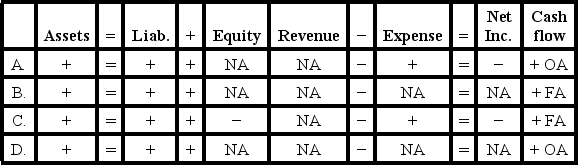
(Multiple Choice)
4.9/5 (81)
(81) Victor Company issued bonds with a $250,000 face value and a 6% stated rate of interest on January 1, Year 1. The bonds carried a 5-year term and sold for 95. Victor uses the straight-line method of amortization. Interest is payable on December 31 of each year. The amount of interest expense appearing on the December 31, Year 3 income statement would be:
(Multiple Choice)
4.7/5 (83)
(83) Contingent liabilities are only recognized if they arise from past events.
(True/False)
4.7/5 (75)
(75) Victor Company issued bonds with a $250,000 face value and a 6% stated rate of interest on January 1, Year 1. The bonds carried a 5-year term and sold for 95. Victor uses the straight-line method of amortization. Interest is payable on December 31 of each year. The amount of cash flow from operating activities on the December 31, Year 3 statement of cash flows would be:
(Multiple Choice)
5.0/5 (81)
(81) Indicate whether each of the following statements about bonds is true or false.
_____ a) The carrying value of a bond increases over time if the bond was issued at a premium.
_____ b) At the end of the term of the bonds, the carrying value of a bond issue is equal to the issue price.
_____ c) If bonds are sold below face value, the difference between the issue price and the face value is called the bond discount.
_____ d) The payment of interest is an operating activity on the statement of cash flows.
_____ e) The issuance of bonds does not appear on the statement of cash flows.
(Essay)
4.9/5 (85)
(85) Davis Corporation borrowed $50,000 on January 1, Year 1. The loan is for a ten-year period and has an annual interest rate of 9%. At the end of each year, Davis will make a payment of $7,791, which includes both principal and interest. The amount of the payment for Year 1 that is reduction of principal is $3,587.
(True/False)
4.9/5 (76)
(76) When do the effects of product warranties appear on the statement of cash flows?
(Multiple Choice)
4.8/5 (80)
(80) Riley Company borrowed $36,000 on April 1, Year 1 from the Titan Bank. The note issued by Riley carried a one year term and a 7% annual interest rate. Riley earned cash revenue of $1,700 in Year 1 and $1,400 in Year 2. Assume no other transactions. The amount of total liabilities that would appear on Riley's December 31 balance sheets for Year 1 and Year 2, respectively, would be:
(Multiple Choice)
4.8/5 (79)
(79) 
Filters
- Essay(0)
- Multiple Choice(0)
- Short Answer(0)
- True False(0)
- Matching(0)