



 Chat with AI
Exam 5: Accounting for Receivables and Inventory Cost Flow

Exam 1: An Introduction to Accounting101 Questions
Exam 2: Accounting for Accruals and Deferrals77 Questions
Exam 3: Accounting for Merchandising Businesses105 Questions
Exam 4: Internal Controls, Accounting for Cash, and Ethics79 Questions
Exam 5: Accounting for Receivables and Inventory Cost Flow120 Questions
Exam 6: Accounting for Long-Term Operational Assets97 Questions
Exam 7: Accounting for Liabilities126 Questions
Exam 8: Proprietorships, Partnerships, and Corporations94 Questions
Exam 9: Financial Statement Analysis108 Questions
Exam 10: An Introduction to Management Accounting111 Questions
Exam 11: Cost Behavior, Operating Leverage, and Profitability Analysis124 Questions
Exam 12: Cost Accumulation, Tracing, and Allocation103 Questions
Exam 13: Relevant Information for Special Decisions104 Questions
Exam 14: Planning for Profit and Cost Control117 Questions
Exam 15: Performance Evaluation116 Questions
Exam 16: Planning for Capital Investments116 Questions
Select questions type


When prices are falling, LIFO will result in:

Free
(Multiple Choice)
4.8/5  (84)
(84) Correct Answer: Verified
C
Rosewood Company made a loan of $16,000 to one of the company's employees on April 1, Year 1. The one-year note carried a 6% rate of interest. The amount of interest revenue that Rosewood would report during the years ending December 31, Year 1 and Year 2, respectively, would be:
Free
(Multiple Choice)
4.7/5 (78)
(78) Correct Answer:Verified
VerifiedD
The adjusting entry to recognize uncollectible accounts expense is an asset use transaction.
Free
(True/False)
4.9/5 (84)
(84) Correct Answer:Verified
VerifiedTrue
Glasgow Enterprises started the period with 80 units in beginning inventory that cost $7.50 each. During the period, the company purchased inventory items as follows. Glasgow sold 220 units after purchase 3 for $17.00 each.  Glasgow's cost of goods sold under FIFO would be:
 (Multiple Choice)
4.8/5 (78)
(78) Elliston Company accepted credit card payments for $10,000 of services provided to customers. The credit card company charges a 3% service charge. This transaction would increase:
(Multiple Choice)
4.9/5 (92)
(92) The amount of accounts receivable that is actually expected to be collected is known as the:
(Multiple Choice)
4.9/5 (80)
(80) Anton Co. uses the perpetual inventory method. Anton purchased 400 units of inventory that cost $12.00 each. At a later date the company purchased an additional 600 units of inventory that cost $16.00 each. If Anton uses the FIFO cost flow method and sells 700 units of inventory, the amount of cost of goods sold will be:
(Multiple Choice)
4.9/5 (67)
(67) The face value of Accounts Receivable plus the balance in the Allowance for Doubtful Accounts is equal to the net realizable value of the receivables.
(True/False)
4.8/5 (74)
(74) Allegheny Company ended Year 1 with balances in Accounts Receivable and Allowance for Doubtful Accounts of $23,000 and $900, respectively. During Year 2, Allegheny wrote off $1,500 of Uncollectible Accounts. After aging its receivables, Allegheny estimates that the ending Allowance for Doubtful Accounts balance should be $1,600. What will Allegheny report as Uncollectible Accounts Expense on its Year 2 income statement?
(Multiple Choice)
4.9/5 (72)
(72) During a period of declining prices, a company would report a lower gross margin using the FIFO cost flow method than with LIFO.
(True/False)
4.8/5 (88)
(88) Indicate whether each of the following statements is true or false.
_____ a) The FIFO cost flow method assumes that the company physically rotates inventory so that the oldest inventory is sold first.
_____ b) In a period of rising prices, FIFO gives higher cost of goods sold than LIFO.
_____ c) Under the weighted average cost flow method, the cost per unit of ending inventory is equal to the cost per unit of inventory sold.
_____ d) In a period of declining prices, LIFO will result in higher income tax expense than FIFO.
_____ e) In a period of rising prices, FIFO gives higher ending inventory than LIFO does.
(Essay)
4.8/5 (73)
(73) The inventory records for Radford Co. reflected the following  Determine the amount of cost of goods sold assuming the LIFO cost flow method.
 (Multiple Choice)
4.8/5 (87)
(87) When an uncollectible account receivable is written off, the amount of total assets is unchanged.
(True/False)
4.9/5 (84)
(84) On January 1, Year 2, the Accounts Receivable balance was $37,000 and the balance in the Allowance for Doubtful Accounts was $2,800. On January 15, Year 2, an $800 uncollectible account was written-off. The net realizable value of accounts receivable immediately after the write-off is:
(Multiple Choice)
4.8/5 (89)
(89) When a company receives payment from a customer whose account was previously written off, the customer's account should be reinstated.
(True/False)
4.7/5 (82)
(82) Alberta Company accepts a credit card as payment for $450 of services provided for the customer. The credit card company charges a 4% handling charge for its collection services. Select the answer that shows how the entry to record the sale would affect Alberta's financial statements. 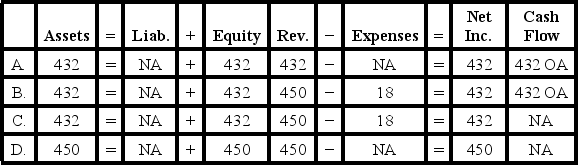
(Multiple Choice)
4.9/5 (77)
(77) Using the allowance method of accounting for uncollectible receivables requires an estimate of the amount of receivables that will not be collected.
(True/False)
5.0/5 (78)
(78) Chase Co. uses the perpetual inventory method. The inventory records for Chase reflected the following  Assuming Chase uses a LIFO cost flow method, the amount of cost of goods sold for the sales transaction on January 18 is:
 (Multiple Choice)
4.9/5 (65)
(65) Singleton Company's perpetual inventory records included the following information:
 If Singleton uses the FIFO cost flow method, its cost of goods sold would be $4,490.
 (True/False)
5.0/5 (75)
(75) 
Filters
- Essay(0)
- Multiple Choice(0)
- Short Answer(0)
- True False(0)
- Matching(0)