



 Chat with AI
Exam 7: Accounting for Liabilities

Exam 1: An Introduction to Accounting101 Questions
Exam 2: Accounting for Accruals and Deferrals77 Questions
Exam 3: Accounting for Merchandising Businesses105 Questions
Exam 4: Internal Controls, Accounting for Cash, and Ethics79 Questions
Exam 5: Accounting for Receivables and Inventory Cost Flow120 Questions
Exam 6: Accounting for Long-Term Operational Assets97 Questions
Exam 7: Accounting for Liabilities126 Questions
Exam 8: Proprietorships, Partnerships, and Corporations94 Questions
Exam 9: Financial Statement Analysis108 Questions
Exam 10: An Introduction to Management Accounting111 Questions
Exam 11: Cost Behavior, Operating Leverage, and Profitability Analysis124 Questions
Exam 12: Cost Accumulation, Tracing, and Allocation103 Questions
Exam 13: Relevant Information for Special Decisions104 Questions
Exam 14: Planning for Profit and Cost Control117 Questions
Exam 15: Performance Evaluation116 Questions
Exam 16: Planning for Capital Investments116 Questions
Select questions type


If a company uses the effective interest method of amortizing a bond discount, the interest expense that is recognized each year will:
(Multiple Choice)
4.9/5  (70)
(70) The Gordon Corporation issued $70,000 of 6%, 5-year bonds on January 1, Year 1 at 98. The interest payments are due on December 31 each year. Gordon uses the straight-line method of amortization. Which of the following answers shows the effect of the first interest payment and amortization of premium or discount?
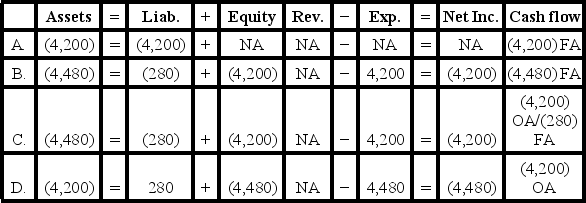
(Multiple Choice)
4.8/5 (82)
(82) The effective rate of interest for a particular bond issue is the market rate of interest for other investments with similar levels of risk.
(True/False)
4.8/5 (84)
(84) Kier Company issued $200,000 in bonds on January 1, Year 1. The bonds were issued at face value and carried a 4-year term to maturity. They had a 6½% stated rate of interest that was payable in cash on December 31st. Based on this information alone, the amount of interest expense shown on the December 31, Year 1 income statement and the cash flow from operating activities shown on the December 31, Year 1 statement of cash flows would be: 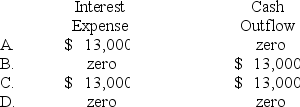
(Multiple Choice)
4.9/5 (59)
(59) On January 1, Year 1, the Niagara Corporation arranges a $6,000 line of credit with the Centennial Bank. It accepted the bank's offer of 1% above the prime rate with interest payments on December 31 of each year. All borrowings and repayments are to take place on January 1 of each year. Niagara records the first year's interest payment on December 31, Year 1. Centennial's prime rate is 4% for Year 1. Which of the following answers shows the effect of this event on the financial statements?
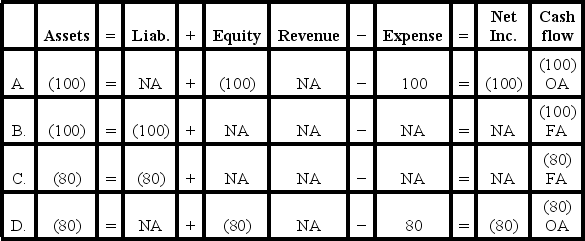
(Multiple Choice)
4.9/5 (81)
(81) A five-year, $500,000 bond was issued on January 1, Year 1. The stated rate of interest was 8%, and the effective rate of interest was 10%. The interest is paid semiannually. Which of the following statements is correct?
(Multiple Choice)
4.8/5 (60)
(60) The Platte Corporation issues a 5-year note payable on January 1, Year 1 for $5,000. The interest rate is 5% and the annual payment of $1,156, due each December 31, includes both interest and principal. Which of the following shows the effect of the December 31, Year 1 payment?
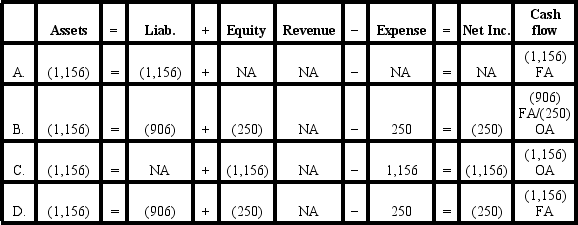
(Multiple Choice)
4.9/5 (90)
(90) Franklin Company obtained a $160,000 line of credit from the State Bank on January 1, Year 1. The company agreed to accept a variable interest rate that was set at 2% above the bank's prime lending rate. The bank's prime rate of interest and the amounts borrowed or repaid during the first three months of Year 1 are shown in the following table. Assume that Franklin borrows or repays on the first day of each month. Borrowing is shown as a positive amount and repayments are shown as negative amounts indicated by parentheses.  Based on this information alone, the amount of interest expense recognized in March would be closest to:
 (Multiple Choice)
4.8/5 (79)
(79) Wayne Company issued bonds with a face value of $600,000, a 6% stated rate of interest, and a 10-year term. The bonds were issued on January 1, Year 1, and Wayne uses the straight-line method of amortization. Interest is paid annually on December 31. If Wayne issued the bonds for 96, the:
(Multiple Choice)
4.9/5 (72)
(72) The Platte Corporation issues a 5-year note payable on January 1, Year 1 for $5,000. The interest rate is 5% and the annual payment of $1,156, due each December 31, includes both interest and principal. Which of the following answers correctly shows the effect of the issuance of the note on Platte's financial statements?
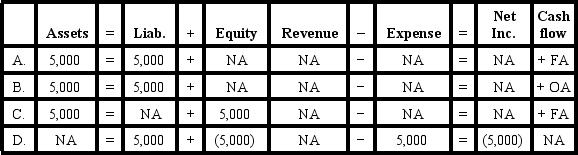
(Multiple Choice)
5.0/5 (77)
(77) The Clarion Company provides a one-year warranty on all merchandise it sells. In Year 1, the company recorded sales of $500,000. It estimated that the warranty costs on these sales would amount to $2,000. In July, Year 2, Clarion paid $250 to satisfy a warranty claim. Indicate whether each of the following statements is true or false.
_____ a) Clarion's recognition of the warranty obligation at the end of Year 1 reduced total assets and total equity.
_____ b) Clarion's recognition of the warranty obligation at the end of Year 1 increased Clarion's total liabilities.
_____ c) The July, Year 2 transaction reduced total assets and net income for Year 2.
_____ d) The July, Year 2 transaction reduced Clarion's total liabilities.
_____ e) The recognition of the warranty obligation at the end of Year 1 did not affect Clarion's revenue for the year.
(Essay)
4.9/5 (83)
(83) Riley Company borrowed $36,000 on April 1, Year 1 from the Titan Bank. The note issued by Riley carried a one year term and a 7% annual interest rate. Riley earned cash revenue of $1,700 in Year 1 and $1,400 in Year 2. Assume no other transactions. The amount of net income on the Year 2 income statement would be:
(Multiple Choice)
4.7/5 (59)
(59) Selling $130 of merchandise to a customer for $200 cash in a state where the sales tax rate is 4%:
(Multiple Choice)
4.8/5 (88)
(88) If the stated interest rate for bonds is the same as the market rate of interest, the bonds will be issued at their face value.
(True/False)
4.8/5 (95)
(95) Riley Company borrowed $36,000 on April 1, Year 1 from the Titan Bank. The note issued by Riley carried a one year term and a 7% annual interest rate. Riley earned cash revenue of $1,700 in Year 1 and $1,400 in Year 2. Assume no other transactions. The amount of cash flow from operating activities that would appear on the Year 2 statement of cash flows would be:
(Multiple Choice)
4.9/5 (65)
(65) Denver Co. issued bonds with a face value of $100,000 and a stated interest rate of 8%. The bonds have a life of five years and were sold at 102 ½. If Denver amortizes discounts and premiums using the straight-line method, the amount of interest expense each full year would be:
(Multiple Choice)
4.8/5 (74)
(74) Payment of interest on a note payable is considered a financing activity on the statement of cash flows.
(True/False)
4.7/5 (84)
(84) Wayne Company issued bonds with a face value of $600,000, a 6% stated rate of interest, and a 10-year term. The bonds were issued on January 1, Year 1, and Wayne uses the straight-line method of amortization. Interest is paid annually on December 31. Assuming Wayne issued the bond for 102½, the amount of interest expense appearing on the Year 1 income statement would be:
(Multiple Choice)
4.9/5 (74)
(74) 
Filters
- Essay(0)
- Multiple Choice(0)
- Short Answer(0)
- True False(0)
- Matching(0)