



 Chat with AI
Exam 6: Accounting for Long-Term Operational Assets

Exam 1: An Introduction to Accounting101 Questions
Exam 2: Accounting for Accruals and Deferrals77 Questions
Exam 3: Accounting for Merchandising Businesses105 Questions
Exam 4: Internal Controls, Accounting for Cash, and Ethics79 Questions
Exam 5: Accounting for Receivables and Inventory Cost Flow120 Questions
Exam 6: Accounting for Long-Term Operational Assets97 Questions
Exam 7: Accounting for Liabilities126 Questions
Exam 8: Proprietorships, Partnerships, and Corporations94 Questions
Exam 9: Financial Statement Analysis108 Questions
Exam 10: An Introduction to Management Accounting111 Questions
Exam 11: Cost Behavior, Operating Leverage, and Profitability Analysis124 Questions
Exam 12: Cost Accumulation, Tracing, and Allocation103 Questions
Exam 13: Relevant Information for Special Decisions104 Questions
Exam 14: Planning for Profit and Cost Control117 Questions
Exam 15: Performance Evaluation116 Questions
Exam 16: Planning for Capital Investments116 Questions
Select questions type


Indicate whether each of the following statements is true or false.
_____ a) A patent with a useful life of 5 years and a legal life of 10 years is amortized over 5 years.
_____ b) Intangible assets with indefinite useful lives must be tested each year for impairment.
_____ c) If it is determined that the original value recorded for goodwill is too high, then an entry is made directly to Retained Earnings, reducing the balance in this account.
_____d) The entry to recognize an impairment loss on goodwill includes a debit to Amortization Expense and a credit to Goodwill.
_____e) The recognition of an impairment loss involves a cash outflow classified as a financing activity.
(Essay)
4.8/5  (60)
(60) Jing Company was started on January 1, Year 1 when it issued common stock for $50,000 cash. Also, on January 1, Year 1 the company purchased office equipment that cost $34,000 cash. The equipment was delivered under terms FOB shipping point, and transportation cost was $2,000. The equipment had a five-year useful life and a $12,000 expected salvage value. Using double-declining-balance depreciation, what the amount of depreciation expense and the amount of accumulated depreciation, respectively, that would appear on the December 31, Year 3 financial statements?
(Multiple Choice)
4.9/5 (80)
(80) On January 1, Year 1, the Vanguard Company purchased a copyright for $12,000. Vanguard estimated the remaining useful life of the copyright to be 6 years. Which of the following correctly shows the effect of Vanguard's purchase of the copyright on the financial statements?
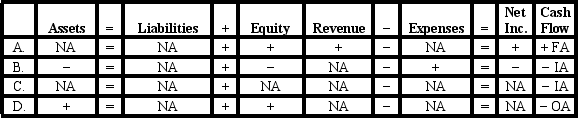
(Multiple Choice)
4.9/5 (80)
(80) Which method of depreciation is used by most U. S. companies for financial reporting purposes?
(Multiple Choice)
4.9/5 (90)
(90) The depreciable cost of a long-term asset is the difference between the amount paid for the asset and its salvage value.
(True/False)
4.8/5 (80)
(80) Laramie Co. paid $800,000 for a purchase that included land, building, and office furniture. An appraiser provided the following estimates of the market values of the assets if they had been purchased separately: Land, $100,000, Building, $740,000, and Office Furniture, $160,000. Based on this information the cost that would be allocated to the land is:
(Multiple Choice)
4.9/5 (91)
(91) On January 1, Year 1, Friedman Company purchased a truck that cost $48,000. The truck had an expected useful life of 8 years and an $8,000 salvage value. The book value of the truck at the end of Year 1, assuming that Friedman uses the double-declining-balance method, is:
(Multiple Choice)
4.9/5 (87)
(87) Which of the following is considered an accelerated depreciation method?
(Multiple Choice)
4.9/5 (85)
(85) Chico Company paid $950,000 for a basket purchase that included office furniture, a building and land. An appraiser provided the following estimates of the market values of the assets if they had been purchased separately: Office furniture - $190,000; Building - $740,000, Land - $132,000. Based on this information, and rounding allocations to two decimal places, the amount of cost that would be allocated to the office furniture is closest to:
(Multiple Choice)
4.8/5 (94)
(94) Monroe Minerals Company purchased a copper mine for $120,000,000. The mine was expected to produce 50,000 tons of copper over its useful life. During Year 1, the company extracted 6,000 tons of copper. The copper was sold for $4,500 per ton. Assume that the company incurred $8,040,000 in operating expenses during Year 1. Based on this information, how much net income would Monroe report in Year 1?
(Multiple Choice)
5.0/5 (77)
(77) Expenditures that extend the useful life of a plant asset are added to the asset account.
(True/False)
4.7/5 (76)
(76) Jing Company was started on January 1, Year 1 when it issued common stock for $50,000 cash. Also, on January 1, Year 1 the company purchased office equipment that cost $34,000 cash. The equipment was delivered under terms FOB shipping point, and transportation cost was $2,000. The equipment had a five-year useful life and a $12,000 expected salvage value. At the end of Year 5, assuming the equipment had not been sold, the book value of the office equipment using straight-line depreciation and double-declining-balance depreciation, respectively, would be:
(Multiple Choice)
4.9/5 (76)
(76) Good Company paid cash to purchase mineral rights on a large parcel of land. Which of the following choices accurately reflects how this event would affect Good's financial statements? 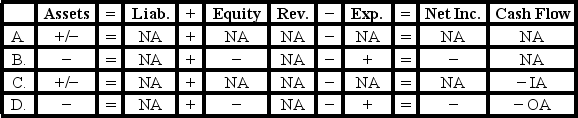
(Multiple Choice)
4.9/5 (79)
(79) Indicate whether each of the following statements is true or false.
_____ a) Long-term assets having no physical substance are called intangible assets.
_____ b) Trademarks are examples of an intangible asset.
_____ c) Natural resources are examples of tangible long-term assets.
_____ d) The reason that land is classified separately from other tangible assets is because the cost is normally much higher.
_____ e) Goodwill is classified as Plant, Property and Equipment.
(Essay)
4.8/5 (86)
(86) Which of the following would not be classified as a tangible long-term asset?
(Multiple Choice)
4.8/5 (94)
(94) Farmer Company purchased equipment on January 1, Year 1 for $82,000. The equipment is estimated to have a 5-year life and a salvage value of $4,000. The company uses the straight-line depreciation method. At the beginning of Year 4, Farmer revised the expected life to eight years. The annual amount of depreciation expense for each of the remaining years would be:
(Multiple Choice)
4.9/5 (77)
(77) Chubb Company paid cash to purchase equipment on January 1, Year 1. Select the answer that shows how the recognition of depreciation expense in Year 2 would affect assets, liabilities, equity, net income, and cash flow (+ means increase, - decrease, and NA not affected). 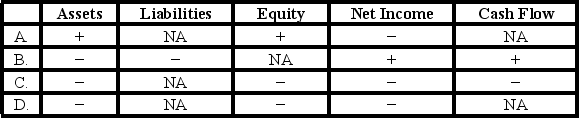
(Multiple Choice)
4.9/5 (88)
(88) 
Filters
- Essay(0)
- Multiple Choice(0)
- Short Answer(0)
- True False(0)
- Matching(0)