



 Chat with AI
Exam 6: Accounting for Long-Term Operational Assets

Exam 1: An Introduction to Accounting101 Questions
Exam 2: Accounting for Accruals and Deferrals77 Questions
Exam 3: Accounting for Merchandising Businesses105 Questions
Exam 4: Internal Controls, Accounting for Cash, and Ethics79 Questions
Exam 5: Accounting for Receivables and Inventory Cost Flow120 Questions
Exam 6: Accounting for Long-Term Operational Assets97 Questions
Exam 7: Accounting for Liabilities126 Questions
Exam 8: Proprietorships, Partnerships, and Corporations94 Questions
Exam 9: Financial Statement Analysis108 Questions
Exam 10: An Introduction to Management Accounting111 Questions
Exam 11: Cost Behavior, Operating Leverage, and Profitability Analysis124 Questions
Exam 12: Cost Accumulation, Tracing, and Allocation103 Questions
Exam 13: Relevant Information for Special Decisions104 Questions
Exam 14: Planning for Profit and Cost Control117 Questions
Exam 15: Performance Evaluation116 Questions
Exam 16: Planning for Capital Investments116 Questions
Select questions type


The Rupert Company purchased a delivery van on January 1, Year 1 for $45,000. Rupert uses straight-line depreciation for the asset, which has a five year estimated useful life and a salvage value estimated at $9,000. The asset was sold on January 1, Year 3 for $33,300 cash. Indicate whether each of the following items related to Rupert Company is true or false.
_____ a) Annual depreciation for Rupert's equipment was $9,000.
_____ b) Accumulated depreciation on January 1, Year 3 was $14,400.
_____ c) Book value on January 1, Year 3 was $30,600.
_____ d) On the date of the sale, Rupert will record a loss of $2,400.
_____ e) A gain or loss on the sale of a plant asset is reported on the balance sheet.
(Essay)
4.9/5  (71)
(71) Jing Company was started on January 1, Year 1 when it issued common stock for $50,000 cash. Also, on January 1, Year 1 the company purchased office equipment that cost $34,000 cash. The equipment was delivered under terms FOB shipping point, and transportation cost was $2,000. The equipment had a five-year useful life and a $12,000 expected salvage value. Assume that Jing Company earned $30,000 cash revenue and incurred $19,000 in cash expenses in Year 3. Using straight-line depreciation and assuming that the office equipment was sold on December 31, Year 3 for $16,000, the amount of net income or (loss) appearing on the December 31, Year 3 income statement would be:
(Multiple Choice)
4.9/5 (78)
(78) On January 1, Year 1, Stiller Company paid $80,000 to obtain a patent. Stiller expected to use the patent for 5 years before it became technologically obsolete. The remaining legal life of the patent was 8 years. Based on this information, the amount of amortization expense on the December 31, Year 3 income statement and the book value of the patent on the December 31, Year 3, balance sheet, respectively, would be:
(Multiple Choice)
4.8/5 (85)
(85) Anton Company paid cash to prolong the life of one of its assets. Which of the following choices accurately reflects how this event would affect Anton's financial statements? 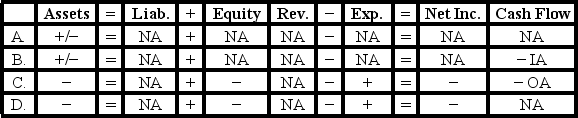
(Multiple Choice)
4.7/5 (80)
(80) Indicate whether each of the following statements is true or false.
_____ a) A trademark has an identifiable legal lifetime.
_____ b) U.S. GAAP requires that research and development costs be capitalized as assets and then expensed over a reasonable period of time.
_____ c) A patent is amortized over the longer of its legal life or useful life.
_____ d) The entry to record the amortization of a patent includes an increase to Amortization Expense, Patent and a decrease to Patent.
_____e) The capitalized cost of a trademark includes the cost to develop the trademark and to defend it.
(Essay)
4.8/5 (90)
(90) An impairment of an intangible asset reduces the asset, stockholders' equity, and net income.
(True/False)
4.8/5 (77)
(77) Gains and losses are reported as non-operating items on the income statement.
(True/False)
4.9/5 (85)
(85) Harding Corporation acquired real estate that contained land, building and equipment. The property cost Harding $1,900,000. Harding paid $350,000 and issued a note payable for the remainder of the cost. An appraisal of the property reported the following values: Land, $374,000; Building, $1,100,000 and Equipment, $726,000. What value will be recorded for the building?
(Multiple Choice)
4.8/5 (76)
(76) Late in a plant asset's useful life, the amount of depreciation that would be recorded with the double-declining-balance method is less than the amount that would be recognized with straight-line depreciation.
(True/False)
4.9/5 (68)
(68) A machine with a book value of $38,000 is sold for $32,000. Which of the following answers would accurately represent the effects of the sale on the financial statements? 
(Multiple Choice)
4.8/5 (81)
(81) The cost of natural resources includes the purchase price, as well as exploration costs and surveys.
(True/False)
4.9/5 (79)
(79) Schubert Co. owned equipment that originally cost $48,000. The company sold the equipment on January 1, Year 4, for $16,000 cash. Accumulated depreciation on the day of sale amounted to $34,000. Based on this information, indicate whether each of the following statements is true or false.
_____ a) The sale will increase Schubert's net income, but it will not affect the company's operating income.
_____ b) Schubert would show a $16,000 cash inflow in the operating activities section of the cash flow statement.
_____ c) The sale would result in a decrease in total assets.
_____ d) The sale would increase Schubert's equity by $2,000.
_____ e) The sale would be recorded as a debit to cash for $16,000, a credit to equipment for $14,000, and a credit to gain on sale of equipment for $2,000.
(Essay)
4.9/5 (78)
(78) Generally accepted accounting principles require that, when the estimated useful life of a long-term asset is changed, previously-issued financial statements should not be revised.
(True/False)
4.8/5 (80)
(80) Dinkins Company purchased a truck that cost $46,000. The company expected to drive the truck 100,000 miles over its 5-year useful life, and the truck had an estimated salvage value of $8,000. If the truck is driven 26,000 miles in the current accounting period, what would be the amount of depreciation expense for the year?
(Multiple Choice)
4.9/5 (86)
(86) The purchase of a new delivery truck for cash is an asset use transaction.
(True/False)
4.8/5 (80)
(80) Which of the following would be classified as a tangible asset?
(Multiple Choice)
4.9/5 (88)
(88) Flagler Company purchased equipment that cost $90,000. The equipment had a useful life of 5 years and a $10,000 salvage value. Flagler used the double-declining-balance method to depreciate its assets. Which of the following choices accurately reflects how the recognition of the first year's depreciation would affect the company's financial statements? 
(Multiple Choice)
4.8/5 (83)
(83) On January 1, Year 1, Milton Manufacturing Company purchased equipment with a list price of $88,000. A total of $4,000 was paid for installation and testing. During the first year, Milton paid $6,000 for insurance on the equipment and another $2,200 for routine maintenance and repairs. Milton uses the units-of-production method of depreciation. Useful life is estimated at 100,000 units, and estimated salvage value is $8,000. During Year 1, the equipment produced 13,000 units. What is closest to the amount of depreciation for the year?
(Multiple Choice)
4.9/5 (82)
(82) Accumulated Depreciation is a temporary account that is closed each year.
(True/False)
4.7/5 (88)
(88) 
Filters
- Essay(0)
- Multiple Choice(0)
- Short Answer(0)
- True False(0)
- Matching(0)