



 Chat with AI
Exam 6: Accounting for Long-Term Operational Assets

Exam 1: An Introduction to Accounting101 Questions
Exam 2: Accounting for Accruals and Deferrals77 Questions
Exam 3: Accounting for Merchandising Businesses105 Questions
Exam 4: Internal Controls, Accounting for Cash, and Ethics79 Questions
Exam 5: Accounting for Receivables and Inventory Cost Flow120 Questions
Exam 6: Accounting for Long-Term Operational Assets97 Questions
Exam 7: Accounting for Liabilities126 Questions
Exam 8: Proprietorships, Partnerships, and Corporations94 Questions
Exam 9: Financial Statement Analysis108 Questions
Exam 10: An Introduction to Management Accounting111 Questions
Exam 11: Cost Behavior, Operating Leverage, and Profitability Analysis124 Questions
Exam 12: Cost Accumulation, Tracing, and Allocation103 Questions
Exam 13: Relevant Information for Special Decisions104 Questions
Exam 14: Planning for Profit and Cost Control117 Questions
Exam 15: Performance Evaluation116 Questions
Exam 16: Planning for Capital Investments116 Questions
Select questions type


Emir Company purchased equipment that cost $110,000 cash on January 1, Year 1. The equipment had an expected useful life of six years and an estimated salvage value of $8,000. Assuming that Emir depreciates its assets under the straight-line method, the amount of depreciation expense appearing on the Year 4 income statement and the amount of accumulated depreciation appearing on the December 31, Year 4, balance sheet would be: 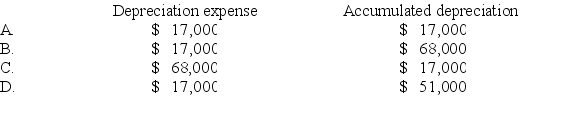
(Multiple Choice)
4.7/5  (84)
(84) On April 1, Year 1, Fossil Energy Company purchased an oil producing well at a cash cost of $12,000,000. It is estimated that the oil well contains 600,000 barrels of oil, of which only 500,000 can be profitably extracted. By December 31, Year 1, 25,000 barrels of oil were produced and sold. The amount of depletion expense for Year 1 on this well would be:
(Multiple Choice)
4.8/5 (81)
(81) Goodwill is the value attributable to a business's ability to generate a high return.
(True/False)
4.9/5 (84)
(84) On January 1, Year 3, Ruiz Company spent $850 on a plant asset to improve its quality. The asset had been purchased on January 1, Year 1 for $8,400 and had an estimated salvage value of $1,200 and a useful life of five years. Ruiz uses the straight-line depreciation method. Which of the following correctly shows the effects of the Year 3 expenditure on the financial statements? 
(Multiple Choice)
4.8/5 (81)
(81) The Hoover Company acquired the Burgess Company for $1,200,000 cash. The fair value of Burgess's assets was $1,040,000, and the company had liabilities of $60,000. How much goodwill will be recorded in connection with the acquisition?
(Multiple Choice)
4.8/5 (80)
(80) Which of the following should be the main determinant for selection of the allocation method for long-term operational assets?
(Multiple Choice)
4.9/5 (76)
(76) On January 1, Year 1, the City Taxi Company purchased a new taxi cab for $36,000. The cab has an expected salvage value of $2,000. The company estimates that the cab will be driven 200,000 miles over its life. It uses the units-of-production method to determine depreciation expense. The cab was driven 45,000 miles the first year and 48,000 the second year. What would be the depreciation expense reported on the Year 2 income statement and the book value of the taxi, respectively, at the end of Year 2?
(Multiple Choice)
4.8/5 (80)
(80) Which of the following terms is used to identify the expense recognition for intangible assets?
(Multiple Choice)
4.8/5 (82)
(82) On January 1, Year 1, Li Company purchased an asset that cost $80,000. The asset had an expected useful life of five years and an estimated salvage value of $16,000. Li uses the straight-line method for the recognition of depreciation expense. At the beginning of the fourth year of usage, the company revised its estimated salvage value to $8,000. Based on this information, the amount of depreciation expense to be recognized at the end of Year 4 is:
(Multiple Choice)
4.9/5 (77)
(77) Recognizing depreciation expense on equipment or a building is an asset use transaction.
(True/False)
4.8/5 (90)
(90) On March 1, Bartholomew Company purchased a new stamping machine with a list price of $34,000. The company paid cash for the machine; therefore, it was allowed a 5% discount. Other costs associated with the machine were: transportation costs, $550; sales tax paid, $1,360; installation costs, $450; routine maintenance during the first month of operation, $500. The cost recorded for the machine was:
(Multiple Choice)
4.9/5 (89)
(89) Which of the following is not classified as property, plant and equipment?
(Multiple Choice)
4.8/5 (86)
(86) The use of estimates and Revision of Estimates are uncommon in financial reporting.
(True/False)
4.7/5 (87)
(87) Which of the following statements is true with regard to depreciation expense?
(Multiple Choice)
4.8/5 (83)
(83) Which of the following statements is correct regarding accounting treatment of goodwill?
(Multiple Choice)
4.9/5 (80)
(80) Which of the following intangible assets does not convey a specific legal right or privilege?
(Multiple Choice)
4.8/5 (77)
(77) The Ernie Company acquired the Bert Company in January of Year 1. Bert's balance sheet included $700,000 of assets, $250,000 of liabilities and equity of $450,000. Ernie agrees to assume the liabilities and pay $480,000 to acquire Bert. An independent appraiser assessed the fair value of Bert's assets to be $630,000. Indicate whether each of the following statements about this transaction is true or false.
_____ a) Ernie's entry to record the transaction includes a debit to the assets for $700,000.
_____ b) Ernie's entry to record the transaction includes a debit to liabilities for $250,000.
_____ c) Ernie will recognize $100,000 of goodwill in recording the acquisition of Bert.
_____ d) It is impossible for Ernie to estimate the length of life for goodwill.
_____ e) The goodwill will be amortized in the same manner as patents.
(Essay)
4.8/5 (75)
(75) At the end of the current accounting period, Ringgold Co. recorded depreciation of $15,000 on its equipment. The effect of this entry on the company's balance sheet is to decrease:
(Multiple Choice)
4.7/5 (75)
(75) Which of the following terms is used to identify the process of expense recognition for property, plant and equipment?
(Multiple Choice)
4.8/5 (75)
(75) 
Filters
- Essay(0)
- Multiple Choice(0)
- Short Answer(0)
- True False(0)
- Matching(0)