



 Chat with AI
Exam 8: Reaction Rates and Equilibrium

Exam 1: Matter, measurements, and Calculations92 Questions
Exam 2: Atoms and Molecules89 Questions
Exam 3: Electronic Structure and the Periodic Law86 Questions
Exam 4: Forces Between Particles89 Questions
Exam 5: Chemical Reactions89 Questions
Exam 6: The States of Matter89 Questions
Exam 7: Solutions and Colloids88 Questions
Exam 8: Reaction Rates and Equilibrium87 Questions
Exam 9: Acids,bases,and Salts86 Questions
Exam 10: Radioactivity and Nuclear Processes86 Questions
Exam 11: Organic Compounds: Alkanes87 Questions
Exam 12: Unsaturated Hydrocarbons88 Questions
Exam 13: Alcohols, phenols, and Ethers87 Questions
Exam 14: Aldehydes and Ketones86 Questions
Exam 15: Carboxylic Acids and Esters86 Questions
Exam 16: Amines and Amides85 Questions
Exam 17: Carbohydrates88 Questions
Exam 18: Lipids91 Questions
Exam 19: Proteins89 Questions
Exam 20: Enzymes88 Questions
Exam 21: Nucleic Acids and Protein Synthesis90 Questions
Exam 22: Nutrition and Energy for Life89 Questions
Exam 23: Carbohydrate Metabolism90 Questions
Exam 24: Lipid and Amino Acid Metabolism94 Questions
Exam 25: Body Fluids86 Questions
Select questions type


Based on the following equilibrium constants,which reaction essentially goes to completion?
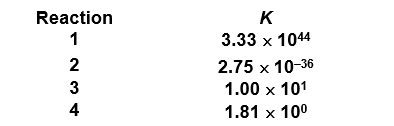 1)81 * 100
 (Multiple Choice)
4.7/5  (83)
(83) The reaction conditions for a specific reaction,BCD + HA ABCDH,are correct,but the reaction does not occur.What could be the reason?
(Multiple Choice)
4.8/5 (75)
(75) Sulfur reacts with oxygen to produce sulfur dioxide,but only if the high activation energy is supplied.Which condition will lower the activation energy the most?
(Multiple Choice)
4.7/5 (83)
(83) You've been told that 'when a change is made in any factor of an established equilibrium,the position of equilibrium will shift in a direction that will minimize or oppose the change.' This is a statement of which of the following?
(Multiple Choice)
4.9/5 (79)
(79) Equilibrium:
The following question(s)refer to the equilibrium given below in which all reactants and products are gases.
CH4 + H2O  CH3OH + H2 + heat
Indicate the effect of the changing condition on the position of equilibrium.
-Refer to Equilibrium.Add CH4 to the mixture.
CH3OH + H2 + heat
Indicate the effect of the changing condition on the position of equilibrium.
-Refer to Equilibrium.Add CH4 to the mixture. (Multiple Choice)
4.9/5 (73)
(73) If heat is absorbed when a compound dissolves in water,the compound should be more soluble at higher temperatures.
(True/False)
4.7/5 (92)
(92) Which statement is incorrect with reference to Le Châtelier's principle?
(Multiple Choice)
4.7/5 (83)
(83) A doctor has given your patient a prescription of a common amphetamine.What should the patient avoid when taking this medication?
(Multiple Choice)
4.7/5 (87)
(87) Which of the conditions given is necessary for a chemical reaction to occur?
(Multiple Choice)
4.9/5 (74)
(74) CFC's are in the environment because they were released into the atmosphere.What was the use of CFC's?
(Multiple Choice)
4.8/5 (66)
(66) All chemical reactions require at least some amount of activation energy to proceed.
(True/False)
5.0/5 (80)
(80) Which of the following is most closely related to the term "reaction rate"?
(Multiple Choice)
4.9/5 (86)
(86) You purchase a glow stick during an evening parade.After it ends,your roommate tells you that if you place it in the freezer,it will glow for a longer time.Assuming she knows what she is talking about,why would this be true?
(Multiple Choice)
4.9/5 (81)
(81) Equilibrium:
The following question(s)refer to the equilibrium given below in which all reactants and products are gases.
CH4 + H2O CH3OH + H2 + heat
Indicate the effect of the changing condition on the position of equilibrium.
-The equilibrium for the following reaction at 1 atm and 25°C lies far to the left.A possible equilbrium constant for this reaction would be _____ .
N2 + 3H2  3NH3
CH3OH + H2 + heat
Indicate the effect of the changing condition on the position of equilibrium.
-The equilibrium for the following reaction at 1 atm and 25°C lies far to the left.A possible equilbrium constant for this reaction would be _____ .
N2 + 3H2
3NH3 (Multiple Choice)
4.8/5 (68)
(68) Equilibrium:
The following question(s)refer to the equilibrium given below in which all reactants and products are gases.
CH4 + H2O CH3OH + H2 + heat
Indicate the effect of the changing condition on the position of equilibrium.
-Refer to Equilibrium.Cool the mixture.
CH3OH + H2 + heat
Indicate the effect of the changing condition on the position of equilibrium.
-Refer to Equilibrium.Cool the mixture. (Multiple Choice)
4.8/5 (73)
(73) Which of the statements is correct when referring to the following reaction?
H2(g)+ I2(g)  2HI(g)
 (Multiple Choice)
4.9/5 (79)
(79) Chemical reactions always occur once the molecules of two substances collide.
(True/False)
4.8/5 (93)
(93) 
Filters
- Essay(0)
- Multiple Choice(0)
- Short Answer(0)
- True False(0)
- Matching(0)