



 Chat with AI
Exam 8: Reaction Rates and Equilibrium

Exam 1: Matter, measurements, and Calculations92 Questions
Exam 2: Atoms and Molecules89 Questions
Exam 3: Electronic Structure and the Periodic Law86 Questions
Exam 4: Forces Between Particles89 Questions
Exam 5: Chemical Reactions89 Questions
Exam 6: The States of Matter89 Questions
Exam 7: Solutions and Colloids88 Questions
Exam 8: Reaction Rates and Equilibrium87 Questions
Exam 9: Acids,bases,and Salts86 Questions
Exam 10: Radioactivity and Nuclear Processes86 Questions
Exam 11: Organic Compounds: Alkanes87 Questions
Exam 12: Unsaturated Hydrocarbons88 Questions
Exam 13: Alcohols, phenols, and Ethers87 Questions
Exam 14: Aldehydes and Ketones86 Questions
Exam 15: Carboxylic Acids and Esters86 Questions
Exam 16: Amines and Amides85 Questions
Exam 17: Carbohydrates88 Questions
Exam 18: Lipids91 Questions
Exam 19: Proteins89 Questions
Exam 20: Enzymes88 Questions
Exam 21: Nucleic Acids and Protein Synthesis90 Questions
Exam 22: Nutrition and Energy for Life89 Questions
Exam 23: Carbohydrate Metabolism90 Questions
Exam 24: Lipid and Amino Acid Metabolism94 Questions
Exam 25: Body Fluids86 Questions
Select questions type


At 20°C,a sample of solid spontaneously sublimes to a gas.This change in state is accompanied by which of the following changes in the solid sample?
(Multiple Choice)
4.8/5  (59)
(59) Which of the following is NOT true regarding a chemical reaction?
(Multiple Choice)
4.7/5 (63)
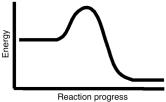
(63) 
Which method can be used to product a timed-release medication?
(Multiple Choice)
4.9/5 (75)
(75) Equilibrium:
The following question(s)refer to the equilibrium given below in which all reactants and products are gases.
CH4 + H2O  CH3OH + H2 + heat
Indicate the effect of the changing condition on the position of equilibrium.
-Refer to Equilibrium.Remove H2 from the mixture.
CH3OH + H2 + heat
Indicate the effect of the changing condition on the position of equilibrium.
-Refer to Equilibrium.Remove H2 from the mixture. (Multiple Choice)
4.8/5 (84)
(84) The reaction below does not progress at room temperature,but does at 1100 C.Therefore,this reaction is spontaneous at 1100 C. 
(True/False)
4.8/5 (87)
(87) In a system of equilibrium,it is true that the rate of the forward reaction
(Multiple Choice)
4.9/5 (75)
(75) Consider the following energy diagram.Which letter represents the activation energy for the forward reaction? 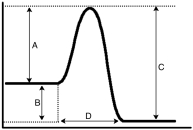
(Multiple Choice)
4.8/5 (72)
(72) A spontaneous process accompanied by an entropy decrease must also be accompanied by an energy decrease.
(True/False)
4.8/5 (73)
(73) BrCl is put into an empty 1.00 L container.At equilibrium,the molar concentration of BrCl is 0.382,and that of Br2 is 0.319.Evaluate the equilibrium constant for the following reaction.
Br2(g)+ Cl2(g)  2BrCl(g)
 (Multiple Choice)
4.7/5 (74)
(74) For the following energy diagram,which letter represents the catalyzed activation energy? 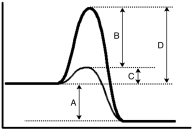
(Multiple Choice)
4.9/5 (74)
(74) Most automobiles function by burning gasoline by a process similar to the equation shown,in which octane is burned.
C8H18 + O2 CO2 + H2O + heat (not balanced)
Using the concept of entropy,interpret the implications of this reaction.
(Multiple Choice)
5.0/5 (78)
(78) A reaction rate can be described using any unit of time (seconds,hours,etc. ).
(True/False)
4.8/5 (68)
(68) The equilibrium constants for a series of reaction of the general type:
AB+CD
 AD+BC
were measured and are shown below. In which reaction is the concentration of the products the largest at equilibrium?
AD+BC
were measured and are shown below. In which reaction is the concentration of the products the largest at equilibrium? (Multiple Choice)
5.0/5 (72)
(72) The following reaction is observed in a lab experiment: A + 2B C + D
In this experiment,it required 750 s for the concentration of C to change from 0.333 M to 0.750 M.What is the rate of the reaction?
(Multiple Choice)
4.9/5 (59)
(59) Which of the following interpretations of the spontaneous chemical reaction is correct? V + W Y + Z + heat
(Multiple Choice)
4.8/5 (82)
(82) Based upon the energy diagram given below,which letter represents the enthalpy for the reaction? 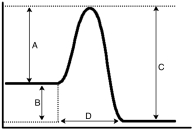
(Multiple Choice)
4.9/5 (76)
(76) At equilibrium,the relative concentrations of each species is the same as the coefficients in the balanced chemical equation.
(True/False)
4.8/5 (83)
(83) 
Filters
- Essay(0)
- Multiple Choice(0)
- Short Answer(0)
- True False(0)
- Matching(0)