



 Chat with AI
Exam 23: Carbohydrate Metabolism

Exam 1: Matter, measurements, and Calculations92 Questions
Exam 2: Atoms and Molecules89 Questions
Exam 3: Electronic Structure and the Periodic Law86 Questions
Exam 4: Forces Between Particles89 Questions
Exam 5: Chemical Reactions89 Questions
Exam 6: The States of Matter89 Questions
Exam 7: Solutions and Colloids88 Questions
Exam 8: Reaction Rates and Equilibrium87 Questions
Exam 9: Acids,bases,and Salts86 Questions
Exam 10: Radioactivity and Nuclear Processes86 Questions
Exam 11: Organic Compounds: Alkanes87 Questions
Exam 12: Unsaturated Hydrocarbons88 Questions
Exam 13: Alcohols, phenols, and Ethers87 Questions
Exam 14: Aldehydes and Ketones86 Questions
Exam 15: Carboxylic Acids and Esters86 Questions
Exam 16: Amines and Amides85 Questions
Exam 17: Carbohydrates88 Questions
Exam 18: Lipids91 Questions
Exam 19: Proteins89 Questions
Exam 20: Enzymes88 Questions
Exam 21: Nucleic Acids and Protein Synthesis90 Questions
Exam 22: Nutrition and Energy for Life89 Questions
Exam 23: Carbohydrate Metabolism90 Questions
Exam 24: Lipid and Amino Acid Metabolism94 Questions
Exam 25: Body Fluids86 Questions
Select questions type


The catabolism of one molecule of glucose in the muscle cells produces 32 ATP molecules.

Free
(True/False)
4.8/5  (83)
(83) Correct Answer: Verified
False
Epinephrine stimulates glycolysis.
Free
(True/False)
4.9/5 (78)
(78) Correct Answer:Verified
VerifiedTrue
A blood sugar level that is lower than normal is referred to as _____ .
Free
(Multiple Choice)
4.8/5 (75)
(75) Correct Answer:Verified
VerifiedA
Under aerobic conditions in humans,what is pyruvate converted to?
(Multiple Choice)
4.8/5 (86)
(86) Under aerobic conditions in the body,pyruvate is converted to _____ .
(Multiple Choice)
4.9/5 (83)
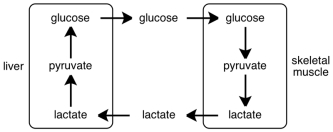
(83) 
Under anaerobic conditions in humans,what is pyruvate converted to?
(Multiple Choice)
4.9/5 (90)
(90) What is the final acceptor of electrons during electron transport?
(Multiple Choice)
4.8/5 (71)
(71) A key organ in regulating blood glucose levels is the _____ .
(Multiple Choice)
4.8/5 (84)
(84) Which of the following reactions represents a step in the metabolism of pyruvate that occurs under aerobic conditions?
(Multiple Choice)
4.9/5 (84)
(84) How many molecules of CO2 are produced per molecule of glucose as a result of the pyruvate dehydrogenase complex?
(Multiple Choice)
4.8/5 (79)
(79) Which of the following foods is most likely to cause problems to those individuals that are lactose intolerant?
(Multiple Choice)
4.9/5 (91)
(91) The first step in the processes of glycolysis is a phosphorolation.
(True/False)
4.9/5 (88)
(88) Which of the following hormones acts to raise the blood glucose level?
(Multiple Choice)
4.7/5 (89)
(89) The free energy change for the complete oxidation of one mole of glucose is -686 kcal and G°' for the hydrolysis of ATP is -7.3 kcal/mol.How many moles of ATP could be synthesized if the entire oxidation process were 100% efficient in converting this energy to the production of ATP?
(Multiple Choice)
5.0/5 (80)
(80) Synthesis of glucose from pyruvate during the Cori cycle occurs primarily in the _____ .
(Multiple Choice)
4.7/5 (85)
(85) Glycogen breakdown is increased in muscle tissue by the presence of epinephrine.
(True/False)
4.7/5 (82)
(82) Lactate,produced in the muscles,is sent to the liver for processing.This is one step of ____.
(Multiple Choice)
4.7/5 (78)
(78) The high-energy compound involved in the conversion of glucose to glycogen is _____ .
(Multiple Choice)
4.9/5 (76)
(76) 
Filters
- Essay(0)
- Multiple Choice(0)
- Short Answer(0)
- True False(0)
- Matching(0)