



 Chat with AI
Exam 9: The Cost of Capital

Exam 1: The Role of Managerial Finance134 Questions
Exam 2: The Financial Market Environment91 Questions
Exam 3: Financial Statements and Ratio Analysis208 Questions
Exam 4: Cash Flow and Financial Planning185 Questions
Exam 5: Time Value of Money173 Questions
Exam 6: Interest Rates and Bond Valuation224 Questions
Exam 7: Stock Valuation188 Questions
Exam 8: Risk and Return188 Questions
Exam 9: The Cost of Capital137 Questions
Exam 10: Capital Budgeting Techniques167 Questions
Exam 11: Capital Budgeting Cash Flows117 Questions
Exam 12: Risk and Refinements in Capital Budgeting106 Questions
Exam 13: Leverage and Capital Structure217 Questions
Exam 14: Payout Policy130 Questions
Exam 15: Working Capital and Current Assets Management336 Questions
Exam 16: Current Liabilities Management171 Questions
Exam 17: Hybrid and Derivative Securities185 Questions
Exam 18: Mergers, Lbos, Divestitures, and Business Failure191 Questions
Exam 19: International Managerial Finance108 Questions
Select questions type


When the constant-growth valuation model is used to find the cost of common stock equity capital, it can easily be adjusted for flotation costs to find the cost of new common stock; the capital asset pricing model (CAPM) does not provide a simple adjustment mechanism.
(True/False)
4.9/5  (80)
(80) From a bond issuer's perspective, the IRR on a bond's cash flows is its yield to maturity (YTM); from the investor's perspective, the IRR on a bond's cash flows is the cost to maturity.
(True/False)
4.8/5 (90)
(90) The amount of preferred stock dividends that must be paid each year may be stated in dollars or as a percentage of the firm's earnings.
(True/False)
4.9/5 (83)
(83) What would be the cost of retained earnings equity for Tangshan Mining if the expected return on U.S. Treasury Bills is 5.00%, the market risk premium is 10.00 percent, and the firm's beta is 1.3?
(Multiple Choice)
4.9/5 (87)
(87) A firm has common stock with a market price of $55 per share and an expected dividend of $2.81 per share at the end of the coming year. The dividends paid on the outstanding stock over the past five years are as follows: 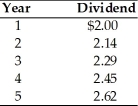 The cost of the firm's common stock equity is ________.
 (Multiple Choice)
4.8/5 (82)
(82) The cost to maturity of existing bonds reflects the rate of return required by the market.
(True/False)
4.8/5 (83)
(83) Given that the cost of common stock is 18 percent, dividends are $1.50 per share and the price of the stock is $12.50 per share, what is the annual growth rate of dividends?
(Multiple Choice)
4.8/5 (87)
(87) The specific cost of each source of long-term financing is based on ________ and ________ costs.
(Multiple Choice)
4.8/5 (84)
(84) A firm has determined its cost of each source of capital and optimal capital structure, which is composed of the following sources and current market value proportions: 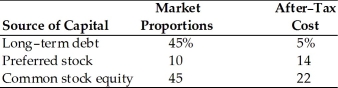 Other things remaining constant, if the firm were to shift toward a capital structure with ________ the weighted average cost of capital will be higher.
 (Multiple Choice)
4.9/5 (82)
(82) The approximate before-tax cost of debt for a 15-year, 10 percent, $1,000 par value bond selling at $950 is ________.
(Multiple Choice)
4.9/5 (78)
(78) Promo Pak has compiled the following financial data: 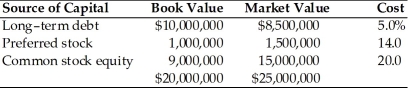 (a) Calculate the weighted average cost of capital using book value weights.
(b) Calculate the weighted average cost of capital using market value weights.
(a) Calculate the weighted average cost of capital using book value weights.
(b) Calculate the weighted average cost of capital using market value weights. (Essay)
4.7/5 (80)
(80) If a corporation has an average tax rate of 40 percent, the approximate, annual, after-tax cost of debt for a 15-year, 12 percent, $1,000 par value bond, selling at $950 is ________.
(Multiple Choice)
5.0/5 (81)
(81) Table 9.1
A firm has determined its optimal capital structure which is composed of the following sources and target market value proportions.  Debt: The firm can sell a 12-year, $1,000 par value, 7 percent bond for $960. A flotation cost of
2 percent of the face value would be required in addition to the discount of $40.
Preferred Stock: The firm has determined it can issue preferred stock at $75 per share par value. The stock will pay a $10 annual dividend. The cost of issuing and selling the stock is $3 per share.
Common Stock: A firm's common stock is currently selling for $18 per share. The dividend expected to be paid at the end of the coming year is $1.74. Its dividend payments have been growing at a constant rate for the last four years. Four years ago, the dividend was $1.50. It is expected that to sell, a new common stock issue must be underpriced $1 per share in floatation costs. Additionally, the firm's marginal tax rate is 40 percent.
-The firm's cost of preferred stock is ________. (See Table 9.1)
Debt: The firm can sell a 12-year, $1,000 par value, 7 percent bond for $960. A flotation cost of
2 percent of the face value would be required in addition to the discount of $40.
Preferred Stock: The firm has determined it can issue preferred stock at $75 per share par value. The stock will pay a $10 annual dividend. The cost of issuing and selling the stock is $3 per share.
Common Stock: A firm's common stock is currently selling for $18 per share. The dividend expected to be paid at the end of the coming year is $1.74. Its dividend payments have been growing at a constant rate for the last four years. Four years ago, the dividend was $1.50. It is expected that to sell, a new common stock issue must be underpriced $1 per share in floatation costs. Additionally, the firm's marginal tax rate is 40 percent.
-The firm's cost of preferred stock is ________. (See Table 9.1) (Multiple Choice)
5.0/5 (73)
(73) Table 9.2
A firm has determined its optimal structure which is composed of the following sources and target market value proportions.  Debt: The firm can sell a 15-year, $1,000 par value, 8 percent bond for $1,050. A flotation cost of 2 percent of the face value would be required in addition to the premium of $50.
Common Stock: A firm's common stock is currently selling for $75 per share. The dividend expected to be paid at the end of the coming year is $5. Its dividend payments have been growing at a constant rate for the last five years. Five years ago, the dividend was $3.10. It is expected that to sell, a new common stock issue must be underpriced $2 per share and the firm must pay $1 per share in flotation costs. Additionally, the firm has a marginal tax rate of 40 percent.
-Assuming the firm plans to pay out all of its earnings as dividends, the weighted average cost of capital is ________. (See Table 9.2)
Debt: The firm can sell a 15-year, $1,000 par value, 8 percent bond for $1,050. A flotation cost of 2 percent of the face value would be required in addition to the premium of $50.
Common Stock: A firm's common stock is currently selling for $75 per share. The dividend expected to be paid at the end of the coming year is $5. Its dividend payments have been growing at a constant rate for the last five years. Five years ago, the dividend was $3.10. It is expected that to sell, a new common stock issue must be underpriced $2 per share and the firm must pay $1 per share in flotation costs. Additionally, the firm has a marginal tax rate of 40 percent.
-Assuming the firm plans to pay out all of its earnings as dividends, the weighted average cost of capital is ________. (See Table 9.2) (Multiple Choice)
4.8/5 (85)
(85) When determining the after-tax cost of a bond, the face value of the issue must be adjusted to the net proceeds amounts by considering ________.
(Multiple Choice)
4.8/5 (86)
(86) The cost of common stock equity may be measured using either the constant-growth valuation model or the capital asset pricing model.
(True/False)
4.7/5 (87)
(87) 
Filters
- Essay(0)
- Multiple Choice(0)
- Short Answer(0)
- True False(0)
- Matching(0)