



 Chat with AI
Exam 9: The Cost of Capital

Exam 1: The Role of Managerial Finance134 Questions
Exam 2: The Financial Market Environment91 Questions
Exam 3: Financial Statements and Ratio Analysis208 Questions
Exam 4: Cash Flow and Financial Planning185 Questions
Exam 5: Time Value of Money173 Questions
Exam 6: Interest Rates and Bond Valuation224 Questions
Exam 7: Stock Valuation188 Questions
Exam 8: Risk and Return188 Questions
Exam 9: The Cost of Capital137 Questions
Exam 10: Capital Budgeting Techniques167 Questions
Exam 11: Capital Budgeting Cash Flows117 Questions
Exam 12: Risk and Refinements in Capital Budgeting106 Questions
Exam 13: Leverage and Capital Structure217 Questions
Exam 14: Payout Policy130 Questions
Exam 15: Working Capital and Current Assets Management336 Questions
Exam 16: Current Liabilities Management171 Questions
Exam 17: Hybrid and Derivative Securities185 Questions
Exam 18: Mergers, Lbos, Divestitures, and Business Failure191 Questions
Exam 19: International Managerial Finance108 Questions
Select questions type


Table 9.3
Balance Sheet
General Talc Mines
December 31, 2014 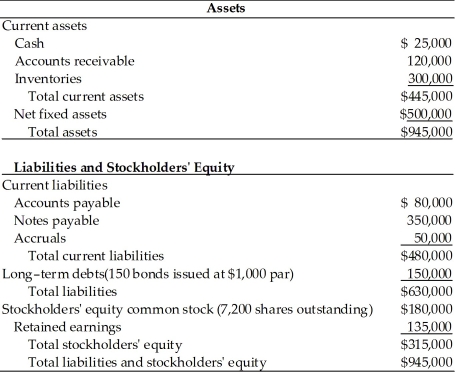 -
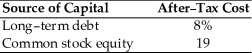 Given this after-tax cost of each source of capital, the weighted average cost of capital using book weights for General Talc Mines is ________. (See Table 9.3)
- Given this after-tax cost of each source of capital, the weighted average cost of capital using book weights for General Talc Mines is ________. (See Table 9.3) (Multiple Choice)
4.8/5  (75)
(75) Holding risk constant, the implementation of projects with a rate of return above the cost of capital will decrease the value of a firm, and vice versa.
(True/False)
4.9/5 (89)
(89) The cost of common stock equity may be estimated by using the ________.
(Multiple Choice)
4.9/5 (85)
(85) The cost of capital of each source of financing is the after-tax cost of obtaining the financing using the historically based cost reflected by the existing financing on the firm's books.
(True/False)
4.8/5 (76)
(76) From a bond issuer's perspective, the IRR on a bond's cash flows is its cost to maturity; from the investor's perspective, the IRR on a bond's cash flows is the yield to maturity (YTM).
(True/False)
4.9/5 (84)
(84) In calculating the cost of common stock equity, the model which describes the relationship between the required return and the nondiversifiable risk of the firm is ________.
(Multiple Choice)
4.9/5 (83)
(83) Although a firm's existing mix of financing sources may reflect its target capital structure, it is ultimately ________.
(Multiple Choice)
4.9/5 (74)
(74) The ________ from the sale of a security are the funds actually received from the sale after ________.
(Multiple Choice)
4.8/5 (61)
(61) In comparing the constant-growth model and the capital asset pricing model (CAPM) to calculate the cost of common stock equity, ________.
(Multiple Choice)
5.0/5 (87)
(87) The constant-growth valuation model is based on the premise that the value of a share of common stock is ________.
(Multiple Choice)
5.0/5 (87)
(87) As the need for capital increases beyond the optimum capital structure, the cost of debt financing will ________ the firm's weighted average cost of capital.
(Multiple Choice)
4.8/5 (85)
(85) Since the net proceeds from sale of new common stock will be less than the current market price, the cost of new issues will always be less than the cost of existing issues.
(True/False)
4.7/5 (76)
(76) The cost of capital is described as the rate of return required by the market suppliers of capital in order to attract their funds to the firm.
(True/False)
4.7/5 (67)
(67) The approximate before-tax cost of debt for a 10-year, 8 percent, $1,000 par value bond selling at $1,150 is ________.
(Multiple Choice)
4.8/5 (79)
(79) The cost of capital is a static concept and it is not affected by economic and firm-specific factors such as business risk and financial risk.
(True/False)
4.8/5 (70)
(70) The cost of retained earnings is always lower than the cost of a new issue of common stock due to the absence of flotation costs when financing projects with retained earnings.
(True/False)
4.7/5 (76)
(76) A firm has determined its cost of each source of capital and optimal capital structure, which is composed of the following sources and target market value proportions: 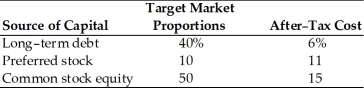 The weighted average cost of capital is ________.
 (Multiple Choice)
4.8/5 (80)
(80) A firm has determined its optimal capital structure, which is composed of the following sources and target market value proportions: 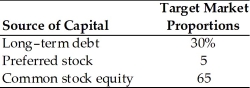 Debt: The firm can sell a 20-year, $1,000 par value, 9 percent bond for $980. A flotation cost of 2 percent of the face value would be required in addition to the discount of $20.
Preferred Stock: The firm has determined it can issue preferred stock at $65 per share par value. The stock will pay an $8.00 annual dividend. The cost of issuing and selling the stock is $3 per share.
Common Stock: The firm's common stock is currently selling for $40 per share. The dividend expected to be paid at the end of the coming year is $5.07. Its dividend payments have been growing at a constant rate for the last five years. Five years ago, the dividend was $3.45. It is expected that to sell, a new common stock issue must be underpriced at $1 per share and the firm must pay $1 per share in flotation costs. Additionally, the firm's marginal tax rate is 40 percent.
Calculate the firm's weighted average cost of capital assuming the firm has exhausted all retained earnings.
Debt: The firm can sell a 20-year, $1,000 par value, 9 percent bond for $980. A flotation cost of 2 percent of the face value would be required in addition to the discount of $20.
Preferred Stock: The firm has determined it can issue preferred stock at $65 per share par value. The stock will pay an $8.00 annual dividend. The cost of issuing and selling the stock is $3 per share.
Common Stock: The firm's common stock is currently selling for $40 per share. The dividend expected to be paid at the end of the coming year is $5.07. Its dividend payments have been growing at a constant rate for the last five years. Five years ago, the dividend was $3.45. It is expected that to sell, a new common stock issue must be underpriced at $1 per share and the firm must pay $1 per share in flotation costs. Additionally, the firm's marginal tax rate is 40 percent.
Calculate the firm's weighted average cost of capital assuming the firm has exhausted all retained earnings. (Essay)
4.8/5 (88)
(88) Preferred stockholders must receive their stated dividends prior to the distribution of any earnings to common stockholders and bondholders.
(True/False)
4.9/5 (85)
(85) 
Filters
- Essay(0)
- Multiple Choice(0)
- Short Answer(0)
- True False(0)
- Matching(0)