



 Chat with AI
Exam 9: The Cost of Capital

Exam 1: The Role of Managerial Finance134 Questions
Exam 2: The Financial Market Environment91 Questions
Exam 3: Financial Statements and Ratio Analysis208 Questions
Exam 4: Cash Flow and Financial Planning185 Questions
Exam 5: Time Value of Money173 Questions
Exam 6: Interest Rates and Bond Valuation224 Questions
Exam 7: Stock Valuation188 Questions
Exam 8: Risk and Return188 Questions
Exam 9: The Cost of Capital137 Questions
Exam 10: Capital Budgeting Techniques167 Questions
Exam 11: Capital Budgeting Cash Flows117 Questions
Exam 12: Risk and Refinements in Capital Budgeting106 Questions
Exam 13: Leverage and Capital Structure217 Questions
Exam 14: Payout Policy130 Questions
Exam 15: Working Capital and Current Assets Management336 Questions
Exam 16: Current Liabilities Management171 Questions
Exam 17: Hybrid and Derivative Securities185 Questions
Exam 18: Mergers, Lbos, Divestitures, and Business Failure191 Questions
Exam 19: International Managerial Finance108 Questions
Select questions type


A firm has issued preferred stock at its $125 per share par value. The stock will pay a $15 annual dividend. The cost of issuing and selling the stock was $4 per share. The cost of the preferred stock is ________.
(Multiple Choice)
4.9/5  (69)
(69) The capital asset pricing model is used to calculate the effect of increase in prices of capital assets due to inflation.
(True/False)
4.8/5 (81)
(81) The cost of capital is used to decide whether a proposed corporate investment will increase or decrease a firm's stock price.
(True/False)
5.0/5 (75)
(75) A firm may face increase in the weighted average cost of capital either when retained earnings have been exhausted or due to increases in debt, preferred stock, and common equity costs as additional new funds are required.
(True/False)
4.9/5 (81)
(81) The net proceeds used in calculation of the cost of long-term debt are funds actually received from the sale after paying for flotation costs and taxes.
(True/False)
5.0/5 (94)
(94) Weights that use accounting values to measure the proportion of each type of capital in a firm's financial structure are called market value weights.
(True/False)
4.8/5 (73)
(73) The weighted average cost that reflects the interrelationship of financing decisions can be obtained by weighing the cost of each source of financing by the target proportion in a firm's capital structure.
(True/False)
4.9/5 (84)
(84) If a corporation has an average tax rate of 40 percent, the approximate annual, after-tax cost of debt for a 10-year, 8 percent, $1,000 par value bond selling at $1,150 is ________.
(Multiple Choice)
4.8/5 (80)
(80) The cost of capital reflects the cost of funds over the long run measured at a given point in time, based on the best information available.
(True/False)
4.8/5 (73)
(73) The cost of new common stock financing is higher than the cost of retained earnings due to ________.
(Multiple Choice)
4.9/5 (69)
(69) Table 9.2
A firm has determined its optimal structure which is composed of the following sources and target market value proportions. 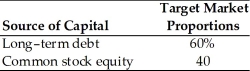 Debt: The firm can sell a 15-year, $1,000 par value, 8 percent bond for $1,050. A flotation cost of 2 percent of the face value would be required in addition to the premium of $50.
Common Stock: A firm's common stock is currently selling for $75 per share. The dividend expected to be paid at the end of the coming year is $5. Its dividend payments have been growing at a constant rate for the last five years. Five years ago, the dividend was $3.10. It is expected that to sell, a new common stock issue must be underpriced $2 per share and the firm must pay $1 per share in flotation costs. Additionally, the firm has a marginal tax rate of 40 percent.
-The weighted average cost of capital up to the point when retained earnings are exhausted is ________. (See Table 9.2)
Debt: The firm can sell a 15-year, $1,000 par value, 8 percent bond for $1,050. A flotation cost of 2 percent of the face value would be required in addition to the premium of $50.
Common Stock: A firm's common stock is currently selling for $75 per share. The dividend expected to be paid at the end of the coming year is $5. Its dividend payments have been growing at a constant rate for the last five years. Five years ago, the dividend was $3.10. It is expected that to sell, a new common stock issue must be underpriced $2 per share and the firm must pay $1 per share in flotation costs. Additionally, the firm has a marginal tax rate of 40 percent.
-The weighted average cost of capital up to the point when retained earnings are exhausted is ________. (See Table 9.2) (Multiple Choice)
4.9/5 (84)
(84) The cost of preferred stock is the ratio of the preferred stock dividend to a firm's total earnings.
(True/False)
4.8/5 (61)
(61) Table 9.2
A firm has determined its optimal structure which is composed of the following sources and target market value proportions. Debt: The firm can sell a 15-year, $1,000 par value, 8 percent bond for $1,050. A flotation cost of 2 percent of the face value would be required in addition to the premium of $50.
Common Stock: A firm's common stock is currently selling for $75 per share. The dividend expected to be paid at the end of the coming year is $5. Its dividend payments have been growing at a constant rate for the last five years. Five years ago, the dividend was $3.10. It is expected that to sell, a new common stock issue must be underpriced $2 per share and the firm must pay $1 per share in flotation costs. Additionally, the firm has a marginal tax rate of 40 percent.
-The firm's cost of a new issue of common stock is ________. (See Table 9.2)
Debt: The firm can sell a 15-year, $1,000 par value, 8 percent bond for $1,050. A flotation cost of 2 percent of the face value would be required in addition to the premium of $50.
Common Stock: A firm's common stock is currently selling for $75 per share. The dividend expected to be paid at the end of the coming year is $5. Its dividend payments have been growing at a constant rate for the last five years. Five years ago, the dividend was $3.10. It is expected that to sell, a new common stock issue must be underpriced $2 per share and the firm must pay $1 per share in flotation costs. Additionally, the firm has a marginal tax rate of 40 percent.
-The firm's cost of a new issue of common stock is ________. (See Table 9.2) (Multiple Choice)
4.9/5 (70)
(70) In computing the cost of retained earnings, the net proceeds represents the amount of money retained net of any underpricing and/or flotation costs.
(True/False)
4.9/5 (70)
(70) A firm's flotation cost can be calculated by weighting the cost of each source of financing by its relative proportion in a firm's target capital structure.
(True/False)
4.8/5 (96)
(96) When discussing weighing schemes for calculating the weighted average cost of capital, ________.
(Multiple Choice)
4.9/5 (80)
(80) The weighted average cost of capital refers to the cost of capital required for one additional dollar of financing.
(True/False)
4.9/5 (80)
(80) Since retained earnings is a more expensive source of financing than debt and preferred stock, the weighted average cost of capital will fall once retained earnings have been exhausted.
(True/False)
5.0/5 (86)
(86) 
Filters
- Essay(0)
- Multiple Choice(0)
- Short Answer(0)
- True False(0)
- Matching(0)