



 Chat with AI
Exam 9: The Cost of Capital

Exam 1: The Role of Managerial Finance134 Questions
Exam 2: The Financial Market Environment91 Questions
Exam 3: Financial Statements and Ratio Analysis208 Questions
Exam 4: Cash Flow and Financial Planning185 Questions
Exam 5: Time Value of Money173 Questions
Exam 6: Interest Rates and Bond Valuation224 Questions
Exam 7: Stock Valuation188 Questions
Exam 8: Risk and Return188 Questions
Exam 9: The Cost of Capital137 Questions
Exam 10: Capital Budgeting Techniques167 Questions
Exam 11: Capital Budgeting Cash Flows117 Questions
Exam 12: Risk and Refinements in Capital Budgeting106 Questions
Exam 13: Leverage and Capital Structure217 Questions
Exam 14: Payout Policy130 Questions
Exam 15: Working Capital and Current Assets Management336 Questions
Exam 16: Current Liabilities Management171 Questions
Exam 17: Hybrid and Derivative Securities185 Questions
Exam 18: Mergers, Lbos, Divestitures, and Business Failure191 Questions
Exam 19: International Managerial Finance108 Questions
Select questions type


The cost of retained earnings is generally higher than both the cost of debt and cost of preferred stock.
(True/False)
4.8/5  (66)
(66) What is the dividend on an 8 percent preferred stock that currently sells for $45 and has a face value of $50 per share?
(Multiple Choice)
4.9/5 (76)
(76) Table 9.2
A firm has determined its optimal structure which is composed of the following sources and target market value proportions.  Debt: The firm can sell a 15-year, $1,000 par value, 8 percent bond for $1,050. A flotation cost of 2 percent of the face value would be required in addition to the premium of $50.
Common Stock: A firm's common stock is currently selling for $75 per share. The dividend expected to be paid at the end of the coming year is $5. Its dividend payments have been growing at a constant rate for the last five years. Five years ago, the dividend was $3.10. It is expected that to sell, a new common stock issue must be underpriced $2 per share and the firm must pay $1 per share in flotation costs. Additionally, the firm has a marginal tax rate of 40 percent.
-The firm's after-tax cost of debt is ________. (See Table 9.2)
Debt: The firm can sell a 15-year, $1,000 par value, 8 percent bond for $1,050. A flotation cost of 2 percent of the face value would be required in addition to the premium of $50.
Common Stock: A firm's common stock is currently selling for $75 per share. The dividend expected to be paid at the end of the coming year is $5. Its dividend payments have been growing at a constant rate for the last five years. Five years ago, the dividend was $3.10. It is expected that to sell, a new common stock issue must be underpriced $2 per share and the firm must pay $1 per share in flotation costs. Additionally, the firm has a marginal tax rate of 40 percent.
-The firm's after-tax cost of debt is ________. (See Table 9.2) (Multiple Choice)
4.8/5 (66)
(66) The cost of retained earnings will always equal the cost of preferred stock.
(True/False)
4.9/5 (89)
(89) Table 9.1
A firm has determined its optimal capital structure which is composed of the following sources and target market value proportions.  Debt: The firm can sell a 12-year, $1,000 par value, 7 percent bond for $960. A flotation cost of
2 percent of the face value would be required in addition to the discount of $40.
Preferred Stock: The firm has determined it can issue preferred stock at $75 per share par value. The stock will pay a $10 annual dividend. The cost of issuing and selling the stock is $3 per share.
Common Stock: A firm's common stock is currently selling for $18 per share. The dividend expected to be paid at the end of the coming year is $1.74. Its dividend payments have been growing at a constant rate for the last four years. Four years ago, the dividend was $1.50. It is expected that to sell, a new common stock issue must be underpriced $1 per share in floatation costs. Additionally, the firm's marginal tax rate is 40 percent.
-If the target market proportion is reduced to 15 percent, what will be the revised weighted average cost of capital? (See Table 9.1)
Debt: The firm can sell a 12-year, $1,000 par value, 7 percent bond for $960. A flotation cost of
2 percent of the face value would be required in addition to the discount of $40.
Preferred Stock: The firm has determined it can issue preferred stock at $75 per share par value. The stock will pay a $10 annual dividend. The cost of issuing and selling the stock is $3 per share.
Common Stock: A firm's common stock is currently selling for $18 per share. The dividend expected to be paid at the end of the coming year is $1.74. Its dividend payments have been growing at a constant rate for the last four years. Four years ago, the dividend was $1.50. It is expected that to sell, a new common stock issue must be underpriced $1 per share in floatation costs. Additionally, the firm's marginal tax rate is 40 percent.
-If the target market proportion is reduced to 15 percent, what will be the revised weighted average cost of capital? (See Table 9.1) (Multiple Choice)
4.8/5 (74)
(74) Table 9.1
A firm has determined its optimal capital structure which is composed of the following sources and target market value proportions. Debt: The firm can sell a 12-year, $1,000 par value, 7 percent bond for $960. A flotation cost of
2 percent of the face value would be required in addition to the discount of $40.
Preferred Stock: The firm has determined it can issue preferred stock at $75 per share par value. The stock will pay a $10 annual dividend. The cost of issuing and selling the stock is $3 per share.
Common Stock: A firm's common stock is currently selling for $18 per share. The dividend expected to be paid at the end of the coming year is $1.74. Its dividend payments have been growing at a constant rate for the last four years. Four years ago, the dividend was $1.50. It is expected that to sell, a new common stock issue must be underpriced $1 per share in floatation costs. Additionally, the firm's marginal tax rate is 40 percent.
-The firm's cost of retained earnings is ________. (See Table 9.1)
Debt: The firm can sell a 12-year, $1,000 par value, 7 percent bond for $960. A flotation cost of
2 percent of the face value would be required in addition to the discount of $40.
Preferred Stock: The firm has determined it can issue preferred stock at $75 per share par value. The stock will pay a $10 annual dividend. The cost of issuing and selling the stock is $3 per share.
Common Stock: A firm's common stock is currently selling for $18 per share. The dividend expected to be paid at the end of the coming year is $1.74. Its dividend payments have been growing at a constant rate for the last four years. Four years ago, the dividend was $1.50. It is expected that to sell, a new common stock issue must be underpriced $1 per share in floatation costs. Additionally, the firm's marginal tax rate is 40 percent.
-The firm's cost of retained earnings is ________. (See Table 9.1) (Multiple Choice)
4.9/5 (81)
(81) Target weights are either book value or market value weights based on a firm's desired capital structure proportions.
(True/False)
4.9/5 (74)
(74) A corporation has concluded that its financial risk premium is too high. In order to decrease this, the firm can ________.
(Multiple Choice)
4.7/5 (80)
(80) The cost of preferred stock is the ratio of the preferred stock dividend to a firm's net proceeds from the sale of the preferred stock.
(True/False)
4.9/5 (89)
(89) The cost of capital acts as a major link between a firm's long-term investment decisions and the wealth of the firm's owners as determined by the market value of their shares.
(True/False)
4.9/5 (62)
(62) One measure of the cost of common stock equity is the rate at which investors discount the expected common stock dividends of the firm to determine its share value.
(True/False)
4.7/5 (79)
(79) A firm has common stock with a market price of $100 per share and an expected dividend of $5.61 per share at the end of the coming year. A new issue of stock is expected to be sold for $98, with $2 per share representing the underpricing necessary in the competitive capital market. Flotation costs are expected to total $1 per share. The dividends paid on the outstanding stock over the past five years are as follows: 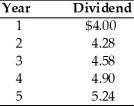 The cost of this new issue of common stock is ________.
 (Multiple Choice)
4.9/5 (75)
(75) Target weights are either book value or market value weights based on actual historical capital structure proportions.
(True/False)
4.9/5 (77)
(77) A firm can retain more of its earnings if it can convince its stockholders that it will earn at least their required return on the reinvested funds.
(True/False)
4.9/5 (93)
(93) In general, floatation costs include two components, underwriting costs and administrative costs.
(True/False)
4.8/5 (82)
(82) Table 9.2
A firm has determined its optimal structure which is composed of the following sources and target market value proportions. Debt: The firm can sell a 15-year, $1,000 par value, 8 percent bond for $1,050. A flotation cost of 2 percent of the face value would be required in addition to the premium of $50.
Common Stock: A firm's common stock is currently selling for $75 per share. The dividend expected to be paid at the end of the coming year is $5. Its dividend payments have been growing at a constant rate for the last five years. Five years ago, the dividend was $3.10. It is expected that to sell, a new common stock issue must be underpriced $2 per share and the firm must pay $1 per share in flotation costs. Additionally, the firm has a marginal tax rate of 40 percent.
-The firm's before-tax cost of debt is ________. (See Table 9.2)
Debt: The firm can sell a 15-year, $1,000 par value, 8 percent bond for $1,050. A flotation cost of 2 percent of the face value would be required in addition to the premium of $50.
Common Stock: A firm's common stock is currently selling for $75 per share. The dividend expected to be paid at the end of the coming year is $5. Its dividend payments have been growing at a constant rate for the last five years. Five years ago, the dividend was $3.10. It is expected that to sell, a new common stock issue must be underpriced $2 per share and the firm must pay $1 per share in flotation costs. Additionally, the firm has a marginal tax rate of 40 percent.
-The firm's before-tax cost of debt is ________. (See Table 9.2) (Multiple Choice)
4.8/5 (79)
(79) Historical weights are the present value of market price based on the actual historical capital structure proportions.
(True/False)
5.0/5 (98)
(98) The weighted average cost of capital represents the annual before-tax percentage cost of the debt.
(True/False)
4.8/5 (73)
(73) The Gordon model is based on the premise that the value of a share of stock is equal to sum of all future dividends it is expected to provide over an infinite time horizon.
(True/False)
4.7/5 (85)
(85) The cost of common stock equity may be estimated by using the ________.
(Multiple Choice)
4.9/5 (89)
(89) 
Filters
- Essay(0)
- Multiple Choice(0)
- Short Answer(0)
- True False(0)
- Matching(0)