



 Chat with AI
Exam 9: The Cost of Capital

Exam 1: The Role of Managerial Finance134 Questions
Exam 2: The Financial Market Environment91 Questions
Exam 3: Financial Statements and Ratio Analysis208 Questions
Exam 4: Cash Flow and Financial Planning185 Questions
Exam 5: Time Value of Money173 Questions
Exam 6: Interest Rates and Bond Valuation224 Questions
Exam 7: Stock Valuation188 Questions
Exam 8: Risk and Return188 Questions
Exam 9: The Cost of Capital137 Questions
Exam 10: Capital Budgeting Techniques167 Questions
Exam 11: Capital Budgeting Cash Flows117 Questions
Exam 12: Risk and Refinements in Capital Budgeting106 Questions
Exam 13: Leverage and Capital Structure217 Questions
Exam 14: Payout Policy130 Questions
Exam 15: Working Capital and Current Assets Management336 Questions
Exam 16: Current Liabilities Management171 Questions
Exam 17: Hybrid and Derivative Securities185 Questions
Exam 18: Mergers, Lbos, Divestitures, and Business Failure191 Questions
Exam 19: International Managerial Finance108 Questions
Select questions type


Use of the capital asset pricing model (CAPM) in measuring the cost of common stock equity differs from the constant-growth valuation model in that it directly considers the firm's risk as reflected by beta.
(True/False)
4.7/5  (81)
(81) What would be the cost of new common stock equity for Tangshan Mining if the firm just paid a dividend of $4.25, the stock price is $55.00, dividends are expected to grow at 8.5 percent indefinitely, and flotation costs are $6.25 per share?
(Multiple Choice)
4.8/5 (87)
(87) In computing the weighted average cost of capital, the historical weights are either book value or market value weights based on actual capital structure proportions.
(True/False)
4.7/5 (79)
(79) The marginal cost of capital is a relevant cost of capital for evaluating a firm's future investment opportunities.
(True/False)
4.8/5 (81)
(81) The weighted average cost of capital (WACC) reflects the expected average future cost of capital over the long run.
(True/False)
4.8/5 (83)
(83) A firm has determined it can issue preferred stock at $115 per share par value. The stock will pay a $12 annual dividend. The cost of issuing and selling the stock is $3 per share. The cost of the preferred stock is ________.
(Multiple Choice)
4.9/5 (77)
(77) The cost of capital is a dynamic concept and it is affected by economic and firm-specific factors such as business risk and financial risk.
(True/False)
4.9/5 (83)
(83) In computing the weighted average cost of capital, from a strictly theoretical point of view, the preferred weighing scheme is target market value proportions.
(True/False)
4.8/5 (93)
(93) The cost of new common stock is normally greater than any other long-term financing cost.
(True/False)
4.9/5 (75)
(75) Generally, the order of cost, from the least expensive to the most expensive, for long-term capital of a corporation is ________.
(Multiple Choice)
4.9/5 (77)
(77) Table 9.1
A firm has determined its optimal capital structure which is composed of the following sources and target market value proportions.  Debt: The firm can sell a 12-year, $1,000 par value, 7 percent bond for $960. A flotation cost of
2 percent of the face value would be required in addition to the discount of $40.
Preferred Stock: The firm has determined it can issue preferred stock at $75 per share par value. The stock will pay a $10 annual dividend. The cost of issuing and selling the stock is $3 per share.
Common Stock: A firm's common stock is currently selling for $18 per share. The dividend expected to be paid at the end of the coming year is $1.74. Its dividend payments have been growing at a constant rate for the last four years. Four years ago, the dividend was $1.50. It is expected that to sell, a new common stock issue must be underpriced $1 per share in floatation costs. Additionally, the firm's marginal tax rate is 40 percent.
-The weighted average cost of capital up to the point when retained earnings are exhausted is ________. (See Table 9.1)
Debt: The firm can sell a 12-year, $1,000 par value, 7 percent bond for $960. A flotation cost of
2 percent of the face value would be required in addition to the discount of $40.
Preferred Stock: The firm has determined it can issue preferred stock at $75 per share par value. The stock will pay a $10 annual dividend. The cost of issuing and selling the stock is $3 per share.
Common Stock: A firm's common stock is currently selling for $18 per share. The dividend expected to be paid at the end of the coming year is $1.74. Its dividend payments have been growing at a constant rate for the last four years. Four years ago, the dividend was $1.50. It is expected that to sell, a new common stock issue must be underpriced $1 per share in floatation costs. Additionally, the firm's marginal tax rate is 40 percent.
-The weighted average cost of capital up to the point when retained earnings are exhausted is ________. (See Table 9.1) (Multiple Choice)
4.9/5 (85)
(85) Nico Trading Corporation is considering issuing long-term debt. The debt would have a 30-year maturity and a 10 percent coupon rate. In order to sell the issue, the bonds must be underpriced at a discount of 5 percent of face value. In addition, the firm would have to pay flotation costs of 5 percent of face value. The firm's tax rate is 35 percent. Given this information, the after-tax cost of debt for Nico Trading would be ________.
(Multiple Choice)
4.9/5 (74)
(74) One major expense associated with issuing new shares of common stock is ________.
(Multiple Choice)
4.9/5 (75)
(75) Weights that use accounting values to measure the proportion of each type of capital in a firm's financial structure are called book value weights.
(True/False)
4.8/5 (77)
(77) A tax adjustment must be made in determining the cost of ________.
(Multiple Choice)
4.9/5 (84)
(84) Table 9.3
Balance Sheet
General Talc Mines
December 31, 2014 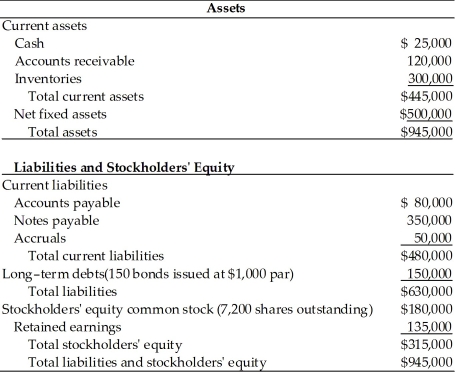 -General Talc Mines has compiled the following data regarding the market value and cost of the specific sources of capital.
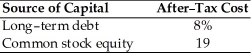 Market price per share of common stock $50 Market value of long-term debt $980 per bond
The weighted average cost of capital using market value weights is ________. (See Table 9.3)
-General Talc Mines has compiled the following data regarding the market value and cost of the specific sources of capital. Market price per share of common stock $50 Market value of long-term debt $980 per bond
The weighted average cost of capital using market value weights is ________. (See Table 9.3) (Multiple Choice)
4.8/5 (72)
(72) The ________ is a weighted average of the cost of funds which reflects the interrelationship of financing decisions.
(Multiple Choice)
5.0/5 (85)
(85) The cost of common stock equity capital represents the return required by existing shareholders on their investment.
(True/False)
4.8/5 (73)
(73) The weights used in weighted average cost of capital must be ________.
(Multiple Choice)
4.8/5 (84)
(84) The cost of capital is the rate of return a firm must earn on investments in order to increase the firm's value.
(True/False)
4.9/5 (96)
(96) 
Filters
- Essay(0)
- Multiple Choice(0)
- Short Answer(0)
- True False(0)
- Matching(0)