



 Chat with AI
Exam 12: Monopoly and Monopsony

Exam 1: Nature and Scope of Managerial Economics25 Questions
Exam 2: Economic Optimization45 Questions
Exam 3: Demand and Supply50 Questions
Exam 4: Demand Analysis46 Questions
Exam 5: Demand Estimation49 Questions
Exam 6: Forecasting50 Questions
Exam 7: Production Analysis and Compensation Policy50 Questions
Exam 8: Cost Analysis and Estimation50 Questions
Exam 9: Linear Programming32 Questions
Exam 10: Competitive Markets50 Questions
Exam 11: Performance and Strategy in Competitive Markets50 Questions
Exam 12: Monopoly and Monopsony50 Questions
Exam 13: Monopolistic Competition and Oligopoly48 Questions
Exam 14: Game Theory and Competitive Strategy37 Questions
Exam 15: Pricing Practices47 Questions
Exam 16: Risk Analysis47 Questions
Exam 17: Capital Budgeting50 Questions
Exam 18: Organization Structure and Corporate Governance50 Questions
Exam 19: Government in the Market Economy50 Questions
Select questions type


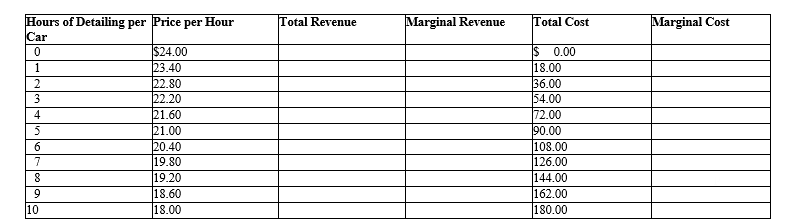
Price/Output Determination. Tallahassee Cars Unlimited, Inc., a rapidly expanding new entrant to this metropolitan area, is considering two proposals for the provision of its cosmetic detailing of cars (washing, waxing, polishing, engine cleaning, etc.). First, a large janitorial agency with some experience in the detailing of cars has offered to purchase the business detailing equipment in return for an exclusive franchise. A second proposal would allow several small contractors to enter the business without any exclusive franchise agreement or competitive restrictions. Under this plan, individuals would bid for the right to provide service on groups of cars as they were delivered to the lot, presumably based on how busy they were at the time. The car lot would then allocate business to the lowest bidder.
TCU has conducted a study of its past sales records and the amount of detailing spent on each car, and the premium over book value recouped in the sale to estimate the amount they would be willing to pay for various amounts of detailing. The car lot has also estimated the total cost of service per car. Service costs are expected to be the same whether or not an exclusive franchise is granted. To instigate bidding, TCU guarantees the winner of any bid a minimum per car, whether or not the service is used.


(Essay)
4.8/5  (82)
(82) The view of regulation as a government-imposed means of private-market control is called:
(Multiple Choice)
4.8/5 (92)
(92) A monopolist maximizes profits by producing a level of output where:
(Multiple Choice)
4.9/5 (79)
(79) Monopoly Regulation. The Hoosier Gas Company, a utility serving customers in Bloomington, Indiana, is currently engaged in a rate case with the regulatory commission under whose jurisdiction it operates. At issue is the rate the company will charge per mcf usage of natural gas. The demand curve for monthly service is P = $6.75 - $0.000375Q. This implies annual demand and marginal revenue curves of:
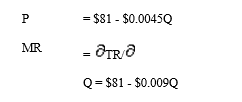 where P is mcf price in dollars and Q is the units of mcf used, in thousands. Total and marginal costs per year (before investment return) are described by the function:
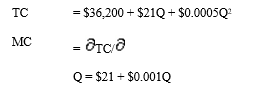 The company has assets of $1 million and the utility commission has authorized an 11% return on investment.

where P is mcf price in dollars and Q is the units of mcf used, in thousands. Total and marginal costs per year (before investment return) are described by the function:
The company has assets of $1 million and the utility commission has authorized an 11% return on investment.
(Essay)
4.8/5 (75)
(75) Costs of Regulation. Biosystems Technology, Inc., manufacturers equipment used by the biotechnology industry in the analysis of protein and DNA. Market demand and marginal revenue relations for the Biosystems units are:
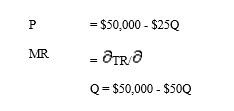 Suppose the Occupational Health and Safety Administration (OSHA) has recently ruled that Biosystems must install expensive new shielding equipment to further guard against worker injuries. This will increase the $10,000 marginal cost of manufacturing by $15,000 per unit. Biosystems' fixed expenses of $15 million per year, which include a required return on investment, will be unaffected.

Suppose the Occupational Health and Safety Administration (OSHA) has recently ruled that Biosystems must install expensive new shielding equipment to further guard against worker injuries. This will increase the $10,000 marginal cost of manufacturing by $15,000 per unit. Biosystems' fixed expenses of $15 million per year, which include a required return on investment, will be unaffected.
(Essay)
4.8/5 (77)
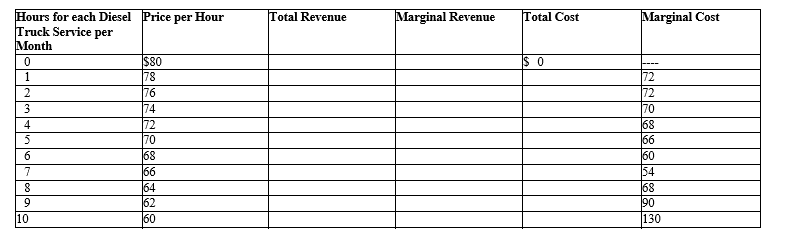
(77) Price/Output Determination. Orange Freight, Inc., an over-the-road common carrier, is considering two proposals for truck maintenance service. First, a national diesel service franchise has offered to purchase the business' overhaul facilities at an attractive price in return for an exclusive franchise on diesel service. A second proposal would allow several small companies to enter the business without any exclusive franchise agreement or competitive restrictions. Under this plan, individual companies would bid for the right to provide service in a given region. Orange Freight would then allocate business to the lowest bidder.
Orange Freight has conducted a survey of regional service hubs to estimate the amount they would be willing to pay for various amounts of diesel service. Orange Freight has also estimated the total cost of service per truck. Service costs are expected to be the same whether or not an exclusive franchise is granted.


(Essay)
4.7/5 (95)
(95) Holding supply conditions constant, the costs of regulation fall wholly on producers when:
(Multiple Choice)
4.9/5 (81)
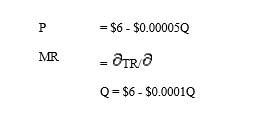
(81) Monopoly Equilibrium. Just CDs, Inc., has developed a booming business in the purchase and sale of used CDs and used DVDs. Demand and marginal revenue relations for the local college student market are:
 Fixed costs are nil, and average variable costs are constant at $4 per unit.

Fixed costs are nil, and average variable costs are constant at $4 per unit.
(Essay)
4.9/5 (70)
(70) In long-run equilibrium, monopoly prices are set a level where:
(Multiple Choice)
4.8/5 (78)
(78) To the extent that costs exceed benefits, a given mode of regulation is:
(Multiple Choice)
5.0/5 (87)
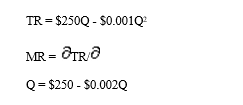
(87) Monopoly Equilibrium. Paradox Dental, Ltd., enjoys a local monopoly in the provision of oral examination services in Tuskegee, Alabama. Total and marginal revenue relations for the standard procedure are:
 Marginal costs for the process are stable at $150 per unit. Fixed costs are nil.

Marginal costs for the process are stable at $150 per unit. Fixed costs are nil.
(Essay)
4.8/5 (61)
(61) The level of competition in a given market tends to increase if:
(Multiple Choice)
4.7/5 (87)
(87) Price Fixing. From 1989 through 1991, the Department of Justice (DOJ) investigated a number of private, selective colleges for price fixing. The investigation eventually settled on an "overlap group," comprised of about one-half of the most selective private colleges in the United States. The group included 23 colleges, from small liberal arts schools like Colby, Vassar, and Middlebury to larger universities like Princeton and MIT. Some students applied to more than one of the 23 schools and, each spring, officials from these institutions met to coordinate the exact calculation of such students' financial need. The case broke new ground in antitrust theory.
The DOJ alleged that the meetings enabled the colleges to collude on higher tuition and to increase their tuition revenue. The colleges defended their meetings by saying that they had to have some coordination in order to successfully implement their commitment to fully cover the need of any student they admitted. The colleges wanted to pull needy, able students into the pool of students who applied to selective private colleges because they saw such students as a "public good" for all their students. Yet, no college wanted to end up with a disproportionate share of the needy students simply because it had unintentionally made more generous need calculations than the other colleges. (All of the colleges attempted to use the same formula for need, but varying and difficult-to-interpret information from parents introduced some actual variation in their calculations.)
Although the colleges denied the price-fixing allegation, they discontinued their annual meetings in 1991. Nor did they resume, even after a federal Court of Appeals rendered a decision in their favor.
A. How would you determine if the "financial-aid overlap" meeting is an example of price fixing?
B. If price fixing did indeed occur at these meetings, which laws in particular might be violated?
(Essay)
4.8/5 (82)
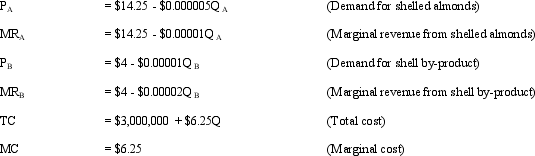
(82) Pollution Regulation. Blue Gem, Inc., processes almonds at a large facility in Redding, California. Each pound of almonds processed yields both shelled almonds and shell by-product in a fixed 1:1 ratio. Although the by-product is unfit for human consumption, some can be sold to a regional manufacturer of stone-washed denim garments (the shells are crushed and used as abrasives). Relevant annual demand and cost relations are:
 Here P is price in dollars, Q is the number of pounds of almonds processed, QA and QB are shelled almonds and shell by-product per pound of almonds, respectively; both total and marginal costs are in dollars. Total costs include a risk-adjusted normal return of 15% on a $10 million investment in plant and equipment.
Currently, the city allows the company to dump excess by-product into its landfill at no charge, viewing the service as an attractive means of keeping a valued employer in the area. However, the landfill is quickly approaching peak capacity and must be expanded at an expected operating cost of $750,000 per year. This is an impossible burden on an already strained city budget.

Here P is price in dollars, Q is the number of pounds of almonds processed, QA and QB are shelled almonds and shell by-product per pound of almonds, respectively; both total and marginal costs are in dollars. Total costs include a risk-adjusted normal return of 15% on a $10 million investment in plant and equipment.
Currently, the city allows the company to dump excess by-product into its landfill at no charge, viewing the service as an attractive means of keeping a valued employer in the area. However, the landfill is quickly approaching peak capacity and must be expanded at an expected operating cost of $750,000 per year. This is an impossible burden on an already strained city budget.
(Essay)
5.0/5 (79)
(79) In monopoly competitive markets, profits are maximized when:
(Multiple Choice)
4.9/5 (99)
(99) 
Filters
- Essay(0)
- Multiple Choice(0)
- Short Answer(0)
- True False(0)
- Matching(0)