Solved

Pollution Regulation

Question 39

Essay

Pollution Regulation. Blue Gem, Inc., processes almonds at a large facility in Redding, California. Each pound of almonds processed yields both shelled almonds and shell by-product in a fixed 1:1 ratio. Although the by-product is unfit for human consumption, some can be sold to a regional manufacturer of stone-washed denim garments (the shells are crushed and used as abrasives). Relevant annual demand and cost relations are:
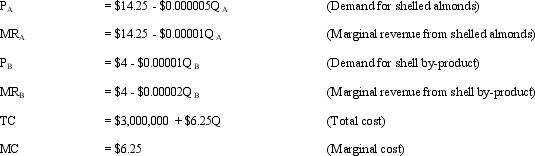
Pollution Regulation. Blue Gem, Inc., processes almonds at a large facility in Redding, California. Each pound of almonds processed yields both shelled almonds and shell by-product in a fixed 1:1 ratio. Although the by-product is unfit for human consumption, some can be sold to a regional manufacturer of stone-washed denim garments (the shells are crushed and used as abrasives). Relevant annual demand and cost relations are:    Here P is price in dollars, Q is the number of pounds of almonds processed, Q<sub>A</sub> and Q<sub>B</sub> are shelled almonds and shell by-product per pound of almonds, respectively; both total and marginal costs are in dollars. Total costs include a risk-adjusted normal return of 15% on a $10 million investment in plant and equipment. Currently, the city allows the company to dump excess by-product into its landfill at no charge, viewing the service as an attractive means of keeping a valued employer in the area. However, the landfill is quickly approaching peak capacity and must be expanded at an expected operating cost of $750,000 per year. This is an impossible burden on an already strained city budget.   Here P is price in dollars, Q is the number of pounds of almonds processed, QA and QB are shelled almonds and shell by-product per pound of almonds, respectively; both total and marginal costs are in dollars. Total costs include a risk-adjusted normal return of 15% on a $10 million investment in plant and equipment.
Currently, the city allows the company to dump excess by-product into its landfill at no charge, viewing the service as an attractive means of keeping a valued employer in the area. However, the landfill is quickly approaching peak capacity and must be expanded at an expected operating cost of $750,000 per year. This is an impossible burden on an already strained city budget.

Pollution Regulation. Blue Gem, Inc., processes almonds at a large facility in Redding, California. Each pound of almonds processed yields both shelled almonds and shell by-product in a fixed 1:1 ratio. Although the by-product is unfit for human consumption, some can be sold to a regional manufacturer of stone-washed denim garments (the shells are crushed and used as abrasives). Relevant annual demand and cost relations are:    Here P is price in dollars, Q is the number of pounds of almonds processed, Q<sub>A</sub> and Q<sub>B</sub> are shelled almonds and shell by-product per pound of almonds, respectively; both total and marginal costs are in dollars. Total costs include a risk-adjusted normal return of 15% on a $10 million investment in plant and equipment. Currently, the city allows the company to dump excess by-product into its landfill at no charge, viewing the service as an attractive means of keeping a valued employer in the area. However, the landfill is quickly approaching peak capacity and must be expanded at an expected operating cost of $750,000 per year. This is an impossible burden on an already strained city budget.

Correct Answer:

verifed

Verified

Unlock this answer now
Get Access to more Verified Answers free of charge

Related Questions