



 Chat with AI
Exam 12: Monopoly and Monopsony

Exam 1: Nature and Scope of Managerial Economics25 Questions
Exam 2: Economic Optimization45 Questions
Exam 3: Demand and Supply50 Questions
Exam 4: Demand Analysis46 Questions
Exam 5: Demand Estimation49 Questions
Exam 6: Forecasting50 Questions
Exam 7: Production Analysis and Compensation Policy50 Questions
Exam 8: Cost Analysis and Estimation50 Questions
Exam 9: Linear Programming32 Questions
Exam 10: Competitive Markets50 Questions
Exam 11: Performance and Strategy in Competitive Markets50 Questions
Exam 12: Monopoly and Monopsony50 Questions
Exam 13: Monopolistic Competition and Oligopoly48 Questions
Exam 14: Game Theory and Competitive Strategy37 Questions
Exam 15: Pricing Practices47 Questions
Exam 16: Risk Analysis47 Questions
Exam 17: Capital Budgeting50 Questions
Exam 18: Organization Structure and Corporate Governance50 Questions
Exam 19: Government in the Market Economy50 Questions
Select questions type


Government seeks to aid economic efficiency in the case of natural monopoly through:
(Multiple Choice)
4.8/5  (71)
(71) Economic agents that have countervailing power in transactions with monopolists are:
(Multiple Choice)
4.8/5 (99)
(99) Price Discrimination. During recent years, national hotel and restaurant chains in the United States have charged lower lodging and meal prices to senior citizens in an effort to profitably segment the market for their services. Thus, senior citizens have come to enjoy discounts of 10-25% off the prices paid by other (younger) full-price customers. This two-tier pricing scheme has raised the ire of some consumers who view it as discriminatory and a violation of antitrust laws.
A. Is this pricing scheme discriminatory in the economic sense? What conditions would be necessary for it to be profitable to the hotel and restaurant industry?
B. Carefully describe how price discrimination could violate U.S. antitrust laws and be sure to mention which laws in particular might be violated.
(Essay)
4.9/5 (78)
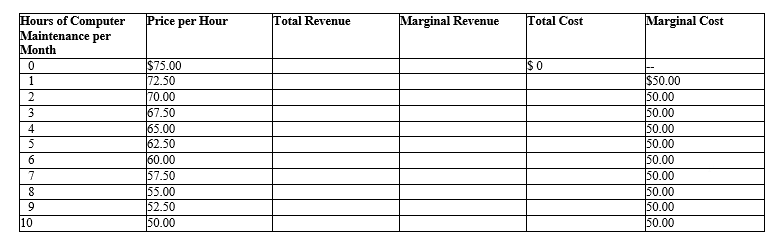
(78) Price/Output Determination. The City of Ithaca, New York is considering two proposals to provide its city government the service of computer maintenance. First, a national computer maintenance and sales franchise has offered to purchase the city's computer equipment at an attractive price in return for an exclusive franchise on computer maintenance. A second proposal would allow several small companies to provide the service without any exclusive franchise agreement or competitive restrictions. Under this plan, individual companies would bid for the right to provide service in a given department. The city would then allocate business to the lowest bidder.
The city has conducted a survey of its department to estimate the amount they would be willing to pay for various amounts of computer maintenance. The city has also estimated the total cost of service per department. Service costs are expected to be the same whether or not an exclusive franchise is granted.


(Essay)
4.8/5 (85)
(85) Theory of Regulation. On November 21, 1986, The Wall Street Journal carried a short article titled "It'll Mean Another Two Semesters in the Red, But Who's Counting?" This article described efforts by the American Institute of Certified Public Accountants (AICPA) to require a fifth (graduate) year of study in accounting for joining the institute. The following is an excerpt from that article:
"Technical demands have become so great on accountants that they can't get five pounds of education in a four-pound bag." explains James MacNeil, director of the AICPA's education division. He says the extra year "would help graduates understand such new complexities as leveraged leases and buyouts and new types of securities being devised by Wall Street." (Hawaii, Utah and Florida already require five years of study before taking the CPA exam, and several other states are giving the matter independent consideration.)
Such arguments, however, have failed to sway many educators. "Most of the deans of the nation's 650 business schools oppose going to five years from four," says Charles Hickman, projects director for the American Assembly of Collegiate Schools of Business, based in St. Louis. "The big question raised by most deans is whether another roadblock should be raised to becoming a working accountant."
Some opponents point out that because Florida imposed its five-year rule in 1983, the number of applicants for the CPA exam there has declined sharply each year. The argue that the new education requirements reflect the regulators being "captured" by the CPA lobby.
Briefly explain:
A. The causes and consequences of regulation according to the "capture" theory of regulation.
B. How the preceding article supports this theory.
(Essay)
4.9/5 (75)
(75) Price Fixing. Three leading toxic waste disposal companies have entered into a secret cartel to fix prices and allocate business in the upper Midwest. The marginal costs per unit for toxic waste disposal services are as follows:


(Essay)
4.9/5 (77)
(77) Tariffs. The Nippon Switch Corporation is an importer and distributor of Japanese-made packet switches, special routing devices that direct data traffic to various computers on a large private telecommunications network for companies like GM, Sears and 3M. The U.S. Commerce Department recently informed the company that it will be subject to a new 35% tariff on the import cost of computer switch devices. The company is concerned that the tariff will slow its sales growth, given the highly competitive nature of the packet switch market. Relevant market demand and marginal revenue relations are:
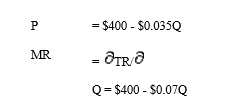 The company's marginal cost equals import costs of $100 per unit, plus $20 to cover transportation, insurance, and related selling expenses. In addition these costs, the company's fixed costs, including a normal rate of return, come to $250,000 per year on this product.

The company's marginal cost equals import costs of $100 per unit, plus $20 to cover transportation, insurance, and related selling expenses. In addition these costs, the company's fixed costs, including a normal rate of return, come to $250,000 per year on this product.
(Essay)
4.8/5 (69)
(69) Price Discrimination. Metropolitan bus service companies in the United States have charged lower fares to senior citizens in an effort to profitably segment the market for their services. Thus, senior citizens have come to enjoy discounts of 25-50% off the prices paid by other (younger) full-price customers. This two-tier pricing scheme has raised the ire of some consumers who view it as discriminatory and a violation of antitrust laws.
A. Is this pricing scheme discriminatory in the economic sense? What conditions would be necessary for it to be profitable to the bus service industry?
B. Carefully describe how price discrimination could violate U.S. antitrust laws and be sure to mention which laws in particular might be violated.
(Essay)
4.7/5 (92)
(92) 
Filters
- Essay(0)
- Multiple Choice(0)
- Short Answer(0)
- True False(0)
- Matching(0)