Exam 12: Monopoly and Monopsony

arrow
  • Select Tags
search iconSearch Question
flashcardsStudy Flashcards
  • Select Tags

A market with one buyer is called:

Free
(Multiple Choice)
4.9/5
(77)
Correct Answer:
Verified

A

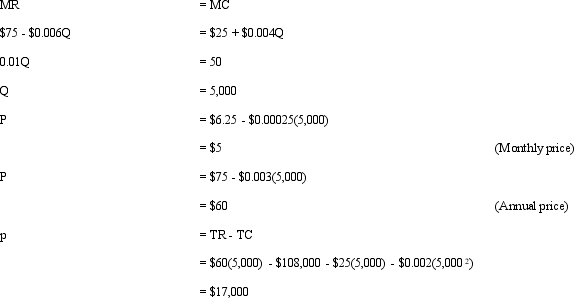
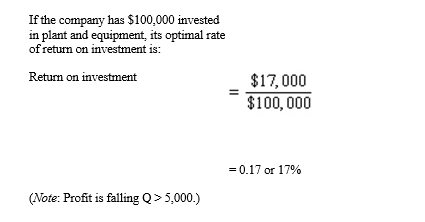
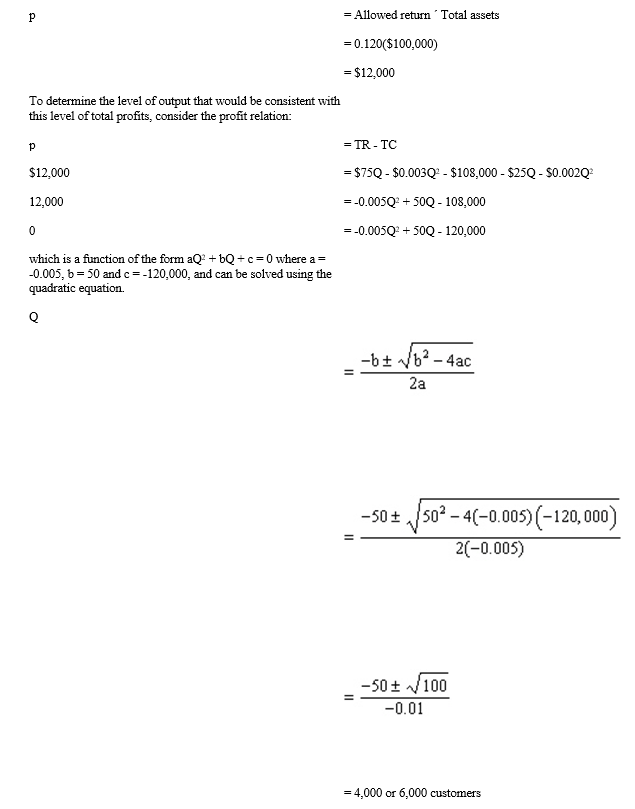
Monopoly Regulation. The Black Hills Telephone Company, a utility serving rural customers in South Dakota is currently engaged in a rate case with the regulatory commission under whose jurisdiction it operates. At issue is the monthly rate the company will charge for call waiting service. The demand curve for this monthly service is P = $6.25 - $0.00025Q. This implies annual demand and marginal revenue curves of: Monopoly Regulation. The Black Hills Telephone Company, a utility serving rural customers in South Dakota is currently engaged in a rate case with the regulatory commission under whose jurisdiction it operates. At issue is the monthly rate the company will charge for call waiting service. The demand curve for this monthly service is P = $6.25 - $0.00025Q. This implies annual demand and marginal revenue curves of:    where P is service price in dollars and Q is the number of customers served. Total and marginal costs per year (before investment return) are described by the function:    The company has assets of $100,000 used for call waiting services and the utility commission has authorized a 12% return on investment.   where P is service price in dollars and Q is the number of customers served. Total and marginal costs per year (before investment return) are described by the function: Monopoly Regulation. The Black Hills Telephone Company, a utility serving rural customers in South Dakota is currently engaged in a rate case with the regulatory commission under whose jurisdiction it operates. At issue is the monthly rate the company will charge for call waiting service. The demand curve for this monthly service is P = $6.25 - $0.00025Q. This implies annual demand and marginal revenue curves of:    where P is service price in dollars and Q is the number of customers served. Total and marginal costs per year (before investment return) are described by the function:    The company has assets of $100,000 used for call waiting services and the utility commission has authorized a 12% return on investment.   The company has assets of $100,000 used for call waiting services and the utility commission has authorized a 12% return on investment. Monopoly Regulation. The Black Hills Telephone Company, a utility serving rural customers in South Dakota is currently engaged in a rate case with the regulatory commission under whose jurisdiction it operates. At issue is the monthly rate the company will charge for call waiting service. The demand curve for this monthly service is P = $6.25 - $0.00025Q. This implies annual demand and marginal revenue curves of:    where P is service price in dollars and Q is the number of customers served. Total and marginal costs per year (before investment return) are described by the function:    The company has assets of $100,000 used for call waiting services and the utility commission has authorized a 12% return on investment.

Free
(Essay)
4.9/5
(86)
Correct Answer:
Verified


For a monopoly in equilibrium:

Free
(Multiple Choice)
4.7/5
(84)
Correct Answer:
Verified

A

Monopoly Regulation. The Woebegone Telephone Company, a utility serving rural customers in Minnesota, is currently engaged in a rate case with the regulatory commission under whose jurisdiction it operates. At issue is the monthly rate the company will charge for basic hookup service. The demand curve for monthly service is P = $50 - $0.005Q. This implies annual demand and marginal revenue curves of: Monopoly Regulation. The Woebegone Telephone Company, a utility serving rural customers in Minnesota, is currently engaged in a rate case with the regulatory commission under whose jurisdiction it operates. At issue is the monthly rate the company will charge for basic hookup service. The demand curve for monthly service is P = $50 - $0.005Q. This implies annual demand and marginal revenue curves of:     where P is service price in dollars and Q is the number of customers served. Total and marginal costs per year (before investment return) are described by the function:    The company has assets of $4 million and the utility commission has authorized a 12.5% return on investment.   where P is service price in dollars and Q is the number of customers served. Total and marginal costs per year (before investment return) are described by the function: Monopoly Regulation. The Woebegone Telephone Company, a utility serving rural customers in Minnesota, is currently engaged in a rate case with the regulatory commission under whose jurisdiction it operates. At issue is the monthly rate the company will charge for basic hookup service. The demand curve for monthly service is P = $50 - $0.005Q. This implies annual demand and marginal revenue curves of:     where P is service price in dollars and Q is the number of customers served. Total and marginal costs per year (before investment return) are described by the function:    The company has assets of $4 million and the utility commission has authorized a 12.5% return on investment.   The company has assets of $4 million and the utility commission has authorized a 12.5% return on investment. Monopoly Regulation. The Woebegone Telephone Company, a utility serving rural customers in Minnesota, is currently engaged in a rate case with the regulatory commission under whose jurisdiction it operates. At issue is the monthly rate the company will charge for basic hookup service. The demand curve for monthly service is P = $50 - $0.005Q. This implies annual demand and marginal revenue curves of:     where P is service price in dollars and Q is the number of customers served. Total and marginal costs per year (before investment return) are described by the function:    The company has assets of $4 million and the utility commission has authorized a 12.5% return on investment.

(Essay)
4.8/5
(86)

Price/Output Determination. Sun City, Arizona, a retirement community that features full-service living arrangements, is considering two proposals to provide lawn-care to elderly residents. First, a national lawn-care firm has offered to purchase the city's lawn-care equipment at an attractive price in return for an exclusive franchise on residential service. A second proposal would allow several small companies to enter the business without any exclusive franchise agreement or competitive restrictions. Under this plan, individual companies would bid for the right to provide service in a given neighborhood. The city would then allocate business to the lowest bidder. The city has conducted a survey of Sun City residents to estimate the amount they would be willing to pay for various amounts of lawn service. The city has also estimated the total cost of service per resident. Service costs are expected to be the same whether or not an exclusive franchise is granted. Price/Output Determination. Sun City, Arizona, a retirement community that features full-service living arrangements, is considering two proposals to provide lawn-care to elderly residents. First, a national lawn-care firm has offered to purchase the city's lawn-care equipment at an attractive price in return for an exclusive franchise on residential service. A second proposal would allow several small companies to enter the business without any exclusive franchise agreement or competitive restrictions. Under this plan, individual companies would bid for the right to provide service in a given neighborhood. The city would then allocate business to the lowest bidder. The city has conducted a survey of Sun City residents to estimate the amount they would be willing to pay for various amounts of lawn service. The city has also estimated the total cost of service per resident. Service costs are expected to be the same whether or not an exclusive franchise is granted.         Price/Output Determination. Sun City, Arizona, a retirement community that features full-service living arrangements, is considering two proposals to provide lawn-care to elderly residents. First, a national lawn-care firm has offered to purchase the city's lawn-care equipment at an attractive price in return for an exclusive franchise on residential service. A second proposal would allow several small companies to enter the business without any exclusive franchise agreement or competitive restrictions. Under this plan, individual companies would bid for the right to provide service in a given neighborhood. The city would then allocate business to the lowest bidder. The city has conducted a survey of Sun City residents to estimate the amount they would be willing to pay for various amounts of lawn service. The city has also estimated the total cost of service per resident. Service costs are expected to be the same whether or not an exclusive franchise is granted.         Price/Output Determination. Sun City, Arizona, a retirement community that features full-service living arrangements, is considering two proposals to provide lawn-care to elderly residents. First, a national lawn-care firm has offered to purchase the city's lawn-care equipment at an attractive price in return for an exclusive franchise on residential service. A second proposal would allow several small companies to enter the business without any exclusive franchise agreement or competitive restrictions. Under this plan, individual companies would bid for the right to provide service in a given neighborhood. The city would then allocate business to the lowest bidder. The city has conducted a survey of Sun City residents to estimate the amount they would be willing to pay for various amounts of lawn service. The city has also estimated the total cost of service per resident. Service costs are expected to be the same whether or not an exclusive franchise is granted.

(Essay)
4.9/5
(78)

Tariffs. The Steel Supply Corporation is an importer and distributor of Taiwanese-made, 96 piece hand-tool sets (screw drivers, wrenches, and the like). The U.S. Commerce Department recently informed the company that it will be subject to a new 25% tariff on the import cost of fabricated steel. The company is concerned that the tariff will slow its sales growth, given the highly competitive nature of the hand-tool market. Relevant market demand and marginal revenue relations are: Tariffs. The Steel Supply Corporation is an importer and distributor of Taiwanese-made, 96 piece hand-tool sets (screw drivers, wrenches, and the like). The U.S. Commerce Department recently informed the company that it will be subject to a new 25% tariff on the import cost of fabricated steel. The company is concerned that the tariff will slow its sales growth, given the highly competitive nature of the hand-tool market. Relevant market demand and marginal revenue relations are:     The company's marginal cost equals import costs of $32 per unit, plus $8 to cover transportation, insurance, and related selling expenses. In addition to these costs, the company's fixed costs, including a normal rate of return, come to $2,500,000 per year on this product.   The company's marginal cost equals import costs of $32 per unit, plus $8 to cover transportation, insurance, and related selling expenses. In addition to these costs, the company's fixed costs, including a normal rate of return, come to $2,500,000 per year on this product. Tariffs. The Steel Supply Corporation is an importer and distributor of Taiwanese-made, 96 piece hand-tool sets (screw drivers, wrenches, and the like). The U.S. Commerce Department recently informed the company that it will be subject to a new 25% tariff on the import cost of fabricated steel. The company is concerned that the tariff will slow its sales growth, given the highly competitive nature of the hand-tool market. Relevant market demand and marginal revenue relations are:     The company's marginal cost equals import costs of $32 per unit, plus $8 to cover transportation, insurance, and related selling expenses. In addition to these costs, the company's fixed costs, including a normal rate of return, come to $2,500,000 per year on this product.

(Essay)
4.9/5
(88)

Costs of Regulation. Glove-Box, Inc., produces glove boxes designed to allow workers to safely handle hazardous materials used in a wide variety of products. Market demand and marginal revenue relations for the Glove-Box units are: Costs of Regulation. Glove-Box, Inc., produces glove boxes designed to allow workers to safely handle hazardous materials used in a wide variety of products. Market demand and marginal revenue relations for the Glove-Box units are:    Assume the Occupational Health and Safety Administration (OSHA) has recently ruled that Glove-Box must install expensive new shielding equipment to further guard against worker injuries. This will increase the $200,000 marginal cost of manufacturing by $250,000 per unit. Glove-Box's fixed expenses of $50 million per year, which include a required return on investment, will be unaffected.   Assume the Occupational Health and Safety Administration (OSHA) has recently ruled that Glove-Box must install expensive new shielding equipment to further guard against worker injuries. This will increase the $200,000 marginal cost of manufacturing by $250,000 per unit. Glove-Box's fixed expenses of $50 million per year, which include a required return on investment, will be unaffected. Costs of Regulation. Glove-Box, Inc., produces glove boxes designed to allow workers to safely handle hazardous materials used in a wide variety of products. Market demand and marginal revenue relations for the Glove-Box units are:    Assume the Occupational Health and Safety Administration (OSHA) has recently ruled that Glove-Box must install expensive new shielding equipment to further guard against worker injuries. This will increase the $200,000 marginal cost of manufacturing by $250,000 per unit. Glove-Box's fixed expenses of $50 million per year, which include a required return on investment, will be unaffected.

(Essay)
4.8/5
(83)

Government-mandated wage arbitration for employers can enhance efficiency when the labor market involves:

(Multiple Choice)
4.9/5
(90)

Windfall profit is economic profit due to:

(Multiple Choice)
4.9/5
(86)

Pollution Regulation. Porky Pig, Inc., processes hogs at a large facility in Iowa City, Iowa. Each hog processed yields both pork and a render by-product in a fixed 1:1 ratio. Although the render by-product is unfit for human consumption, some can be sold to a local pet food company for further processing. Relevant annual demand and cost relations are: Pollution Regulation. Porky Pig, Inc., processes hogs at a large facility in Iowa City, Iowa. Each hog processed yields both pork and a render by-product in a fixed 1:1 ratio. Although the render by-product is unfit for human consumption, some can be sold to a local pet food company for further processing. Relevant annual demand and cost relations are:    Here P is price in dollars, Q is the number of hogs processed (with an average weight of 100 pounds), Q<sub>P</sub> and Q<sub>B</sub> are pork and rendered by-product per hog, respectively; both total and marginal costs are in dollars. Total costs include a risk-adjusted normal return of 15% on a $2 million investment in plant and equipment. Currently, the city allows the company to dump excess by-product into its sewage treatment facility at no charge, viewing the service as an attractive means of keeping a valued employer in the area. However, the sewage treatment facility is quickly approaching peak capacity and must be expanded at an expected operating cost of $500,000 per year. This is an impossible burden on an already strained city budget.   Here P is price in dollars, Q is the number of hogs processed (with an average weight of 100 pounds), QP and QB are pork and rendered by-product per hog, respectively; both total and marginal costs are in dollars. Total costs include a risk-adjusted normal return of 15% on a $2 million investment in plant and equipment. Currently, the city allows the company to dump excess by-product into its sewage treatment facility at no charge, viewing the service as an attractive means of keeping a valued employer in the area. However, the sewage treatment facility is quickly approaching peak capacity and must be expanded at an expected operating cost of $500,000 per year. This is an impossible burden on an already strained city budget. Pollution Regulation. Porky Pig, Inc., processes hogs at a large facility in Iowa City, Iowa. Each hog processed yields both pork and a render by-product in a fixed 1:1 ratio. Although the render by-product is unfit for human consumption, some can be sold to a local pet food company for further processing. Relevant annual demand and cost relations are:    Here P is price in dollars, Q is the number of hogs processed (with an average weight of 100 pounds), Q<sub>P</sub> and Q<sub>B</sub> are pork and rendered by-product per hog, respectively; both total and marginal costs are in dollars. Total costs include a risk-adjusted normal return of 15% on a $2 million investment in plant and equipment. Currently, the city allows the company to dump excess by-product into its sewage treatment facility at no charge, viewing the service as an attractive means of keeping a valued employer in the area. However, the sewage treatment facility is quickly approaching peak capacity and must be expanded at an expected operating cost of $500,000 per year. This is an impossible burden on an already strained city budget.

(Essay)
4.8/5
(79)

The Celler-Kefauver Act specifically prohibits:

(Multiple Choice)
4.8/5
(88)

Utility price and profit regulation is based on the perception of:

(Multiple Choice)
4.8/5
(101)

The demand curve for a unique product without substitutes is:

(Multiple Choice)
4.8/5
(73)

Tariffs. The Northern Lights Company is an importer and distributor of Scandinavian wool sweaters. The U.S. Commerce Department recently informed the company that it will be subject to a new 20% tariff on the import cost of woolen clothing. The company is concerned that the tariff will slow its sales growth, given the highly competitive nature of the clothing market. Relevant market demand and marginal revenue relations are: Tariffs. The Northern Lights Company is an importer and distributor of Scandinavian wool sweaters. The U.S. Commerce Department recently informed the company that it will be subject to a new 20% tariff on the import cost of woolen clothing. The company is concerned that the tariff will slow its sales growth, given the highly competitive nature of the clothing market. Relevant market demand and marginal revenue relations are:     The company's marginal cost equals import costs of $50 per unit, plus $10 to cover transportation, insurance, and related selling expenses. In addition these costs, the company's fixed costs, including a normal rate of return, come to $4 million per year on this product.   The company's marginal cost equals import costs of $50 per unit, plus $10 to cover transportation, insurance, and related selling expenses. In addition these costs, the company's fixed costs, including a normal rate of return, come to $4 million per year on this product. Tariffs. The Northern Lights Company is an importer and distributor of Scandinavian wool sweaters. The U.S. Commerce Department recently informed the company that it will be subject to a new 20% tariff on the import cost of woolen clothing. The company is concerned that the tariff will slow its sales growth, given the highly competitive nature of the clothing market. Relevant market demand and marginal revenue relations are:     The company's marginal cost equals import costs of $50 per unit, plus $10 to cover transportation, insurance, and related selling expenses. In addition these costs, the company's fixed costs, including a normal rate of return, come to $4 million per year on this product.

(Essay)
4.8/5
(93)

At the profit maximizing level of output for a monopolist:

(Multiple Choice)
4.9/5
(78)

Price Fixing. Three leading CATV companies have entered into a secret cartel to fix prices and allocate business in rural southeastern markets. The marginal costs per unit for CATV service (basic hook-up) are as follows: 1Price Fixing. Three leading CATV companies have entered into a secret cartel to fix prices and allocate business in rural southeastern markets. The marginal costs per unit for CATV service (basic hook-up) are as follows:  1   Price Fixing. Three leading CATV companies have entered into a secret cartel to fix prices and allocate business in rural southeastern markets. The marginal costs per unit for CATV service (basic hook-up) are as follows:  1

(Essay)
4.8/5
(68)

A natural monopoly exists if:

(Multiple Choice)
4.7/5
(75)

Monopoly Regulation. The Redwood Cable Company, a CATV utility serving customers in Eugene, Oregon, is currently engaged in a rate case with the regulatory commission under whose jurisdiction it operates. At issue is the monthly rate the company will charge for basic hookup service. The demand curve for monthly service is P = $37.50 - $0.0005Q. This implies annual demand and marginal revenue curves of: Monopoly Regulation. The Redwood Cable Company, a CATV utility serving customers in Eugene, Oregon, is currently engaged in a rate case with the regulatory commission under whose jurisdiction it operates. At issue is the monthly rate the company will charge for basic hookup service. The demand curve for monthly service is P = $37.50 - $0.0005Q. This implies annual demand and marginal revenue curves of:    where P is service price in dollars and Q is the number of customers served. Total and marginal costs per year (before investment return) are described by the function:    The company has assets of $1.5 million and the utility commission has authorized a 15% return on investment.   where P is service price in dollars and Q is the number of customers served. Total and marginal costs per year (before investment return) are described by the function: Monopoly Regulation. The Redwood Cable Company, a CATV utility serving customers in Eugene, Oregon, is currently engaged in a rate case with the regulatory commission under whose jurisdiction it operates. At issue is the monthly rate the company will charge for basic hookup service. The demand curve for monthly service is P = $37.50 - $0.0005Q. This implies annual demand and marginal revenue curves of:    where P is service price in dollars and Q is the number of customers served. Total and marginal costs per year (before investment return) are described by the function:    The company has assets of $1.5 million and the utility commission has authorized a 15% return on investment.   The company has assets of $1.5 million and the utility commission has authorized a 15% return on investment. Monopoly Regulation. The Redwood Cable Company, a CATV utility serving customers in Eugene, Oregon, is currently engaged in a rate case with the regulatory commission under whose jurisdiction it operates. At issue is the monthly rate the company will charge for basic hookup service. The demand curve for monthly service is P = $37.50 - $0.0005Q. This implies annual demand and marginal revenue curves of:    where P is service price in dollars and Q is the number of customers served. Total and marginal costs per year (before investment return) are described by the function:    The company has assets of $1.5 million and the utility commission has authorized a 15% return on investment.

(Essay)
4.7/5
(70)

Monopoly Equilibrium. Quick Tax, Inc., enjoys pricing power in the Daytona Beach market for tax preparation services. Total and marginal revenue relations for small business customers are: Monopoly Equilibrium. Quick Tax, Inc., enjoys pricing power in the Daytona Beach market for tax preparation services. Total and marginal revenue relations for small business customers are:     Marginal costs are stable at $100 per unit. All other costs have been fully amortized.   Marginal costs are stable at $100 per unit. All other costs have been fully amortized. Monopoly Equilibrium. Quick Tax, Inc., enjoys pricing power in the Daytona Beach market for tax preparation services. Total and marginal revenue relations for small business customers are:     Marginal costs are stable at $100 per unit. All other costs have been fully amortized.

(Essay)
4.8/5
(89)

Monopoly Equilibrium. The Athletic Medicine Center in Madison, Wisconsin, enjoys pricing power in the practice of medicine. Market demand and marginal revenue relations for a standard medical procedure to repair damaged knee cartilage are: Monopoly Equilibrium. The Athletic Medicine Center in Madison, Wisconsin, enjoys pricing power in the practice of medicine. Market demand and marginal revenue relations for a standard medical procedure to repair damaged knee cartilage are:    Fixed costs are nil, and average variable costs are constant at $4,000 per unit.   Fixed costs are nil, and average variable costs are constant at $4,000 per unit. Monopoly Equilibrium. The Athletic Medicine Center in Madison, Wisconsin, enjoys pricing power in the practice of medicine. Market demand and marginal revenue relations for a standard medical procedure to repair damaged knee cartilage are:    Fixed costs are nil, and average variable costs are constant at $4,000 per unit.

(Essay)
4.8/5
(77)
Showing 1 - 20 of 50
close modal

Filters

  • Essay(0)
  • Multiple Choice(0)
  • Short Answer(0)
  • True False(0)
  • Matching(0)