



 Chat with AI
Exam 19: Government in the Market Economy

Exam 1: Nature and Scope of Managerial Economics25 Questions
Exam 2: Economic Optimization45 Questions
Exam 3: Demand and Supply50 Questions
Exam 4: Demand Analysis46 Questions
Exam 5: Demand Estimation49 Questions
Exam 6: Forecasting50 Questions
Exam 7: Production Analysis and Compensation Policy50 Questions
Exam 8: Cost Analysis and Estimation50 Questions
Exam 9: Linear Programming32 Questions
Exam 10: Competitive Markets50 Questions
Exam 11: Performance and Strategy in Competitive Markets50 Questions
Exam 12: Monopoly and Monopsony50 Questions
Exam 13: Monopolistic Competition and Oligopoly48 Questions
Exam 14: Game Theory and Competitive Strategy37 Questions
Exam 15: Pricing Practices47 Questions
Exam 16: Risk Analysis47 Questions
Exam 17: Capital Budgeting50 Questions
Exam 18: Organization Structure and Corporate Governance50 Questions
Exam 19: Government in the Market Economy50 Questions
Select questions type


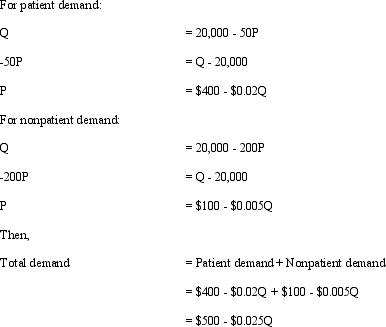
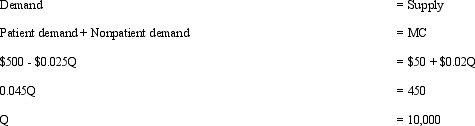
Demand Estimation for Public Goods. Assume that patients and nonpatients have revealed their group demands for hospital emergency room service, a public good, as follows:


Free
(Essay)
4.9/5  (92)
(92) Correct Answer: Verified
where Q is the number of emergency room patients per year at the local hospital and P is the price of emergency room service.






It is not generally considered to be an appropriate function of government to:
Free
(Multiple Choice)
4.8/5 (85)
(85) Correct Answer:Verified
VerifiedB
At the socially efficient price-output level:
Free
(Multiple Choice)
4.8/5 (69)
(69) Correct Answer:Verified
VerifiedD
Nonexclusion Concept. Many public goods display the attribute of being nonexclusionary in consumption.
A. Explain the nonexclusion concept, and how it differs from the nonrival consumption concept.
B. Does national defense display both the nonrival and nonexclusion attributes?
C. Is an optimal amount of national defense likely to be provided by the private sector?
(Essay)
4.8/5 (96)
(96) One important difference between private and public institutions is:
(Multiple Choice)
4.8/5 (73)
(73) Size of Government. Both unregulated private markets and government-administered resources have their strengths and weaknesses.
A. Discuss a primary weakness of the unregulated private-sector allocation of economic resources.
B. Discuss a primary weakness of government-administered social programs or public-sector investment projects.
(Essay)
4.7/5 (75)
(75) Social Rate of Discount. Assume that the rate of return on long-term government bonds is 5%, a typical after-tax return on investment in the private sector is 7%, the marginal corporate and individual tax rate is 50%, and consumption averages 95% of total income.
A. Based on the information provided, calculate an economically appropriate social rate of discount.
B. Would a decrease in the private-sector savings rate due to new tax benefits for individual retirement accounts increase, decrease, or have no effect on the appropriate social rate of discount?
(Essay)
5.0/5 (82)
(82) An example of a public good subject to nonrival consumption is given by:
(Multiple Choice)
4.8/5 (82)
(82) Demand Estimation for Public Goods. Assume that students and nonstudents have revealed their group demands for secondary education, a public good, in the local school district as follows:

(Essay)
4.8/5 (75)
(75) Public vs Private Goods. Use the nonrival concept to classify each of the following goods and services as public goods or private goods. Also indicate whether or not the good or service in question can be characterized by the nonexclusion concept. Explain.
A. Lighthouse signals.
B. Small pox vaccinations.
C. Criminal justice system.
D. Local phone service.
E. The Simpsons television program provided on "free" TV.
(Essay)
4.9/5 (86)
(86) Public Management Theory. A traditional rationale for public sector management of economic resources is that there is a fundamental difference in the economic characteristics of two broad categories of goods and services. These two categories are called public goods and private goods.
A. Describe the essential characteristic of public goods and cite some examples.
B. Describe the essential characteristic of private goods and cite some examples.
(Essay)
4.9/5 (98)
(98) Expenses that are not directly borne by producers or their customers are called:
(Multiple Choice)
4.8/5 (86)
(86) If use by certain individuals does not reduce availability for others, then a good or service is said to display:
(Multiple Choice)
4.9/5 (83)
(83) External Social Benefits. Publicly-funded primary and secondary education is common throughout the world. This support is usually justified on the basis that there are significant external social benefits to having an articulate and well-educated populace. Some of the external benefits associated with a more highly educated populace include higher income tax revenues, reduced crime, higher voter participation, and so on.
A. Describe the nonrival consumption concept as it pertains to publicly-funded primary and secondary education.
B. Describe the nonexclusion consumption concept as it pertains to publicly-funded primary and secondary education.
C. In terms of the external social benefits of education argument, is the public support basis for college education as strong as it is for primary and secondary education?
(Essay)
4.9/5 (81)
(81) The stabilization function of government refers to attempts to control the problems of:
(Multiple Choice)
4.9/5 (93)
(93) External Social Benefits. During recent years, professional sports have enjoyed an unprecedented boom all across the United States and Canada. Team revenues have skyrocketed with growing fan interest and attendance, thriving broadcast revenues, and flourishing corporate sponsorship support. At the same time, major and minor league teams in baseball, football, basketball, and hockey have come to increasingly rely upon public funding to cover construction costs and maintenance expenses for sport facilities.
A. Describe the nonrival consumption concept as it applies to publicly-funded sport facilities.
B. Describe the nonexclusion consumption concept as it applies to publicly-funded sport facilities.
C. In terms of the external social benefits concept, is the equity argument in favor of public support for sport facilities as strong as it is for industrial development in general?
(Essay)
5.0/5 (86)
(86) Privatization. With airline regulation, high prices were eaten away by ever-rising costs for new airplane equipment, fancy meals, and redundant employees. In the post-deregulation period, passenger fares have plummeted as consumers made known their preference for safe and reliable service with cheap airfares. Critics of public sector management of the U.S. Post Office contend that experience with airline deregulation suggests that privatization of the U.S. Post office would lead to dramatic cost reductions and service improvements.
A. Explain how breaking the U.S. Post Office monopoly could help reduce the cost and improve the quality of first-class mail delivery.
B. Explain why privatizing the U.S. Post Office might not lead to such advantages.
(Essay)
4.8/5 (79)
(79) 
Filters
- Essay(0)
- Multiple Choice(0)
- Short Answer(0)
- True False(0)
- Matching(0)