Essay
Pollution Regulation. Porky Pig, Inc., processes hogs at a large facility in Iowa City, Iowa. Each hog processed yields both pork and a render by-product in a fixed 1:1 ratio. Although the render by-product is unfit for human consumption, some can be sold to a local pet food company for further processing. Relevant annual demand and cost relations are:
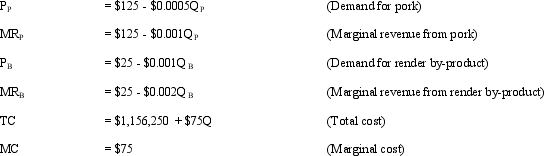 Here P is price in dollars, Q is the number of hogs processed (with an average weight of 100 pounds), QP and QB are pork and rendered by-product per hog, respectively; both total and marginal costs are in dollars. Total costs include a risk-adjusted normal return of 15% on a $2 million investment in plant and equipment.
Currently, the city allows the company to dump excess by-product into its sewage treatment facility at no charge, viewing the service as an attractive means of keeping a valued employer in the area. However, the sewage treatment facility is quickly approaching peak capacity and must be expanded at an expected operating cost of $500,000 per year. This is an impossible burden on an already strained city budget.

Correct Answer:

Verified
Correct Answer:
Verified
Q5: Price/Output Determination. Sun City, Arizona, a retirement
Q6: Tariffs. The Steel Supply Corporation is an
Q7: Costs of Regulation. Glove-Box, Inc., produces glove
Q8: Government-mandated wage arbitration for employers can enhance
Q9: Windfall profit is economic profit due to:<br>A)
Q11: The Celler-Kefauver Act specifically prohibits:<br>A) mergers that
Q12: Utility price and profit regulation is based
Q13: The demand curve for a unique product
Q14: Tariffs. The Northern Lights Company is an
Q15: At the profit maximizing level of output