



 Chat with AI
Exam 19: Chemical Thermodynamics

Exam 1: Introduction: Matter, energy, and Measurement163 Questions
Exam 2: Atoms, molecules, and Ions249 Questions
Exam 3: Chemical Reactions and Reaction Stoichiometry178 Questions
Exam 4: Reactions in Aqueous Solution178 Questions
Exam 5: Thermochemistry154 Questions
Exam 6: Electronic Structure of Atoms186 Questions
Exam 7: Periodic Properties of the Elements176 Questions
Exam 8: Basic Concepts of Chemical Bonding146 Questions
Exam 9: Molecular Geometry and Bonding Theories183 Questions
Exam 10: Gases175 Questions
Exam 11: Liquids and Intermolecular Forces124 Questions
Exam 12: Solids and Modern Materials84 Questions
Exam 13: Properties of Solutions160 Questions
Exam 14: Chemical Kinetics134 Questions
Exam 15: Chemical Equilibrium97 Questions
Exam 16: Acid-Base Equilibria139 Questions
Exam 17: Additional Aspects of Aqueous Equilibria116 Questions
Exam 18: Chemistry of the Environment126 Questions
Exam 19: Chemical Thermodynamics125 Questions
Exam 20: Electrochemistry113 Questions
Exam 21: Nuclear Chemistry178 Questions
Exam 22: Chemistry of the Nonmetals194 Questions
Exam 23: Transition Metals and Coordination Chemistry165 Questions
Exam 24: The Chemistry of Life: Organic and Biological Chemistry131 Questions
Select questions type


Given the following table of thermodynamic data, 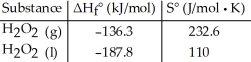 complete the following sentence.The vaporization of H2O2 (l)is ________.
 (Multiple Choice)
4.8/5  (75)
(75) The combustion of acetylene in the presence of excess oxygen yields carbon dioxide and water: 2C2H2 (g)+ 5O2 (g)→ 4CO2 (g)+ 2H2O (l)
The value of ΔS° for this reaction is ________ J/K ∙ mol.
(Multiple Choice)
5.0/5 (77)
(77) At what temperature will a reaction be spontaneous? ΔH = +22.2 kJ/mol and ΔS = +81.1 J/K-mol and assume both do not vary with temperature.
(Multiple Choice)
4.8/5 (89)
(89) For a given reaction with ΔH = -28.1 kJ/mol,the ΔG = 0 at  The value of ΔS must be
 assuming that ΔH and ΔS do not vary with temperature.
The value of ΔS must be assuming that ΔH and ΔS do not vary with temperature. (Multiple Choice)
4.9/5 (73)
(73) The value of ΔS° for the decomposition of gaseous sulfur dioxide to solid elemental sulfur and gaseous oxygen,
SO2 (g)→ S (s,rhombic)+ O2 (g)
Is ________ J/K ∙ mol.
(Multiple Choice)
4.8/5 (81)
(81) 
Filters
- Essay(0)
- Multiple Choice(0)
- Short Answer(0)
- True False(0)
- Matching(0)