



 Chat with AI
Exam 19: Chemical Thermodynamics

Exam 1: Introduction: Matter, energy, and Measurement163 Questions
Exam 2: Atoms, molecules, and Ions249 Questions
Exam 3: Chemical Reactions and Reaction Stoichiometry178 Questions
Exam 4: Reactions in Aqueous Solution178 Questions
Exam 5: Thermochemistry154 Questions
Exam 6: Electronic Structure of Atoms186 Questions
Exam 7: Periodic Properties of the Elements176 Questions
Exam 8: Basic Concepts of Chemical Bonding146 Questions
Exam 9: Molecular Geometry and Bonding Theories183 Questions
Exam 10: Gases175 Questions
Exam 11: Liquids and Intermolecular Forces124 Questions
Exam 12: Solids and Modern Materials84 Questions
Exam 13: Properties of Solutions160 Questions
Exam 14: Chemical Kinetics134 Questions
Exam 15: Chemical Equilibrium97 Questions
Exam 16: Acid-Base Equilibria139 Questions
Exam 17: Additional Aspects of Aqueous Equilibria116 Questions
Exam 18: Chemistry of the Environment126 Questions
Exam 19: Chemical Thermodynamics125 Questions
Exam 20: Electrochemistry113 Questions
Exam 21: Nuclear Chemistry178 Questions
Exam 22: Chemistry of the Nonmetals194 Questions
Exam 23: Transition Metals and Coordination Chemistry165 Questions
Exam 24: The Chemistry of Life: Organic and Biological Chemistry131 Questions
Select questions type


The value of ΔS° for the oxidation of solid elemental sulfur to gaseous sulfur dioxide,
S (s,rhombic)+ O2(g)→ SO2(g)
Is ________ J/K ∙ mol.
(Multiple Choice)
4.8/5  (74)
(74) Consider the formation of solid silver chloride from aqueous silver and chloride ions. Given the following table of thermodynamic data at 298 K: 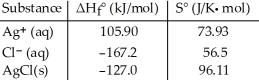 The value of K for the reaction at 25 °C is ________.
 (Multiple Choice)
4.8/5 (75)
(75) Consider the reaction between ammonia and hydrochloric acid to produce ammonium chloride. Given the following table of thermodynamic data at 298 K: 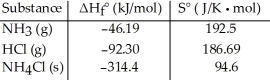 The value of K for the reaction at 25 °C is ________.
 (Multiple Choice)
4.9/5 (71)
(71) For the reaction C2H6 (g)→ C2H4 (g)+ H2 (g)
ΔH° is +137 kJ/mol and ΔS° is +120 J/K ∙ mol.This reaction is ________.
(Multiple Choice)
4.9/5 (81)
(81) The value of ΔS° for the oxidation of carbon to carbon monoxide,
2C (s,graphite)+ O2 (g)→ 2CO (g)
Is ________ J/K ∙ mol.Carbon monoxide is produced in the combustion of carbon with limited oxygen.
(Multiple Choice)
4.9/5 (77)
(77) The value of ΔG° at 25 °C for the decomposition of phosphorous trichloride into its constituent elements, 2PCl3 (g)→ P2 (g)+ 3Cl2 (g)
Is ________ kJ/mol.
(Multiple Choice)
4.9/5 (84)
(84) The value of ΔS° for the formation of POCl3 from its constituent elements, P2 (g)+ O2 (g)+ 3Cl2 (g)→ 2POCl3 (g)
Is ________ J/K ∙ mol.
(Multiple Choice)
4.8/5 (87)
(87) The value of ΔS° for the decomposition of gaseous sulfur trioxide to solid elemental sulfur and gaseous oxygen,
2SO3 (g)→ 2S (s,rhombic)+ 3O2 (g)
Is ________ J/K ∙ mol.
(Multiple Choice)
4.9/5 (75)
(75) The value of ΔS° for the oxidation of solid elemental sulfur to gaseous sulfur trioxide,
2S (s,rhombic)+ 3O2(g)→ 2SO3 (g)
Is ________ J/K ∙ mol.
(Multiple Choice)
4.7/5 (86)
(86) The vaporization of a substance at its boiling point is an isothermal process.
(True/False)
4.8/5 (80)
(80) The thermodynamic quantity that expresses the extent of randomness in a system is ________.
(Multiple Choice)
4.7/5 (78)
(78) Which reaction produces a decrease in the entropy of the system?
(Multiple Choice)
4.9/5 (76)
(76) Given the following table of thermodynamic data, 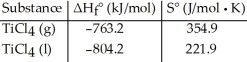 complete the following sentence.The vaporization of Ti
 is ________.
complete the following sentence.The vaporization of Ti is ________. (Multiple Choice)
4.8/5 (81)
(81) Which one of the following is always positive when a spontaneous process occurs?
(Multiple Choice)
4.9/5 (75)
(75)  and atm?
Which one of the following processes produces a decrease of the entropy of the system?
(Multiple Choice)
4.9/5 (73)
(73) The value of ΔH° for the decomposition of calcium chloride into its constituent elements, CaCl2 (s)→ Ca (s)+ Cl2 (g)
Is ________ kJ/mol.
(Multiple Choice)
4.8/5 (90)
(90) 
Filters
- Essay(0)
- Multiple Choice(0)
- Short Answer(0)
- True False(0)
- Matching(0)