



 Chat with AI
Exam 19: Chemical Thermodynamics

Exam 1: Introduction: Matter, energy, and Measurement163 Questions
Exam 2: Atoms, molecules, and Ions249 Questions
Exam 3: Chemical Reactions and Reaction Stoichiometry178 Questions
Exam 4: Reactions in Aqueous Solution178 Questions
Exam 5: Thermochemistry154 Questions
Exam 6: Electronic Structure of Atoms186 Questions
Exam 7: Periodic Properties of the Elements176 Questions
Exam 8: Basic Concepts of Chemical Bonding146 Questions
Exam 9: Molecular Geometry and Bonding Theories183 Questions
Exam 10: Gases175 Questions
Exam 11: Liquids and Intermolecular Forces124 Questions
Exam 12: Solids and Modern Materials84 Questions
Exam 13: Properties of Solutions160 Questions
Exam 14: Chemical Kinetics134 Questions
Exam 15: Chemical Equilibrium97 Questions
Exam 16: Acid-Base Equilibria139 Questions
Exam 17: Additional Aspects of Aqueous Equilibria116 Questions
Exam 18: Chemistry of the Environment126 Questions
Exam 19: Chemical Thermodynamics125 Questions
Exam 20: Electrochemistry113 Questions
Exam 21: Nuclear Chemistry178 Questions
Exam 22: Chemistry of the Nonmetals194 Questions
Exam 23: Transition Metals and Coordination Chemistry165 Questions
Exam 24: The Chemistry of Life: Organic and Biological Chemistry131 Questions
Select questions type


The value of ΔG° at 25 °C for the decomposition of gaseous sulfur trioxide to solid elemental sulfur and gaseous oxygen, 2SO3 (g)→ 2S (s,rhombic)+ 3O2 (g)
Is ________ kJ/mol.
(Multiple Choice)
4.9/5  (74)
(74) The entropy change accompanying any process is given by the equation:
(Multiple Choice)
4.8/5 (74)
(74) The standard Gibbs free energy of formation of ________ is zero. (a)Mn (s)
(b)I2 (s)
(c)Cu (s)
(Multiple Choice)
4.7/5 (71)
(71) For a given reaction,ΔS = +69.0 J/mol∙K,and the reaction is spontaneous at temperatures above the crossover temperature,  The value of
 assuming that ΔH and ΔS do not vary with temperature.
The value of assuming that ΔH and ΔS do not vary with temperature. (Multiple Choice)
4.7/5 (78)
(78) The more negative ΔG° is for a given reaction,the larger the value of the corresponding equilibrium constant,K.
(True/False)
4.7/5 (70)
(70) The combustion of ethene in the presence of excess oxygen yields carbon dioxide and water: C2H4 (g)+ 3O2 (g)→ 2CO2 (g)+ 2H2O (l)
The value of ΔS° for this reaction is ________ J/K ∙ mol.
(Multiple Choice)
4.8/5 (86)
(86)  and atm?
Given the thermodynamic data in the table below,calculate the equilibrium constant (at 298 K)for the reaction: 2 SO2 (g)+ O2 (g)  2 SO3 (g)
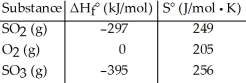
2 SO3 (g) (Multiple Choice)
5.0/5 (75)
(75) The value of ΔS° for the reaction 2C (s,diamond)+ O2 (g)→ 2CO (g)
Is ________ J/K ∙ mol.
(Multiple Choice)
4.9/5 (91)
(91) Which reaction produces an increase in the entropy of the system?
(Multiple Choice)
4.7/5 (94)
(94) At what temperature in Kelvin will a reaction have  ? ΔH = -24.2 kJ/mol and ΔS = -55.5 J/K-mol and assume both do not vary with temperature.
 (Multiple Choice)
4.8/5 (89)
(89) Which one of the following statements is true about the equilibrium constant for a reaction if ΔG° for the reaction is negative?
(Multiple Choice)
4.8/5 (69)
(69) The value of ΔG° at 25 °C for the following reaction: C2H4 (g)+ H2 (g)→ C2H6 (g)
Is ________ kJ/mol.At 298 K,ΔH° for this reaction is -137.5 kJ/mol,and ΔS° is +120.5 J/K.
(Multiple Choice)
4.8/5 (91)
(91) The melting of a substance at its melting point is an isothermal process.
(True/False)
4.9/5 (84)
(84) The value of ΔG° at 25 °C for the decomposition of gaseous sulfur dioxide to solid elemental sulfur and gaseous oxygen, SO2 (g)→ S (s,rhombic)+ O2 (g)
Is ________ kJ/mol.
(Multiple Choice)
4.8/5 (82)
(82) For a given reaction with ΔS = -50.8 J/K-mol,the ΔG = 0 at  The value of ΔH must be
 assuming that ΔH and ΔS do not vary with temperature.
The value of ΔH must be assuming that ΔH and ΔS do not vary with temperature. (Multiple Choice)
4.9/5 (71)
(71) The value of ΔG° at 25 °C for the formation of phosphorous trichloride from its constituent elements, P2 (g)+ 3Cl2 (g)→ 2PCl3 (g)
Is ________ kJ/mol.
(Multiple Choice)
4.8/5 (69)
(69) 
Filters
- Essay(0)
- Multiple Choice(0)
- Short Answer(0)
- True False(0)
- Matching(0)