



 Chat with AI
Exam 19: Chemical Thermodynamics

Exam 1: Introduction: Matter, energy, and Measurement163 Questions
Exam 2: Atoms, molecules, and Ions249 Questions
Exam 3: Chemical Reactions and Reaction Stoichiometry178 Questions
Exam 4: Reactions in Aqueous Solution178 Questions
Exam 5: Thermochemistry154 Questions
Exam 6: Electronic Structure of Atoms186 Questions
Exam 7: Periodic Properties of the Elements176 Questions
Exam 8: Basic Concepts of Chemical Bonding146 Questions
Exam 9: Molecular Geometry and Bonding Theories183 Questions
Exam 10: Gases175 Questions
Exam 11: Liquids and Intermolecular Forces124 Questions
Exam 12: Solids and Modern Materials84 Questions
Exam 13: Properties of Solutions160 Questions
Exam 14: Chemical Kinetics134 Questions
Exam 15: Chemical Equilibrium97 Questions
Exam 16: Acid-Base Equilibria139 Questions
Exam 17: Additional Aspects of Aqueous Equilibria116 Questions
Exam 18: Chemistry of the Environment126 Questions
Exam 19: Chemical Thermodynamics125 Questions
Exam 20: Electrochemistry113 Questions
Exam 21: Nuclear Chemistry178 Questions
Exam 22: Chemistry of the Nonmetals194 Questions
Exam 23: Transition Metals and Coordination Chemistry165 Questions
Exam 24: The Chemistry of Life: Organic and Biological Chemistry131 Questions
Select questions type


A reaction that is not spontaneous at low temperature can become spontaneous at high temperature if  is ________ and
 is ________.
is ________ and is ________. (Multiple Choice)
4.9/5  (80)
(80) The value of ΔS° for the oxidation of carbon to carbon dioxide,
C (s,graphite)+ O2 (g)→ CO2(g)
Is ________ J/K ∙ mol.The combustion of carbon,as in charcoal briquettes,in the presence of abundant oxygen produces carbon dioxide.
(Multiple Choice)
4.8/5 (76)
(76) The value of ΔG° at 25 °C for the oxidation of solid elemental sulfur to gaseous sulfur trioxide, 2S (s,rhombic)+ 3O2 (g)→ 2SO3 (g)
Is ________ kJ/mol.
(Multiple Choice)
5.0/5 (87)
(87) The combustion of hydrogen in the presence of excess oxygen yields liquid water: What is the value of ΔS° in J/K ∙ mol.for this reaction?
(Multiple Choice)
4.7/5 (75)
(75) The value of ΔG° at 25 °C for the decomposition of calcium chloride into its constituent elements, CaCl2 (s)→ Ca (s)+ Cl2 (g)
Is ________ kJ/mol.
(Multiple Choice)
4.9/5 (77)
(77) The normal boiling point of C2Cl3F3 is 47.6 °C and its molar enthalpy of vaporization is 27.49 kJ/mol.What is the change in entropy in the system in J/K when 28.6 grams of C2Cl3F3 vaporizes to a gas at the normal boiling point?
(Multiple Choice)
4.8/5 (82)
(82) For a given reaction,ΔH = +74.6 kJ/mol,and the reaction is spontaneous at temperatures above the crossover temperature,  The value of
 assuming that ΔH and ΔS do not vary with temperature.
The value of assuming that ΔH and ΔS do not vary with temperature. (Multiple Choice)
5.0/5 (85)
(85) The value of ΔS° for the catalytic hydrogenation of acetylene to ethane, C2H2 (g)+ 2H2 (g)→ C2H6 (g)
Is ________ J/K ∙ mol.
(Multiple Choice)
4.9/5 (73)
(73) What is the ΔG° (kJ/mol)for the formation of silver chloride at 25 °C?
Ksp = 1.8 × 10⁻¹⁰
(Short Answer)
4.9/5 (82)
(82) The value of ΔS° for the formation of phosphorous trichloride from its constituent elements, P2 (g)+ 3Cl2 (g)→ 2PCl3 (g)
Is ________ J/K ∙ mol.
(Multiple Choice)
5.0/5 (63)
(63) The value of ΔS° for the decomposition of POCl3 into its constituent elements, 2POCl3 (g)→ P2 (g)+ O2 (g)+ 3Cl2 (g)
Is ________ J/K ∙ mol.
(Multiple Choice)
4.8/5 (72)
(72) The value of ΔS° for the catalytic hydrogenation of acetylene to ethene, C2H2 (g)+ H2 (g)→ C2H4 (g)
Is ________ J/K∙ mol.
(Multiple Choice)
4.8/5 (78)
(78) Which one of the following correctly indicates the relationship between the entropy of a system and the number of different arrangements,W,in the system?
(Multiple Choice)
4.8/5 (88)
(88) Consider the reaction: FeO (s)+ Fe (s)+ O2(g)→ Fe2O3 (s)
Given the following table of thermodynamic data at 298 K: 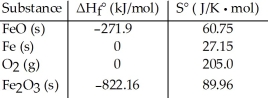 The value K for the reaction at 25 °C is ________.
 (Multiple Choice)
4.8/5 (83)
(83) The equilibrium constant for a reaction is 0.38 at 25 °C.What is the value of ΔG° (kJ/mol)at this temperature?
(Multiple Choice)
4.9/5 (86)
(86) What is the change in entropy in the system in J/K when 112.2 grams of ethanol at 1 atm condenses to a liquid at the normal boiling point? The normal boiling point of ethanol (C2H5OH)is 78.3 °C and its molar enthalpy of vaporization is 38.56 kJ/mol.
(Multiple Choice)
4.9/5 (77)
(77) Consider the reaction: NH3 (g)+ HCl (g)→ NH4Cl (s)
Given the following table of thermodynamic data, 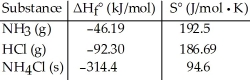 determine the temperature (in °C)above which the reaction is nonspontaneous.
 (Multiple Choice)
4.7/5 (76)
(76) 
Filters
- Essay(0)
- Multiple Choice(0)
- Short Answer(0)
- True False(0)
- Matching(0)