



 Chat with AI
Exam 5: Thermochemistry

Exam 1: Introduction: Matter, energy, and Measurement163 Questions
Exam 2: Atoms, molecules, and Ions249 Questions
Exam 3: Chemical Reactions and Reaction Stoichiometry178 Questions
Exam 4: Reactions in Aqueous Solution178 Questions
Exam 5: Thermochemistry154 Questions
Exam 6: Electronic Structure of Atoms186 Questions
Exam 7: Periodic Properties of the Elements176 Questions
Exam 8: Basic Concepts of Chemical Bonding146 Questions
Exam 9: Molecular Geometry and Bonding Theories183 Questions
Exam 10: Gases175 Questions
Exam 11: Liquids and Intermolecular Forces124 Questions
Exam 12: Solids and Modern Materials84 Questions
Exam 13: Properties of Solutions160 Questions
Exam 14: Chemical Kinetics134 Questions
Exam 15: Chemical Equilibrium97 Questions
Exam 16: Acid-Base Equilibria139 Questions
Exam 17: Additional Aspects of Aqueous Equilibria116 Questions
Exam 18: Chemistry of the Environment126 Questions
Exam 19: Chemical Thermodynamics125 Questions
Exam 20: Electrochemistry113 Questions
Exam 21: Nuclear Chemistry178 Questions
Exam 22: Chemistry of the Nonmetals194 Questions
Exam 23: Transition Metals and Coordination Chemistry165 Questions
Exam 24: The Chemistry of Life: Organic and Biological Chemistry131 Questions
Select questions type


When work is done on a system,w will be a ________ value.

Free
(Multiple Choice)
4.7/5  (87)
(87) Correct Answer: Verified
A
The value of ΔH° for the reaction below is -482 kJ.Calculate the heat (kJ)released to the surroundings when 10.0 g of CO (g)reacts completely. 2CO (g)+ O2 (g)→ 2CO2 (g)
Free
(Multiple Choice)
4.9/5 (77)
(77) Correct Answer:Verified
VerifiedC
Given the data in the table below,ΔH°rxn for the reaction 3Cl2 (g)+ PH3 (g)→ PCl3 (g)+ 3HCl (g)
Is ________ kJ. 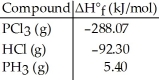
Free
(Multiple Choice)
4.9/5 (84)
(84) Correct Answer:Verified
VerifiedB
Calculate the kinetic energy in joules of an automobile weighing 2135 lb and traveling at 55 mph. 
(Multiple Choice)
4.9/5 (85)
(85) The value of ΔE for a system that performs 19 kJ of work on its surroundings and loses  of heat is

of heat is (Multiple Choice)
4.8/5 (76)
(76) Calculate the value of ΔE in joules for a system that loses 115 J of heat and has 150 J of work performed on it by the surroundings.
(Multiple Choice)
4.8/5 (78)
(78) For the following reactions,the ΔH°rxn is NOT equal to ΔH°f for the product except for ________.
(Multiple Choice)
4.7/5 (81)
(81) The value of ΔH° for the reaction below is +128.1 kJ: CH3OH (l)→ CO (g)+ 2H2 (g)
How many kJ of heat are consumed when 15.5 g of C  OH (l)decomposes as shown in the equation?
 (Multiple Choice)
4.8/5 (89)
(89) The value of ΔH° for the reaction below is -790 kJ.The enthalpy change accompanying the reaction of 0.95 g of S is ________ kJ. 2S (s)+ 3O2 (g)→ 2SO3 (g)
(Multiple Choice)
4.8/5 (76)
(76) Given the data in the table below and ΔH°rxn for the reaction SO2Cl2 (g)+ 2H2O (l)→ H2SO4 (l)+ 2HCl (g)ΔH° = -62 kJ
ΔH°f of HCl (g)is ________ kJ/mol. 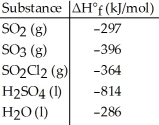
(Multiple Choice)
4.8/5 (68)
(68) A sample of iron absorbs 81.0 J of heat,upon which the temperature of the sample increases from  to
 If the specific heat of iron is 0.450 J/g-K,what is the mass (in grams)of the sample?
to If the specific heat of iron is 0.450 J/g-K,what is the mass (in grams)of the sample? (Multiple Choice)
4.9/5 (79)
(79) The specific heat capacity of methane gas is 2.20 J/g-K.How many joules of heat are needed to raise the temperature of 7.25 g of methane from 22.0 °C to 57.0 °C?
(Multiple Choice)
4.9/5 (75)
(75) Hydrogen gas and bromine gas react to form hydrogen bromide gas.How much heat (kJ)is released when 155 grams of HBr is formed in this reaction? ΔH° = -72 kJ.
(Multiple Choice)
4.8/5 (85)
(85) The internal energy of a system is always increased by ________.
(Multiple Choice)
4.8/5 (84)
(84) The ΔE of a system that absorbs 12.4 J of heat and does 4.2 J of work on the surroundings is ________ J.
(Multiple Choice)
4.9/5 (81)
(81) A sample of calcium carbonate [CaCO3 (s)] absorbs  of heat,upon which the temperature of the sample increases from
 to
 If the specific heat of calcium carbonate is
 what is the mass (in grams)of the sample?
of heat,upon which the temperature of the sample increases from to If the specific heat of calcium carbonate is what is the mass (in grams)of the sample? (Multiple Choice)
4.8/5 (76)
(76) 
Filters
- Essay(0)
- Multiple Choice(0)
- Short Answer(0)
- True False(0)
- Matching(0)