



 Chat with AI
Exam 5: Thermochemistry

Exam 1: Introduction: Matter, energy, and Measurement163 Questions
Exam 2: Atoms, molecules, and Ions249 Questions
Exam 3: Chemical Reactions and Reaction Stoichiometry178 Questions
Exam 4: Reactions in Aqueous Solution178 Questions
Exam 5: Thermochemistry154 Questions
Exam 6: Electronic Structure of Atoms186 Questions
Exam 7: Periodic Properties of the Elements176 Questions
Exam 8: Basic Concepts of Chemical Bonding146 Questions
Exam 9: Molecular Geometry and Bonding Theories183 Questions
Exam 10: Gases175 Questions
Exam 11: Liquids and Intermolecular Forces124 Questions
Exam 12: Solids and Modern Materials84 Questions
Exam 13: Properties of Solutions160 Questions
Exam 14: Chemical Kinetics134 Questions
Exam 15: Chemical Equilibrium97 Questions
Exam 16: Acid-Base Equilibria139 Questions
Exam 17: Additional Aspects of Aqueous Equilibria116 Questions
Exam 18: Chemistry of the Environment126 Questions
Exam 19: Chemical Thermodynamics125 Questions
Exam 20: Electrochemistry113 Questions
Exam 21: Nuclear Chemistry178 Questions
Exam 22: Chemistry of the Nonmetals194 Questions
Exam 23: Transition Metals and Coordination Chemistry165 Questions
Exam 24: The Chemistry of Life: Organic and Biological Chemistry131 Questions
Select questions type


When ________ is constant,the enthalpy change of a process equal to the amount of heat transferred into or out of the system?
(Multiple Choice)
4.9/5  (84)
(84) Calculate the work (kJ)done during a reaction in which the internal volume contracts from  to
 against an outside pressure of

to against an outside pressure of (Multiple Choice)
4.8/5 (79)
(79) CH3OH (l)decomposes into carbon monoxide and hydrogen gas in the presence of heat.How much heat is consumed when 5.75 g of CO (g)is formed? ΔH° = +128.1 kJ.
(Multiple Choice)
4.9/5 (76)
(76) Calculate the kinetic energy in J of an electron moving at 6.00 × 10⁶ m/s.The mass of an electron is 9.11 × 10⁻²⁸ g.
(Multiple Choice)
4.8/5 (75)
(75) Given the data in the table below,ΔH° for the reaction 2CO (g)+ O2 (g)→ 2CO2 (g)
Is ________ kJ. 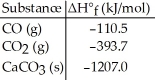
(Multiple Choice)
4.9/5 (66)
(66) The specific heat of liquid bromine is 0.226 J/g-K. How much heat (J)is required to raise the temperature of 10.0 mL of bromine from 25.00 °C to 27.30 °C? The density of liquid bromine: 3.12 g/mL.
(Multiple Choice)
4.8/5 (90)
(90) Consider the following two reactions: A → 2B ΔH°rxn = 456.7 kJ/mol
A → C ΔH°rxn = -22.1 kJ/mol
Determine the enthalpy change for the process:
2B → C
(Multiple Choice)
4.8/5 (76)
(76) Petroleum is a liquid that can be refined to produce fuels such as gasoline,diesel oil,and kerosene.
(True/False)
4.7/5 (57)
(57) The enthalpy change for the following reaction is -483.6 kJ: 2H2 (g)+ O2 (g)→ 2H2O (g)
Therefore,the enthalpy change for the following reaction is ________ kJ.
4H2 (g)+ 2O2 (g)→ 4H2O (g)
(Multiple Choice)
4.9/5 (75)
(75) A sample of aluminum metal absorbs 11.2 J of heat,upon which the temperature of the sample increases from 23.2 °C to 30.5 °C.Since the specific heat capacity of aluminum is 0.90 J/g-K,the mass of the sample is ________ g.
(Multiple Choice)
4.9/5 (86)
(86) 
Filters
- Essay(0)
- Multiple Choice(0)
- Short Answer(0)
- True False(0)
- Matching(0)