



 Chat with AI
Exam 7: Kinetics

Exam 1: Atoms202 Questions
Exam 2: Molecules181 Questions
Exam 3: States of Matter287 Questions
Exam 4: Thermodynamics192 Questions
Exam 5: Equilibrium191 Questions
Exam 6: Reactions282 Questions
Exam 7: Kinetics87 Questions
Exam 8: The Main-Group Elements191 Questions
Exam 9: The D-Block Elements95 Questions
Exam 10: Nuclear Chemistry96 Questions
Exam 11: Organic Chemistry193 Questions
Select questions type


The reaction
3C + D products
Has rate = k[D] and has a half-life of 1.29 s.If initially [D] = 0.820,What is the concentration of D after 2.55 s?
(Multiple Choice)
4.9/5  (77)
(77) Given:
5Br-(aq)+ BrO3-(aq)+ 6H+(aq) 3Br2(aq)+ 3H2O(l)
Rate = k[Br-][ BrO3-][H+]2
The overall order of the reaction and the order with respect to H+ are
(Multiple Choice)
5.0/5 (89)
(89) The reaction [(CN)5CoOH2]2-(aq)+ SCN-(aq) [(CN)5CoSCN]3-+ H2O(l)
has the rate law,rate=k[(CN)5CoOH22-].Postulate a mechanism for this reaction.
(Essay)
4.8/5 (68)
(68) For the reaction
HO(g)+ H2(g) H2O(g)+ H(g)
A plot of
Versus 1/T gives a straight line with a slope equal to -5.1 * 103 K.What is the activation energy for the reaction?
(Multiple Choice)
4.8/5 (79)
(79) The fraction of molecules that collide with a kinetic energy equal to the activation energy for a reaction decreases rapidly with an increase in temperature.
(True/False)
4.8/5 (76)
(76) The concentration.time curves for two sets of reactions, A/B and C/D,
Are: 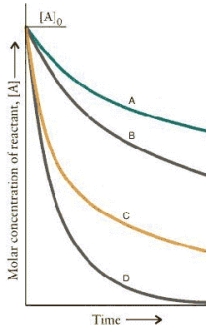 Which set of reactions has the largest rate constant?
 (Short Answer)
4.9/5 (86)
(86) The rates of first-order and second-order reactions do not change with elapsed time
(True/False)
4.7/5 (90)
(90) The rate law for the following mechanism is
NO2(g)+ F2(g) NO2F(g)+ F(g)
K1,
Slow
F(g)+ NO2(g) NO2F(g)
K2,
Fast
(Multiple Choice)
4.8/5 (83)
(83) The reaction between nitrogen dioxide and carbon monoxide is thought to occur by the mechanism
2NO2(g NO3(g)+ NO(g)
K1,Slow
NO3(g)+ CO(g) NO2(g)+ CO2(g)
K2,Fast
The rate law for this mechanism is
(Multiple Choice)
4.9/5 (76)
(76) All of the following statements with respect to the effect of a catalyst on a reaction are true except:
(Multiple Choice)
4.9/5 (77)
(77) The rate of formation of oxygen in the reaction
2N2O5(g) 4NO2(g)+ O2(g)Is 2.28 (mol O2).L-1.s-1.What is the rate of formation of NO2?
(Multiple Choice)
4.8/5 (82)
(82) Consider the reaction for the dimerization of butadiene(g)at a certain temperature.
2C4H6(g) C8H12(g)
rate = k[C4H6]2.When the initial concentration of butadiene is 0.500 M,
the time required for 80% dimerization is measured at 11.4 s.What is the rate constant for the dimerization?
(Short Answer)
4.9/5 (72)
(72) Consider the reaction
2A B,Rate = k[A]2
If the rate of appearance of B is followed,derive the experimental rate constant.
(Essay)
4.9/5 (85)
(85) A possible mechanism for the reaction A + B + D E + F is
A + B
k1,k-1,fast
C
C + D E + F
k2
where C is a reactive intermediate present in very low concentrations.
Calculate the steady state concentration of C in terms of the rate constants for the individual steps and the concentrations of the reactants.
(Short Answer)
4.9/5 (93)
(93) It is important to distinguish between the reaction rate and the rate constant.The units of reaction rate are M.s-1.
(True/False)
4.9/5 (94)
(94) The concentration-time dependence for two first order reactions is: 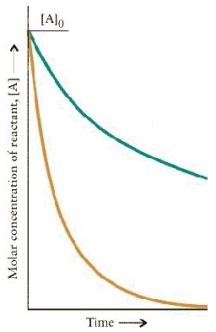 Which reaction has the greater t½?
 (Short Answer)
4.8/5 (103)
(103) For a given first-order reaction, after 2.00 min,20% of the reactants remain.Calculate the rate constant for the reaction.
(Multiple Choice)
4.8/5 (78)
(78) The reaction
2ClO2(g)+ F2(g) 2FClO2(g)
Is first order in both ClO2 and F2.When the initial concentrations of ClO2 and F2 are equal,The rate after 25% of the F2 has reacted is what percent of the initial rate?
(Multiple Choice)
4.9/5 (75)
(75) In the reaction: A + B C, where: rate = k[A][B], Which of the following is true?
(Multiple Choice)
4.8/5 (76)
(76) 
Filters
- Essay(0)
- Multiple Choice(0)
- Short Answer(0)
- True False(0)
- Matching(0)