



 Chat with AI
Exam 7: Kinetics

Exam 1: Atoms202 Questions
Exam 2: Molecules181 Questions
Exam 3: States of Matter287 Questions
Exam 4: Thermodynamics192 Questions
Exam 5: Equilibrium191 Questions
Exam 6: Reactions282 Questions
Exam 7: Kinetics87 Questions
Exam 8: The Main-Group Elements191 Questions
Exam 9: The D-Block Elements95 Questions
Exam 10: Nuclear Chemistry96 Questions
Exam 11: Organic Chemistry193 Questions
Select questions type


Consider the reaction
NOBr(g) NO(g)+ ½Br2(g)
A plot of [NOBr]-sup>1 vs t gives a straight line with a slope of 2.00 M-1.s-1.The order of the reaction and the rate constant,Respectively,Are
(Multiple Choice)
4.8/5  (80)
(80) A first-order reaction has a rate constant of 0.00300 s-1 .The time required for 60% reaction is
(Multiple Choice)
4.9/5 (78)
(78) If the average rate of formation of H2(g) is 3.90 (mol H2).L-1.s-1 for the reaction2PH3(g) 2P(g)+ 3H2(g),The unique average reaction rate is
(Multiple Choice)
4.7/5 (93)
(93) For a second-order reaction, a straight line is obtained from a plot of
(Multiple Choice)
4.9/5 (70)
(70) Consider the reaction
2N2O5(g) 4NO2(g)+ O2(g)
Rate = k[N2O5]
Calculate the time for the concentration of N2O5 to fall to one-fourth its initial value if the half-life is 133 s.
(Multiple Choice)
4.8/5 (83)
(83) What is the rate constant for a first-order reaction with a half-life of 9.0 ms?
(Multiple Choice)
4.9/5 (89)
(89) If the average rate of decomposition of PH3(g) is 3.2 (mol PH3).L-1.min-1 for the reaction 2PH3(g) 2P(g)+ 3H2(g),
The unique average reaction rate is
(Multiple Choice)
4.8/5 (76)
(76) An elementary process has an activation energy of 92 kJ/mol .If the enthalpy change for the reaction is -62 kJ/mol, What is the activation energy for the reverse reaction?
(Multiple Choice)
4.8/5 (68)
(68) Consider the mechanism
ClO-(aq)+ H2O(l)
HOCl(aq)+ OH-(aq) K,fast
I-(aq)+ HOCl(aq) HOI(aq)+ Cl-(aq) k,slow
HOI(aq)+ OH-(aq) OI-(aq)+ H2O(l) k,fast
Draw the reaction profile for this mechanism.
(Essay)
4.9/5 (89)
(89) Consider the following mechanism for the destruction of ozone.
O3 + NO NO2 + O2
NO2 + O NO + O2
What is the catalyst in this reaction?
(Short Answer)
4.9/5 (85)
(85) Consider the reaction
2N2O(g) 2N2(g)+ O2(g)
Rate = k[N2O]For an initial concentration of N2O of 0.50 M,What is the concentration of N2O remaining after 2.0 min if k = 3.4 * 10-3 s-1?
(Multiple Choice)
4.8/5 (96)
(96) A second-order reaction has a rate constant of 1.25 M-1.s-1 .If the initial reactant concentration is 1.0 M,Calculate the time required for 90% reaction.
(Multiple Choice)
4.8/5 (67)
(67) The concentration-time dependence is shown below for two first-order reactions is: 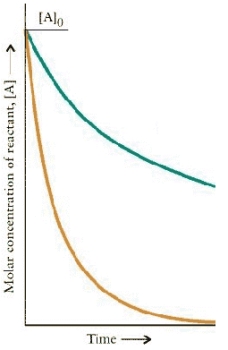 Which reaction has the larger rate constant?
 (Short Answer)
4.7/5 (83)
(83) What is the half-life of a reaction that has a rate constant of 280 s-1?
(Multiple Choice)
4.9/5 (87)
(87) The reaction profile for the mechanism
NO2(g)+ F2(g) NO2F(g)+ F(g)
Slow
F(g)+ NO2(g) NO2F(g)
Fast
Shows
(Multiple Choice)
4.9/5 (66)
(66) The reduction of M3+ by Cr2+ was studied with [Cr2+] 100 times the concentration of Cr2+ .When [Cr2+] = 0.0050 M,The rate was 2.5 s-1.The rate constant for this reaction is
(Multiple Choice)
4.8/5 (76)
(76) If the rate of a reaction increases by a factor of 64 when the concentration of reactant increases by a factor of 4, the order of the reaction with respect to this reactant is
(Multiple Choice)
4.8/5 (82)
(82) The rate law for the following mechanism is
ClO-(aq)+ H2O(l)
HOCl(aq)+ OH-(aq)
K,Fast
I-(aq)+ HOCl(aq) HOI(aq)+ Cl-(aq)
K1,Slow
HOI(aq)+ OH-(aq) OI-(aq)+ H2O(l)
K2,Fast
(Multiple Choice)
4.9/5 (73)
(73) Technetium-99m, used to image the heart and brain,Has a half-life of 6.00 h.
What fraction of technetium-99m remains in the body after 1 day?
(Multiple Choice)
4.8/5 (85)
(85) 
Filters
- Essay(0)
- Multiple Choice(0)
- Short Answer(0)
- True False(0)
- Matching(0)