



 Chat with AI
Exam 7: Kinetics

Exam 1: Atoms202 Questions
Exam 2: Molecules181 Questions
Exam 3: States of Matter287 Questions
Exam 4: Thermodynamics192 Questions
Exam 5: Equilibrium191 Questions
Exam 6: Reactions282 Questions
Exam 7: Kinetics87 Questions
Exam 8: The Main-Group Elements191 Questions
Exam 9: The D-Block Elements95 Questions
Exam 10: Nuclear Chemistry96 Questions
Exam 11: Organic Chemistry193 Questions
Select questions type


A given first-order reaction has a rate constant of 0.00300 s-1 .The time required for 85% reaction is
(Multiple Choice)
4.8/5  (81)
(81) Consider the following mechanism for the production of phosgene.
Cl2 Cl + Cl
Cl + CO COCl
COCl + Cl COCl2
The molecularity of the first and second elementary reactions is ____ and ____.
(Short Answer)
4.8/5 (88)
(88) Consider the reaction
2N2O5(g) 4NO2(g)+ O2(g)
Rate = k[N2O5]
If the initial concentration of N2O5 is 0.80 M,The concentration after 5 half-lives is
(Multiple Choice)
4.9/5 (83)
(83) If the rate of reaction increases by a factor of 2.3 when the concentration of reactant increases by a factor of 1.5, the order of the reaction with respect to this reactant is
(Multiple Choice)
4.9/5 (81)
(81) A nonsteroidal anti-inflammatory drug is metabolized with a first-order rate constant of 3.25day-1 .What fraction of the drug remains in the body after 13.0 hr?
(Multiple Choice)
4.8/5 (69)
(69) If the rate of reaction increases by a factor of 9.6 when the concentration of reactant increases by a factor of 3.1, the order of the reaction with respect to this reactant is
(Multiple Choice)
4.8/5 (71)
(71) Consider the reaction
A + B C + D rate = k[A]2
The time it takes for [A] to decrease from 1.0 to 0.50 M is the same as the time it takes for [A] to decrease from0.50 to 0.25 M.
(True/False)
4.9/5 (69)
(69) Given:
4Fe2+(aq)+ O2(aq)+ 2H2O(l) 4Fe3+(aq)+ 4OH-(aq)
Rate = k[Fe2+][OH-]2[O2]
The overall order of the reaction and the order with respect to O2 are
(Multiple Choice)
5.0/5 (77)
(77) For a zero-order reaction,the rate constant has the same units as the rate of reaction.
(True/False)
4.8/5 (81)
(81) The reaction
2NO(g)+ 2H2(g) N2(g)+ 2H2O(g)
Is first order in H2 and second order in NO.Starting with equal concentrations of H2 and NO,The rate after 25% of the H2 has reacted is what percent of the initial rate?
(Multiple Choice)
4.9/5 (88)
(88) In the Michaelis-Menten mechanism of enzyme reaction, the Michaelis constant,KM,Is
(Multiple Choice)
4.8/5 (79)
(79) Given:
CH4(g)+ Cl2(g) CH3Cl(g)+ HCl(g)
The rate law for this elementary process is
(Multiple Choice)
4.9/5 (67)
(67) Consider the reaction
2N2O(g) 2N2(g)+ O2(g)
Rate = k[N2O]
Calculate the time required for the concentration of N2O(g) To decrease from 0.75 M to 0.33 M.The rate constant for the reaction is k = 6.8 * 10-3 s-1.
(Multiple Choice)
4.7/5 (87)
(87) The concentration-time curves for two sets of reactions, A/B and C/D,
Are: 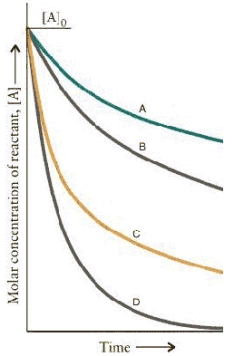 Which of the reactions are first order?
 (Multiple Choice)
4.9/5 (86)
(86) The HBr synthesis is thought to involve the following reactions:
1.Br2 2Br.
2.Br. + H2 HBr + H.
3.H. + Br2 HBr + Br.
4.2Br. Br2
5.2H. H2
6.H. + Br. HBr
The chain termination reactions in this mechanism are reactions"
(Multiple Choice)
4.8/5 (88)
(88) Given:
2A(g)+ B(g) C(g)+ D(g)
When [A] = [B] = 0.10 M,The rate is 2.0 M.s-1; for [A] = [B] = 0.20,The rate is 8.0 M.s-1; and for[A] = 0.10 M,[B] = 0.20 M,The rate is 2.0 M.s-1.The rate law is
(Multiple Choice)
4.8/5 (91)
(91) For the reaction A products,the following data were collected. time, s 0 1 2 3 4 []. 1.00 0.430 0.270 0.200 0.160
Determine the order of the reaction and calculate the rate constant.
(Short Answer)
4.9/5 (75)
(75) A reaction has k = 8.39 M-1.s-1 .How long does it take for the reactant concentration to drop from 0.0840 M to 0.0220 M?
(Multiple Choice)
4.9/5 (75)
(75) For the reaction cyclobutane(g) 2ethylene(g)
At 800 K,The half-life is 0.43 s.Calculate the time needed for the concentration of cyclobutane to fall to 1/64 of its initial value.
(Multiple Choice)
4.8/5 (93)
(93) 
Filters
- Essay(0)
- Multiple Choice(0)
- Short Answer(0)
- True False(0)
- Matching(0)