Short Answer
The concentration.time curves for two sets of reactions, A/B and C/D,
Are: 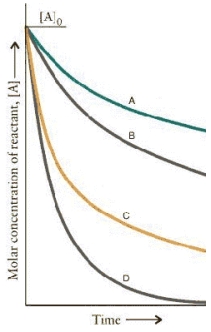
Which set of reactions has the largest rate constant?
Correct Answer:

Verified
Correct Answer:
Verified
Q41: The reaction<br>3C + D <span
Q42: Given:<br>5Br<sup>-</sup>(aq)+ BrO<sub>3</sub><sup>-</sup>(aq)+ 6H<sup>+</sup>(aq) <span class="ql-formula" data-value="\rightarrow"><span
Q43: The reaction [(CN)<sub>5</sub>CoOH<sub>2</sub>]<sup>2</sup><sup>-</sup>(aq)+ SCN<sup>-</sup>(aq) <span class="ql-formula"
Q44: For the reaction<br>HO(g)+ H<sub>2</sub>(g) <span class="ql-formula"
Q45: The fraction of molecules that collide with
Q47: The rates of first-order and second-order reactions
Q48: The rate law for the following
Q49: What is the half-life of a second
Q50: The reaction between nitrogen dioxide and
Q51: All of the following statements with respect