



 Chat with AI
Exam 14: Capital Investment Decisions

Exam 1: Introduction to Managerial Accounting64 Questions
Exam 2: Basic Managerial Accounting Concepts247 Questions
Exam 3: Cost Behavior237 Questions
Exam 4: Cost-Volume-Profit Analysis: a Managerial Planning Tool179 Questions
Exam 5: Job-Order Costing196 Questions
Exam 6: Process Costing177 Questions
Exam 7: Activity-Based Costing and Management178 Questions
Exam 8: Absorption and Variable Costing, and Inventory Management124 Questions
Exam 9: Profit Planning186 Questions
Exam 10: Standard Costing: a Managerial Control Tool180 Questions
Exam 11: Flexible Budgets and Overhead Analysis172 Questions
Exam 12: Performance Evaluation and Decentralization166 Questions
Exam 13: Short-Run Decision Making: Relevant Costing170 Questions
Exam 14: Capital Investment Decisions172 Questions
Exam 15: Statement of Cash Flows185 Questions
Exam 16: Financial Statement Analysis191 Questions
Select questions type


A postaudit is an analysis of a capital project before it is implemented.
(True/False)
4.9/5  (86)
(86) Figure 14-3.Davis Company is considering the purchase of a new piece of equipment that will cost $1,600,000 and have a life of five years with no expected salvage value. The expected cash flows associated with the project are as follows:
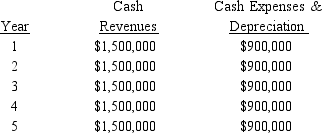 -Refer to Figure 14-3. What is the average annual income for this project?
 (Multiple Choice)
4.8/5 (78)
(78) Oakland Shop is considering the purchase of a used printing press costing $9,600. The printing press would generate a net cash inflow of $4,000 per year for three years. At the end of three years, the press would have no salvage value. The company's cost of capital is 10%. The company uses straight-line depreciation with no mid-year convention. What is the accounting rate of return on the original investment in the press to the nearest percent, assuming no taxes are paid?
(Multiple Choice)
4.8/5 (79)
(79) Figure 14-9.Kenner Company is considering two projects. 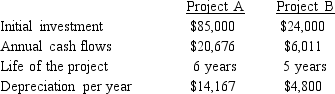 Present value of an Annuity of $1 in Arrears
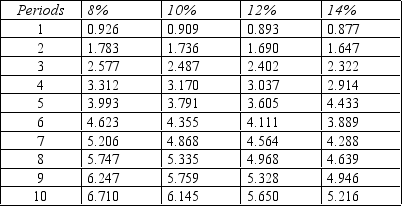 -Refer to Figure 14-9. Which of the two projects, A or B, is better in terms of internal rate of return?
Present value of an Annuity of $1 in Arrears
-Refer to Figure 14-9. Which of the two projects, A or B, is better in terms of internal rate of return? (Multiple Choice)
4.8/5 (77)
(77) If cash flows are uneven, the payback period assumes that the inflows during the last fraction of a year occur evenly.
(True/False)
4.9/5 (94)
(94) The payback period provides information to managers that can be used to help
(Multiple Choice)
4.9/5 (70)
(70) Match each item with the correct statement below.
-assumes that all future cash inflows earn the minimum rate of return
(Multiple Choice)
4.8/5 (80)
(80) Which of the following is true regarding the internal rate of return for a project?
(Multiple Choice)
4.8/5 (84)
(84) Figure 14-10.Present value of $1
 Present value of an Annuity of $1
 -Refer to Figure 14-10. A company is considering two modifications to its current manufacturing process. The after-tax cash flows associated with the two investments are:
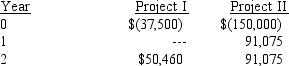 The company's cost of capital is 12%.

Present value of an Annuity of $1
-Refer to Figure 14-10. A company is considering two modifications to its current manufacturing process. The after-tax cash flows associated with the two investments are:
The company's cost of capital is 12%.
(Essay)
4.9/5 (76)
(76) A firm is considering a project requiring an investment of $27,000. The project would generate an annual cash flow of $6,296 for the next seven years. The company uses the straight-line method of depreciation. The approximate internal rate of return for the project is
(Multiple Choice)
4.8/5 (77)
(77) Neil Morrison has just invested $130,000 in a restaurant. He expects to receive income of $24,000 a year, and to have the investment for 8 years. What is the accounting rate of return?
(Multiple Choice)
4.8/5 (65)
(65) The ___________________ is the minimum acceptable rate of return.
(Short Answer)
5.0/5 (78)
(78) 
Filters
- Essay(0)
- Multiple Choice(0)
- Short Answer(0)
- True False(0)
- Matching(0)