



 Chat with AI
Exam 10: Standard Costing: a Managerial Control Tool

Exam 1: Introduction to Managerial Accounting64 Questions
Exam 2: Basic Managerial Accounting Concepts247 Questions
Exam 3: Cost Behavior237 Questions
Exam 4: Cost-Volume-Profit Analysis: a Managerial Planning Tool179 Questions
Exam 5: Job-Order Costing196 Questions
Exam 6: Process Costing177 Questions
Exam 7: Activity-Based Costing and Management178 Questions
Exam 8: Absorption and Variable Costing, and Inventory Management124 Questions
Exam 9: Profit Planning186 Questions
Exam 10: Standard Costing: a Managerial Control Tool180 Questions
Exam 11: Flexible Budgets and Overhead Analysis172 Questions
Exam 12: Performance Evaluation and Decentralization166 Questions
Exam 13: Short-Run Decision Making: Relevant Costing170 Questions
Exam 14: Capital Investment Decisions172 Questions
Exam 15: Statement of Cash Flows185 Questions
Exam 16: Financial Statement Analysis191 Questions
Select questions type


The production data needed to calculate the standard unit cost as well as the underlying details for the standard cost per unit are provided in

Free
(Multiple Choice)
4.7/5  (84)
(84) Correct Answer: Verified
A
During August, 10,000 units were produced. The standard quantity of material allowed per unit was 10 pounds at a standard cost of $3 per pound. If there was an unfavorable usage variance of $18,750 for August, the actual quantity of materials used must be
Free
(Multiple Choice)
4.8/5 (90)
(90) Correct Answer:Verified
VerifiedA
The ____________________ is the difference between the actual cost of the input and its planned cost.
Free
(Short Answer)
4.7/5 (74)
(74) Correct Answer:Verified
Verifiedtotal budget variance
Figure 10-2Highland Company's standard cost is $250,000. The allowable deviation is 10%. Its actual costs for six months are
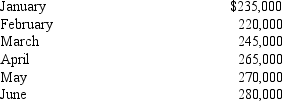 -Refer to Figure 10-2. The variance that is higher than the upper control limit is
 (Multiple Choice)
4.8/5 (65)
(65) ________________ demands maximum efficiency and can be achieved only if everything operates perfectly.
(Short Answer)
4.8/5 (80)
(80) Managers develop quantity standards when they decide what amount of input should be used per unit of output.
(True/False)
4.8/5 (90)
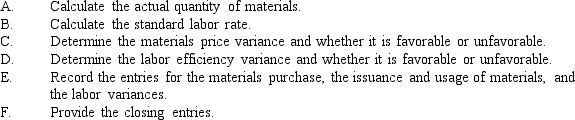
(90) During April, Rain Gear Unlimited produced 5,500 umbrellas from nylon that costs $0.45 per yard, which is $0.05 cheaper than the standard cost. It also used 3,000 direct labor hours at a rate of $6.50. Its direct materials standard is 1 yard per umbrella. Its direct labor standard is 0.5 hour per umbrella.
Its materials usage variance was a favorable $500 and its labor rate variance was a favorable $900.
(Essay)
4.8/5 (76)
(76) Figure 10-3Bortello Corporation produces high-quality leather boots. The company has a standard cost system and has set the following standards for materials and labor:
 During the year Bortello produced 125 boots. Actual leather purchased was 1,700 strips, at $16 per strip. There were no beginning or ending inventories of leather. Actual direct labor was 1,500 hours at $15 per hour.
-Refer to Figure 10-3. Compute the materials price variance and the materials usage variance, respectively.
During the year Bortello produced 125 boots. Actual leather purchased was 1,700 strips, at $16 per strip. There were no beginning or ending inventories of leather. Actual direct labor was 1,500 hours at $15 per hour.
-Refer to Figure 10-3. Compute the materials price variance and the materials usage variance, respectively. (Multiple Choice)
4.9/5 (84)
(84) Anderson Company has the following information concerning its direct labor:
 A. Determine the labor rate variance and whether it is favorable or unfavorable.
B. Determine the labor efficiency variance and whether it is favorable or unfavorable.
C. Provide the journal entry for the labor variances.
A. Determine the labor rate variance and whether it is favorable or unfavorable.
B. Determine the labor efficiency variance and whether it is favorable or unfavorable.
C. Provide the journal entry for the labor variances. (Essay)
4.9/5 (84)
(84) The ___________________ measures the difference between the labor hours that were actually used and the labor hours that should have been used.
(Short Answer)
4.7/5 (79)
(79) In setting standards, historical experience should be used with caution because it can perpetuate operating inefficiencies.
(True/False)
4.9/5 (89)
(89) The total budget variance is the difference between the actual cost of the input and its planned cost.
(True/False)
4.8/5 (76)
(76)  It took James 1,400,000 yards at $2.50 per yard to make the 250,000 t-shirts.
-Refer to Figure 10-9. What is the entry to record the purchase of materials?
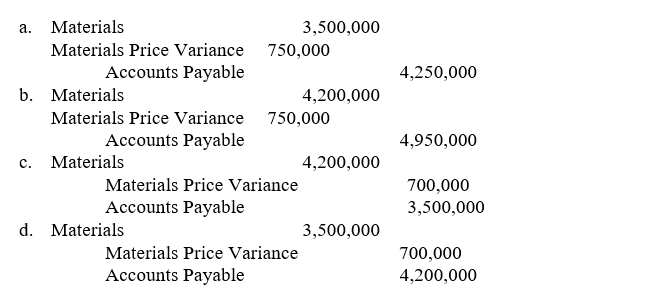
It took James 1,400,000 yards at $2.50 per yard to make the 250,000 t-shirts.
-Refer to Figure 10-9. What is the entry to record the purchase of materials?
(Short Answer)
4.9/5 (76)
(76) During June, Cisco Company produced 12,000 chainsaw blades. The standard quantity of material allowed per unit was 1.5 pounds of steel per blade at a standard cost of $8 per pound. Cisco determined that it had a favorable materials usage variance of $1,000 for June. Calculate the actual quantity of materials Cisco used.
(Multiple Choice)
4.9/5 (77)
(77) The ____________________ measures the difference between the actual costs of materials and their budgeted costs for actual level of activity.
(Short Answer)
4.9/5 (73)
(73) The standard unit cost is developed before the standard costs for direct materials, direct labor, and overhead can be set.
(True/False)
4.8/5 (76)
(76) 
Filters
- Essay(0)
- Multiple Choice(0)
- Short Answer(0)
- True False(0)
- Matching(0)