



 Chat with AI
Exam 14: Capital Investment Decisions

Exam 1: Introduction to Managerial Accounting64 Questions
Exam 2: Basic Managerial Accounting Concepts247 Questions
Exam 3: Cost Behavior237 Questions
Exam 4: Cost-Volume-Profit Analysis: a Managerial Planning Tool179 Questions
Exam 5: Job-Order Costing196 Questions
Exam 6: Process Costing177 Questions
Exam 7: Activity-Based Costing and Management178 Questions
Exam 8: Absorption and Variable Costing, and Inventory Management124 Questions
Exam 9: Profit Planning186 Questions
Exam 10: Standard Costing: a Managerial Control Tool180 Questions
Exam 11: Flexible Budgets and Overhead Analysis172 Questions
Exam 12: Performance Evaluation and Decentralization166 Questions
Exam 13: Short-Run Decision Making: Relevant Costing170 Questions
Exam 14: Capital Investment Decisions172 Questions
Exam 15: Statement of Cash Flows185 Questions
Exam 16: Financial Statement Analysis191 Questions
Select questions type


Match each item with the correct statement below.
-assumes that all future cash inflows earn the same rate of return as the project itself
(Multiple Choice)
4.9/5  (72)
(72) Which of the following is a drawback of the payback period?
(Multiple Choice)
4.9/5 (66)
(66) Figure 14-11.Present value of an Annuity of $1 in Arrears
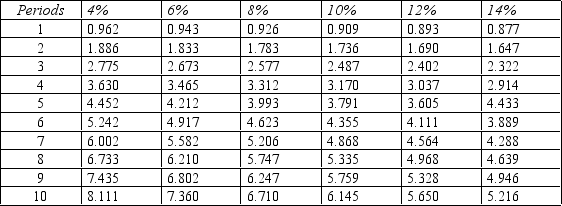 -Refer to Figure 14-11. Lyster Company wants to buy a new machine that will be able to perform many of the steps in the manufacturing process that they currently have to do manually. The hope is that it will reduce the amount of time it takes to create one unit and reduce the number of defective units. The machine requires an investment of $750,000. The machine will last six years with no expected salvage value. The expected after-tax cash flows associated with the project are as follows:
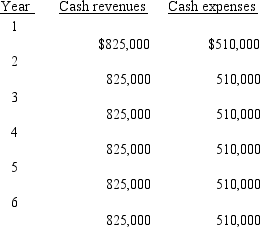

-Refer to Figure 14-11. Lyster Company wants to buy a new machine that will be able to perform many of the steps in the manufacturing process that they currently have to do manually. The hope is that it will reduce the amount of time it takes to create one unit and reduce the number of defective units. The machine requires an investment of $750,000. The machine will last six years with no expected salvage value. The expected after-tax cash flows associated with the project are as follows:
(Essay)
5.0/5 (89)
(89) Which of the following is true regarding the measurement and use of indirect and intangible benefits in capital investment decision making?
(Multiple Choice)
4.8/5 (85)
(85) A division manager is considering a project that requires a significant initial investment. The company's top management will not approve any project that does not return at least 12%. The manager will most likely use which of the following capital investment models?
(Multiple Choice)
5.0/5 (72)
(72) Barker Production Company is considering the purchase of a flexible manufacturing system. The annual cash benefits/savings associated with the system are:
 The system will cost $750,000 and will last ten years. The company's cost of capital is 10%.
Required:

The system will cost $750,000 and will last ten years. The company's cost of capital is 10%.
Required:
(Essay)
4.9/5 (78)
(78) Figure 14-2.A company is considering two projects. 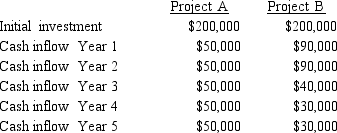 -Refer to Figure 14-2. What is the payback period for Project B?
 (Multiple Choice)
4.8/5 (70)
(70) Jerry Hall invested in a project that required an initial amount of $52,160, and returned cash inflows of $10,000 per year for 10 years. A partial table of the present value of an annuity of $1 in arrears is as follows:  What is the internal rate of return for this investment?
 (Multiple Choice)
4.9/5 (88)
(88) A firm is considering a project with an annual cash flow of $80,000. The project would have a 10-year life, and the company uses a discount rate of 8%. What is the maximum amount the company could invest in the project and have the project still be acceptable (rounded)?
(Multiple Choice)
4.9/5 (86)
(86) Because of the postaudit, managers are more likely to make capital investment decisions in the best interests of the firm.
(True/False)
4.8/5 (92)
(92) A division manager was considering a project that required a significant initial investment. If accepted, the project could have a negative impact on certain financial ratios that the firm was required to maintain to satisfy debt contracts. To ensure that the ratios would not be adversely affected by the investment, the manager would use which of the following capital investment models?
(Multiple Choice)
4.9/5 (74)
(74) A key element in the capital investment process is called a postaudit.
(True/False)
4.8/5 (85)
(85) The difference between the present value of the cash inflows and outflows associated with a project is the internal rate of return model.
(True/False)
4.9/5 (79)
(79) Which model is better for independent projects - net present value or internal rate of return? For mutually exclusive projects? Explain your reasoning for each case.
(Essay)
4.9/5 (84)
(84) The payback period considers the profitability of a project over its entire life span.
(True/False)
4.7/5 (84)
(84) Figure 14-10.Present value of $1
 Present value of an Annuity of $1
 -Refer to Figure 14-10. Ray Corporation is looking to invest in a new piece of equipment. Two manufacturers of this type of equipment are being considered. After-tax inflows for the two competing projects are:
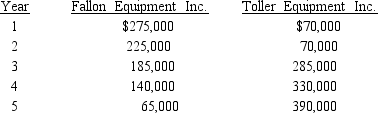 Both projects require an initial investment of $400,000. In both cases, assume that the equipment has a life of 5 years with no salvage value.
Required:
A. Assuming a discount rate of 8%, compute the net present value of each piece of equipment.
B. A third option is now available for a supplier outside of the country. The cost is also $400,000, but it will produce even cash flows over its 5-year life. What must the annual cash flow be for this equipment to be selected over the other two? Assume an 8% discount rate.
Present value of an Annuity of $1
-Refer to Figure 14-10. Ray Corporation is looking to invest in a new piece of equipment. Two manufacturers of this type of equipment are being considered. After-tax inflows for the two competing projects are:
Both projects require an initial investment of $400,000. In both cases, assume that the equipment has a life of 5 years with no salvage value.
Required:
A. Assuming a discount rate of 8%, compute the net present value of each piece of equipment.
B. A third option is now available for a supplier outside of the country. The cost is also $400,000, but it will produce even cash flows over its 5-year life. What must the annual cash flow be for this equipment to be selected over the other two? Assume an 8% discount rate. (Essay)
4.9/5 (80)
(80) When comparing the payback method and the accounting rate of return methods, which of the following is true? 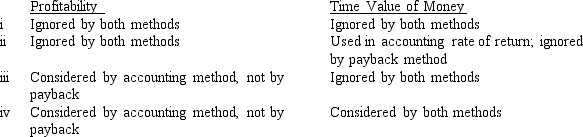
(Multiple Choice)
4.9/5 (73)
(73) 
Filters
- Essay(0)
- Multiple Choice(0)
- Short Answer(0)
- True False(0)
- Matching(0)