



 Chat with AI
Exam 6: Closing Entries and Teh Postclosing Trial Balance

Exam 1: Accounting: The Language of Business84 Questions
Exam 2: Analyzing Business Transactions100 Questions
Exam 3: Analyzing Business Transactions Using T Accounts116 Questions
Exam 4: The General Journal and the General Ledger98 Questions
Exam 5: Adjustments and the Worksheet97 Questions
Exam 6: Closing Entries and Teh Postclosing Trial Balance97 Questions
Exam 7: Accounting for Sales and Accounts Receivable99 Questions
Exam 8: Accounting for Purchases and Accounts Payable111 Questions
Exam 9: Cash Receipts, Cash Payments, and Banking Procedures92 Questions
Exam 10: Payroll Computations, Records, and Payment89 Questions
Exam 11: Payroll Taxes, Deposits, and Reports88 Questions
Exam 12: Accruals, Deferrals, and the Worksheet94 Questions
Exam 13: Financial Statements and Closing Procedures92 Questions
Exam 14: Accounting Principles and Reporting Standards95 Questions
Exam 15: Accounts Receivable and Uncollectible Accounts93 Questions
Exam 16: Notes Payable and Notes Receivable101 Questions
Exam 17: Merchandise Inventory114 Questions
Exam 18: Property, Plant, and Equipment123 Questions
Exam 19: Accounting for Partnerships118 Questions
Exam 20: Corporations: Formation and Capital Stock Transactions104 Questions
Exam 21: Corporate Earnings and Capital Transactions118 Questions
Exam 22: Long-Term Bonds114 Questions
Exam 23: Financial Statement Analysis131 Questions
Exam 24: The Statement of Cash Flows154 Questions
Exam 25: Departmentalized Profit and Cost Centers121 Questions
Exam 26: Accounting for Manufacturing Activities114 Questions
Exam 27: Job Order Cost Accounting111 Questions
Exam 28: Process Cost Accounting99 Questions
Exam 29: Controlling Manufacturing Costs: Standard Costs126 Questions
Exam 30: Cost-Revenue Analysis for Decision Making126 Questions
Select questions type


Use the following account balances from the adjusted trial balance of Gees Catering:
 Select the correct closing entry that Gees Catering would make to close the owner's withdrawal account at the end of the accounting period.
 (Multiple Choice)
4.8/5  (78)
(78) Managers often consult financial statements for specific types of information. Indicate whether each of the following items would appear on the income statement, statement of owner's equity, or the balance sheet. Note that an item may appear on more than one statement. The first item is completed as an example.
Income Statement Statement of Owner's Equity Balance Sheet Accounts Payable Accounts Receivable Accumulated Depreciation - Equipment Cash Depreciation Expense - Equipment
Equipment Fees Income N. Dalton, Capital, beginning of period N. Dalton, Capital, end of period N. Dalton, Drawing Rent Expense Salaries Expense Supplies Supplies Expense Total assets of the business Total expenses for the period Total liabilities of the business Total revenues for the period
(Essay)
4.9/5 (81)
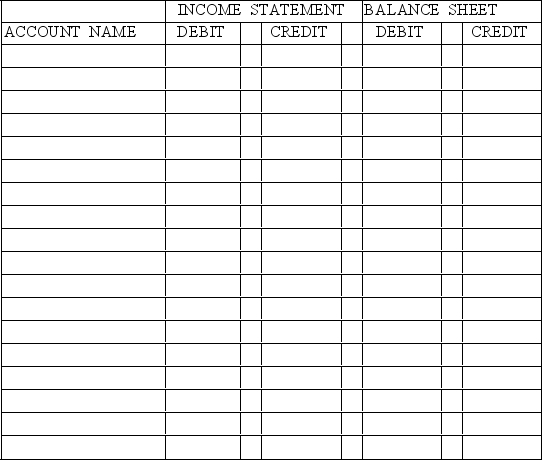
(81) The adjusted ledger accounts of RD Consulting on December 31, 2019, appear as follows. All accounts have normal balances and adjusting entries have been made. Extend the balances to the Balance Sheet and Income Statement columns of the worksheet. Then, journalize the closing entries on page 4 of a general journal. 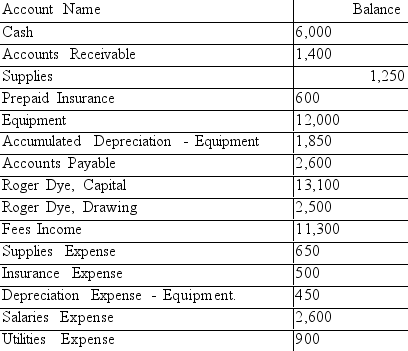
(Essay)
4.8/5 (85)
(85) The entry to close the revenue account, Fees Income, requires a debit to that account.
(True/False)
4.9/5 (74)
(74) The partial worksheet for the Jamison Company showed the following data on October 31, 2019. Record the closing entries on page 6 of a general journal.


(Essay)
4.8/5 (74)
(74) When done properly, how many journal entries are involved in the closing process?
(Multiple Choice)
4.9/5 (79)
(79) The entry to close the owner's drawing account would include a debit to the:
(Multiple Choice)
4.9/5 (84)
(84) Information in the financial statements provides answers to many questions, including:
(Multiple Choice)
4.9/5 (83)
(83) Which of the following accounts has a normal debit balance?
(Multiple Choice)
4.8/5 (73)
(73) Which of the following accounts has a normal credit balance?
(Multiple Choice)
4.8/5 (88)
(88) The final closing entry transfers the balance of the ________ account to the owner's capital account.
(Short Answer)
4.8/5 (74)
(74) Match the accounting terms with the description by entering the proper letter in the space provided.
A. Closing entries
B. Income Summary account
C. Interpret
D. Post-closing trial balance
________ 1. To understand and explain the meaning and importance of something (such as financial statements)
________ 2. Journal entries that transfer the results of operations (net income or net loss)to owner's equity and reduce the revenue, expense, and drawing account balances to zero
3. A statement that is prepared to prove the equality of total debits and credits after the closing process is completed
________ 4. A special owner's equity account that is used only in the closing process to summarize the results of operations
(Short Answer)
4.8/5 (87)
(87) The postclosing trial balance contains balance sheet accounts only.
(True/False)
4.8/5 (70)
(70) The asset, liability, and owner's capital accounts appear on all of the following except the:
(Multiple Choice)
4.7/5 (78)
(78) After all the closing entries are posted to the ledger, the Income Summary account will have a________ balance.
(Short Answer)
4.7/5 (82)
(82) The ________ entries transfer the results of operations to owner's equity.
(Short Answer)
4.9/5 (82)
(82) Withdrawals by the owner for personal use do not affect net income or net loss of the business.
(True/False)
5.0/5 (73)
(73) If the Income Summary account has a debit balance before it is closed, the firm experienced a net________ from operations.
(Short Answer)
4.8/5 (93)
(93) The first two closing entries to the Income Summary account indicate a debit of $47,000 and a credit of $41,000. The third closing entry would be:
(Multiple Choice)
4.7/5 (68)
(68) All of the following accounts will appear on the post-closing trial balance except:
(Multiple Choice)
4.8/5 (71)
(71) 
Filters
- Essay(0)
- Multiple Choice(0)
- Short Answer(0)
- True False(0)
- Matching(0)