



 Chat with AI
Exam 23: Financial Statement Analysis

Exam 1: Accounting: The Language of Business84 Questions
Exam 2: Analyzing Business Transactions100 Questions
Exam 3: Analyzing Business Transactions Using T Accounts116 Questions
Exam 4: The General Journal and the General Ledger98 Questions
Exam 5: Adjustments and the Worksheet97 Questions
Exam 6: Closing Entries and Teh Postclosing Trial Balance97 Questions
Exam 7: Accounting for Sales and Accounts Receivable99 Questions
Exam 8: Accounting for Purchases and Accounts Payable111 Questions
Exam 9: Cash Receipts, Cash Payments, and Banking Procedures92 Questions
Exam 10: Payroll Computations, Records, and Payment89 Questions
Exam 11: Payroll Taxes, Deposits, and Reports88 Questions
Exam 12: Accruals, Deferrals, and the Worksheet94 Questions
Exam 13: Financial Statements and Closing Procedures92 Questions
Exam 14: Accounting Principles and Reporting Standards95 Questions
Exam 15: Accounts Receivable and Uncollectible Accounts93 Questions
Exam 16: Notes Payable and Notes Receivable101 Questions
Exam 17: Merchandise Inventory114 Questions
Exam 18: Property, Plant, and Equipment123 Questions
Exam 19: Accounting for Partnerships118 Questions
Exam 20: Corporations: Formation and Capital Stock Transactions104 Questions
Exam 21: Corporate Earnings and Capital Transactions118 Questions
Exam 22: Long-Term Bonds114 Questions
Exam 23: Financial Statement Analysis131 Questions
Exam 24: The Statement of Cash Flows154 Questions
Exam 25: Departmentalized Profit and Cost Centers121 Questions
Exam 26: Accounting for Manufacturing Activities114 Questions
Exam 27: Job Order Cost Accounting111 Questions
Exam 28: Process Cost Accounting99 Questions
Exam 29: Controlling Manufacturing Costs: Standard Costs126 Questions
Exam 30: Cost-Revenue Analysis for Decision Making126 Questions
Select questions type


What is the PE ratio? How is it calculated and why is it that the PE ratio for a privately held company often cannot be calculated?

Free
(Essay)
4.9/5  (84)
(84) Correct Answer: Verified
The PE ratio is the price-earnings ratio. It compares the market value of common stock with the earnings per share of that stock. The market value per share is divided by the earnings per share and indicates the amount investors are willing to pay for stock based on future expectations for it. In order to calculate the PE ratio, a market value for the shares must be readily available. For privately-held corporations, a market value is often not available.
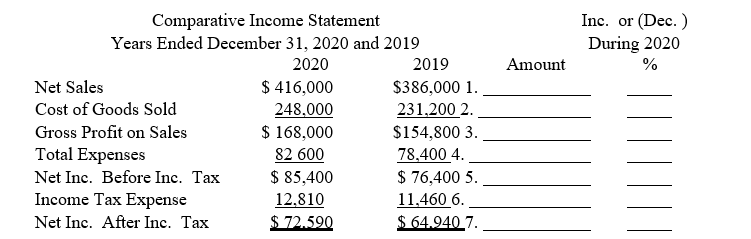
Using the comparative income statement given below, prepare a horizontal analysis of all items. Carry all calculations to two decimal places and then round to one decimal place.
Free
(Short Answer)
4.8/5 (85)
(85) Correct Answer:Verified
Verified1. $30,000; 7.8%; 2. $16,800; 7.3%; 3. $13,200; 8.5%; 4. $4,200; 5.4%; 5. $9,000;11.8%; 6. $1,350; 11.8%; 7. $7,650; 11.8%
If long-term liabilities are $62,000 and total assets are $480,000, what percentage of total assets are long-term liabilities?
Free
(Multiple Choice)
4.8/5 (78)
(78) Correct Answer:Verified
VerifiedC
A firm has current liabilities of $60,000, stockholders' equity of $180,000 and total assets of $300,000. The percentage of total liabilities to total assets is:
(Multiple Choice)
4.9/5 (85)
(85) The current ratio is a measure of the ability of a company to pay its currently maturing debts, which is also known as------------- .
(Short Answer)
4.8/5 (78)
(78) The following financial information was taken from a firm's accounting records on December 31, 2019. Use this information to determine the items below.
Cash \ 55,000 Accounts Receivable (Net) 140,000 Merchandise Inventory 265,000 Property, Plant, and Equipment (Net) 500,000 Total Assets 960,000 Accounts Payable 120,000 Bonds Payable, 2028 400,000 Total Liabilities 520,000
(1.) Working capital
(2.) Current ratio
(3.) Acid-test ratio
(4.) Ratio of stockholders' equity to total liabilities
(Short Answer)
4.9/5 (82)
(82) Ratios provide useful, stand-alone tools to assess management performance and improvement efforts.
(True/False)
4.7/5 (77)
(77) Current assets divided by current liabilities is the---------- .
(Short Answer)
4.9/5 (84)
(84) The excess of current assets minus current liabilities is known as----------- .
(Short Answer)
4.9/5 (81)
(81) Cost of goods sold divided by average inventory equals the----------- .
(Short Answer)
4.8/5 (79)
(79) Because the number of shares of common stock outstanding during the year can fluctuate, computing return on common stockholders' equity is not a useful indicator of profitability.
(True/False)
4.9/5 (86)
(86) Liquidity is the ability of a company to pay its debts when due.
(True/False)
4.9/5 (88)
(88) The price-earnings ratio compares the present market value of a corporation's common stock with the earnings per share of that stock.
(True/False)
4.8/5 (85)
(85) In a vertical analysis of the income statement data, the cost of goods sold most likely would be expressed as a percentage of:
(Multiple Choice)
5.0/5 (81)
(81) In 2019, net sales were $672,000 and cost of goods sold was $450,000. In 2018, net sales amounted to $600,000 and cost of goods sold was $400,000. In a comparative income statement, using vertical analysis, the 12% increase in net sales will be presented in the percentage column.
(True/False)
4.8/5 (84)
(84) Where the current ratio measures a company's ability to pay its current debts using current assets on a dollar for dollar basis, working capital provides a similar measure by providing the actual margin of security afforded to short-term creditors.
(True/False)
4.9/5 (62)
(62) The following financial information was taken from a firm's accounting records on December 31, 2019. Use this information to determine the items below.
Cash \ 56,000 Accounts Receivable (Net) 191,000 Merchandise Inventory 362,000 Property, Plant, and Equipment (Net) 454,000 Accounts Payable 139,000 Bonds Payable, 2028 160,000
(1.) Working capital
(2.) Current ratio
(3.) Acid-test ratio
(Short Answer)
4.9/5 (79)
(79) All of the following are shortcomings of financial statement analyses except:
(Multiple Choice)
5.0/5 (73)
(73) In horizontal analysis, the earlier period is called the ----------period.
(Short Answer)
4.9/5 (85)
(85) 
Filters
- Essay(0)
- Multiple Choice(0)
- Short Answer(0)
- True False(0)
- Matching(0)