



 Chat with AI
Exam 29: Controlling Manufacturing Costs: Standard Costs

Exam 1: Accounting: The Language of Business84 Questions
Exam 2: Analyzing Business Transactions100 Questions
Exam 3: Analyzing Business Transactions Using T Accounts116 Questions
Exam 4: The General Journal and the General Ledger98 Questions
Exam 5: Adjustments and the Worksheet97 Questions
Exam 6: Closing Entries and Teh Postclosing Trial Balance97 Questions
Exam 7: Accounting for Sales and Accounts Receivable99 Questions
Exam 8: Accounting for Purchases and Accounts Payable111 Questions
Exam 9: Cash Receipts, Cash Payments, and Banking Procedures92 Questions
Exam 10: Payroll Computations, Records, and Payment89 Questions
Exam 11: Payroll Taxes, Deposits, and Reports88 Questions
Exam 12: Accruals, Deferrals, and the Worksheet94 Questions
Exam 13: Financial Statements and Closing Procedures92 Questions
Exam 14: Accounting Principles and Reporting Standards95 Questions
Exam 15: Accounts Receivable and Uncollectible Accounts93 Questions
Exam 16: Notes Payable and Notes Receivable101 Questions
Exam 17: Merchandise Inventory114 Questions
Exam 18: Property, Plant, and Equipment123 Questions
Exam 19: Accounting for Partnerships118 Questions
Exam 20: Corporations: Formation and Capital Stock Transactions104 Questions
Exam 21: Corporate Earnings and Capital Transactions118 Questions
Exam 22: Long-Term Bonds114 Questions
Exam 23: Financial Statement Analysis131 Questions
Exam 24: The Statement of Cash Flows154 Questions
Exam 25: Departmentalized Profit and Cost Centers121 Questions
Exam 26: Accounting for Manufacturing Activities114 Questions
Exam 27: Job Order Cost Accounting111 Questions
Exam 28: Process Cost Accounting99 Questions
Exam 29: Controlling Manufacturing Costs: Standard Costs126 Questions
Exam 30: Cost-Revenue Analysis for Decision Making126 Questions
Select questions type


The Costmore Company uses standard costing and has established the following standards for direc materials and direct labor for each unit it makes:
Direct Materials 3 gallons at \ 5 per gallon Direct Labor 1 hour at \ 12 per hour
During July, the company made 4,000 units of product and used 13,000 gallons. The actual price paid for materials was $5.20 per gallon.
Direct Labor used was 3,600 hours and workers were paid $11.75 per hour. An analysis would indicate

Free
(Multiple Choice)
4.8/5  (67)
(67) Correct Answer: Verified
C
SweetBerry Ice-creams uses a standard cost system. The following data is available for June:
Actual output \ 6,000 gallons Standard material cost \ 8 gallon Standard quantity allowed per gallon \ 1 gallon Material price variance \ 630 Unfavorable Material usage variance \ 2,400 Unfavorable
The actual material cost for June was:
Free
(Multiple Choice)
4.8/5 (80)
(80) Correct Answer:Verified
VerifiedD
A budget prepared using several differing levels of activity is a
Free
(Multiple Choice)
4.9/5 (85)
(85) Correct Answer:Verified
VerifiedC
As the level of activity increases, the variable cost per unit of activity
(Multiple Choice)
4.7/5 (64)
(64) If the actual cost of an item is lower than the standard cost, a(n)-----------price variance will be recognized.
(Short Answer)
4.8/5 (87)
(87) A budget that shows expected costs at only one level of production activity is called a(n)-----------budget.
(Short Answer)
5.0/5 (73)
(73) Kenwood Company's manufacturing overhead costs for the assembly department are given below.
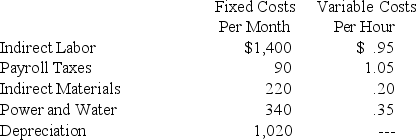 Taxes and Insurance 450 -- Repairs 175 .15
Using the information provided, prepare a departmental monthly overhead performance report comparing actual costs with the budget allowance for the number of hours worked. Assume that during the month of May actual production was 1,900 hours. Actual costs for the month were as follows:
Taxes and Insurance 450 -- Repairs 175 .15
Using the information provided, prepare a departmental monthly overhead performance report comparing actual costs with the budget allowance for the number of hours worked. Assume that during the month of May actual production was 1,900 hours. Actual costs for the month were as follows: (Essay)
4.8/5 (83)
(83) Material budgets are calculated by multiplying units to be produced by the expected unit cost of direct materials.
(True/False)
4.9/5 (79)
(79) Two variances associated with analyzing manufacturing overhead costs are the production volume variance and the flexible budget variance.
(True/False)
4.9/5 (68)
(68) A simple method used to analyze the fixed and variable components in semi-variable costs is called the---------- point method.
(Short Answer)
5.0/5 (92)
(92) In order to analyze the differences between actual costs and standard costs, it is necessary to identify the fixed and variable components of semi-variable costs.
(True/False)
4.9/5 (71)
(71) If a price variance for materials is unfavorable, the quantity variance for materials also must be unfavorable.
(True/False)
4.8/5 (91)
(91) As the volume of output increases, the------- cost per unit of output decreases.
(Short Answer)
4.7/5 (82)
(82) Usually, a well-run manufacturing company prepares only annual manufacturing cost budgets.
(True/False)
4.8/5 (72)
(72) Direct materials and direct labor are examples of costs that tend to vary directly with the volume of output.
(True/False)
4.9/5 (87)
(87) The Hoatzin Birdhouse Factory produced the following standard cost card. In July, the company had an order for 500 birdhouses (Model: Wren) for Job No. CB32. Manufacturing overhead is based on direct labor hours. The manufacturing overhead cost estimates for the year total $32,400 and total direct labor hours are estimated at 9,000 for the year. Complete the Standard Cost Card an Job Order Cost Sheet. Calculate the total cost variance.
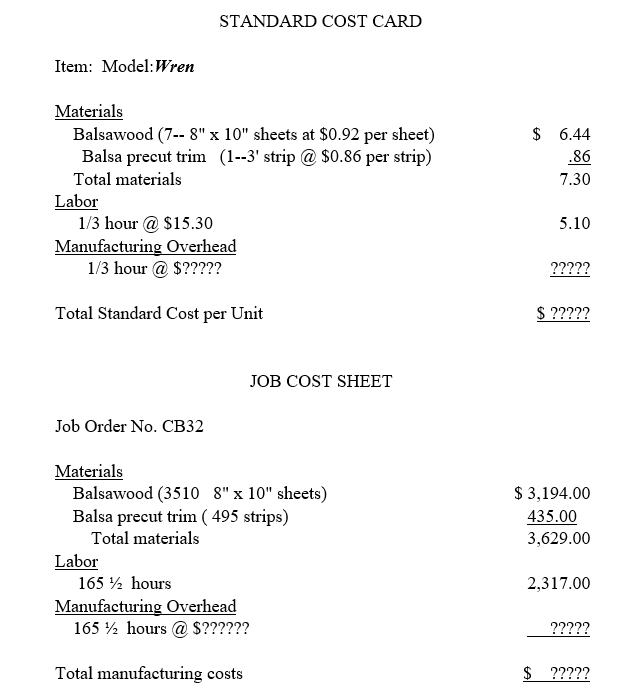
(Essay)
4.8/5 (77)
(77) Reelmates manufactures fishing poles. In a recent month, the company budgeted production of 2,000 poles. Actual production was 2,200. According to the standard cost card, each pole requires 3 feet of fiberglass rod at a cost of $9 per foot. Reelmates used 6,500 feet of rod at a net cost of $65,000 for the period.
-
The total material variance was:
(Multiple Choice)
4.9/5 (88)
(88) Complete the flexible budget for Cullville Industries for April 2019. Overhead is based on direct labor hours.
Cullville Industries Budget of
Manufacturing Costs
Month of April 2019
Activity Level Number of direct labor hours 2,500 5,000 7,500 Percent of expected activity (1) 100 150
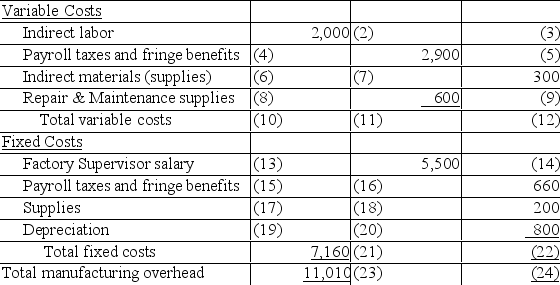
(Essay)
4.9/5 (70)
(70) 
Filters
- Essay(0)
- Multiple Choice(0)
- Short Answer(0)
- True False(0)
- Matching(0)