



 Chat with AI
Exam 29: Controlling Manufacturing Costs: Standard Costs

Exam 1: Accounting: The Language of Business84 Questions
Exam 2: Analyzing Business Transactions100 Questions
Exam 3: Analyzing Business Transactions Using T Accounts116 Questions
Exam 4: The General Journal and the General Ledger98 Questions
Exam 5: Adjustments and the Worksheet97 Questions
Exam 6: Closing Entries and Teh Postclosing Trial Balance97 Questions
Exam 7: Accounting for Sales and Accounts Receivable99 Questions
Exam 8: Accounting for Purchases and Accounts Payable111 Questions
Exam 9: Cash Receipts, Cash Payments, and Banking Procedures92 Questions
Exam 10: Payroll Computations, Records, and Payment89 Questions
Exam 11: Payroll Taxes, Deposits, and Reports88 Questions
Exam 12: Accruals, Deferrals, and the Worksheet94 Questions
Exam 13: Financial Statements and Closing Procedures92 Questions
Exam 14: Accounting Principles and Reporting Standards95 Questions
Exam 15: Accounts Receivable and Uncollectible Accounts93 Questions
Exam 16: Notes Payable and Notes Receivable101 Questions
Exam 17: Merchandise Inventory114 Questions
Exam 18: Property, Plant, and Equipment123 Questions
Exam 19: Accounting for Partnerships118 Questions
Exam 20: Corporations: Formation and Capital Stock Transactions104 Questions
Exam 21: Corporate Earnings and Capital Transactions118 Questions
Exam 22: Long-Term Bonds114 Questions
Exam 23: Financial Statement Analysis131 Questions
Exam 24: The Statement of Cash Flows154 Questions
Exam 25: Departmentalized Profit and Cost Centers121 Questions
Exam 26: Accounting for Manufacturing Activities114 Questions
Exam 27: Job Order Cost Accounting111 Questions
Exam 28: Process Cost Accounting99 Questions
Exam 29: Controlling Manufacturing Costs: Standard Costs126 Questions
Exam 30: Cost-Revenue Analysis for Decision Making126 Questions
Select questions type


Efficiency and cost control can be evaluated by comparing actual overhead costs with the budget for the actual level of operations with the
(Multiple Choice)
4.7/5  (66)
(66) Vista Company's records show the following information for the first six months of 2019.
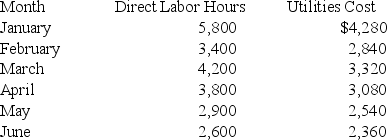 1. What are the variable costs per hour using the high-low point method?
2. What are the fixed costs per month using the high-low point method?
1. What are the variable costs per hour using the high-low point method?
2. What are the fixed costs per month using the high-low point method? (Short Answer)
5.0/5 (88)
(88) Costs that vary in some degree with the volume of activity, but not in direct proportion to it are called----------- costs.
(Short Answer)
4.8/5 (81)
(81) Petersen Company produces a single product with the following production and average cost data:
 -
The best estimate of total cost at an activity level of 7,250 units is:
-
The best estimate of total cost at an activity level of 7,250 units is: (Multiple Choice)
4.9/5 (73)
(73) The price variance for an item is the difference between its actual price and its standard price, multiplied by the--------- quantity.
(Short Answer)
4.9/5 (93)
(93) Weaver Corporation has a three-year contract with a security firm that sets hourly wage rates for the firm at $10 per hour. At 7,000 units of output, factory security costs were $14,000. Production is expected to increase next year to a level of 10,000 units and the security costs are expected to remain the same. The security costs are an example of fixed factory costs.
(True/False)
4.8/5 (88)
(88) The company's accountant developed the data given below for Product X for the year 2019. Use this information to calculate the answers to the questions that follow.
Total budgeted production: 10,000 units
Raw materials: 5 units of raw materials, costing $1.75 per unit, required for each unit of finished goods
Direct labor: 4 hours of labor at the rate of $12 per hour required for each unit of finished goods
Mfg. overhead: $70,000 budgeted for 10,000 units of finished goods
1. What is the standard cost per unit of product for materials?
2. What is the standard cost per unit of product for labor?
3. What is the standard cost per unit of product for overhead?
4. What is the total standard cost per unit of product?
(Short Answer)
4.9/5 (73)
(73) Match the following descriptions with the appropriate term.
Correct Answer: Verified
Premises:
Responses:
(Matching)
4.7/5 (60)
(60) A flexible budget shows budgeted costs at several different levels of activity.
(True/False)
4.9/5 (90)
(90) Complete the flexible budget of manufacturing costs for Lansome Industries for September 2019. Overhead is based on direct labor hours.
Lansome Industries Budget of Manufacturing Costs
Month of September 2019
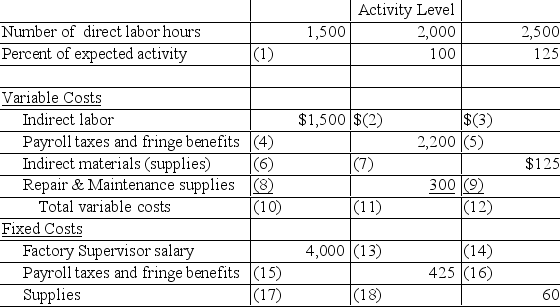 Depreciation (19) Total fixed costs (21) Total manufacturing overhead (23) (24)
 (Essay)
4.8/5 (74)
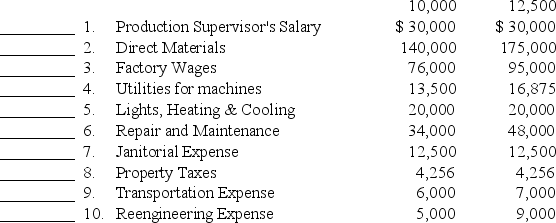
(74) Determine the cost behavior for each of the following items as Fixed (F), Variable (V), or Semi-variable (S).
Production Level
(Short Answer)
4.8/5 (89)
(89) A price variance for an item is the difference between its actual price and its standard price multiplied by the standard quantity.
(True/False)
4.9/5 (65)
(65) A budget that shows expected costs at more than one level of activity is called a(n)----------budget.
(Short Answer)
4.9/5 (73)
(73) The purchasing department can determine the standard quantity per unit of each type of raw material required to manufacture a product.
(True/False)
4.7/5 (75)
(75) The labor standard for a product was 5.5 hours at a wage rate of $9 per hour. The firm produced 1,020 units of the item. Labor costs totaled $50,414 and 5,540 hours of labor were used. An analysis of labor costs would indicate
(Multiple Choice)
4.8/5 (68)
(68) In a factory, the fixed costs per unit are $60 when 500 units are produced. If 600 units are produced, the fixed costs per unit would be
(Multiple Choice)
4.9/5 (70)
(70) The difference between the total standard cost and the total actual cost is the----------- .
(Short Answer)
4.8/5 (70)
(70) The standard costs for a unit of product are shown below.
Materials: 2 pounds at \ 1.00 per pound \ 2.00 Labor: 1 hours at \ 10.00 per hour 10.00 Overhead: 60\% of directlabor 6.00
During June, Job N-5 for 100 units was completed. The actual costs of the job are shown below.
Materials: 300 pounds at \ 1.45 per pound \ 435.00 Labor: 200 hours at \ 9.50 per hour 1,900 Overhead Applied: 60\% of direct labor 1,140
1. What is the total cost variance between actual cost and standard cost?
2. What is the total material variance?
3. What is the material quantity variance?
4. What is the material price variance?
(Short Answer)
4.9/5 (83)
(83) 
Filters
- Essay(0)
- Multiple Choice(0)
- Short Answer(0)
- True False(0)
- Matching(0)