



 Chat with AI
Exam 17: Merchandise Inventory

Exam 1: Accounting: The Language of Business84 Questions
Exam 2: Analyzing Business Transactions100 Questions
Exam 3: Analyzing Business Transactions Using T Accounts116 Questions
Exam 4: The General Journal and the General Ledger98 Questions
Exam 5: Adjustments and the Worksheet97 Questions
Exam 6: Closing Entries and Teh Postclosing Trial Balance97 Questions
Exam 7: Accounting for Sales and Accounts Receivable99 Questions
Exam 8: Accounting for Purchases and Accounts Payable111 Questions
Exam 9: Cash Receipts, Cash Payments, and Banking Procedures92 Questions
Exam 10: Payroll Computations, Records, and Payment89 Questions
Exam 11: Payroll Taxes, Deposits, and Reports88 Questions
Exam 12: Accruals, Deferrals, and the Worksheet94 Questions
Exam 13: Financial Statements and Closing Procedures92 Questions
Exam 14: Accounting Principles and Reporting Standards95 Questions
Exam 15: Accounts Receivable and Uncollectible Accounts93 Questions
Exam 16: Notes Payable and Notes Receivable101 Questions
Exam 17: Merchandise Inventory114 Questions
Exam 18: Property, Plant, and Equipment123 Questions
Exam 19: Accounting for Partnerships118 Questions
Exam 20: Corporations: Formation and Capital Stock Transactions104 Questions
Exam 21: Corporate Earnings and Capital Transactions118 Questions
Exam 22: Long-Term Bonds114 Questions
Exam 23: Financial Statement Analysis131 Questions
Exam 24: The Statement of Cash Flows154 Questions
Exam 25: Departmentalized Profit and Cost Centers121 Questions
Exam 26: Accounting for Manufacturing Activities114 Questions
Exam 27: Job Order Cost Accounting111 Questions
Exam 28: Process Cost Accounting99 Questions
Exam 29: Controlling Manufacturing Costs: Standard Costs126 Questions
Exam 30: Cost-Revenue Analysis for Decision Making126 Questions
Select questions type


A physical inventory should be taken annually, at a minimum, to verify the quantity of goods on hand.
(True/False)
4.8/5  (88)
(88) Under the retail inventory method, if the gross profit ratio is 45% and ending inventory at retail is
$67,000, then estimated ending inventory is $36,850.
(True/False)
5.0/5 (79)
(79) The following data concerns selected inventory items.
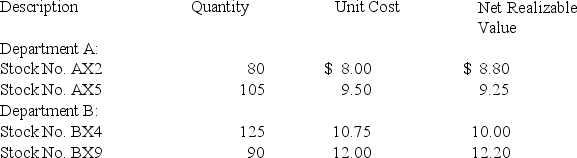 Determine the amount to be reported as the inventory valuation at cost or net realizable value, whichever is lower, under each of the following methods.
1. Lower of cost or net realizable value for each item separately
2. Lower of total cost or net realizable value in total
3. Lower of total cost or net realizable value by department
Determine the amount to be reported as the inventory valuation at cost or net realizable value, whichever is lower, under each of the following methods.
1. Lower of cost or net realizable value for each item separately
2. Lower of total cost or net realizable value in total
3. Lower of total cost or net realizable value by department (Short Answer)
4.9/5 (78)
(78) The--------- method of estimating ending inventory involves estimating the cost of goods sold by applying a company's cost/sales ratio to its sales for the current period.
(Short Answer)
4.9/5 (73)
(73) A firm that uses a period system sells a single product that had a beginning inventory of 9,000 units with a total cost of $45,000. Early in the year, 15,000 units were purchased at $6 each. At the end of the year there were 4,000 units on hand. Using LIFO, what is the value of the ending inventory of 4,000 units?
(Multiple Choice)
4.7/5 (76)
(76) Alyse Designer Handbags uses the periodic inventory system and had the following inventory figures for its Nicole Model during 2019 as shown below.
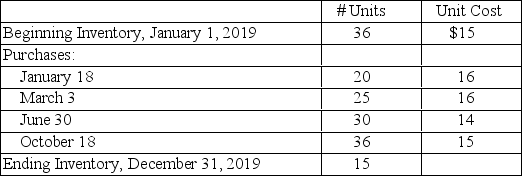 What is the cost of the ending inventory and the cost of goods sold?
1. Assume the company utilizes the FIFO method
2. Assume the company utilizes the LIFO method
3. Assume the company utilizes the average cost method
What is the cost of the ending inventory and the cost of goods sold?
1. Assume the company utilizes the FIFO method
2. Assume the company utilizes the LIFO method
3. Assume the company utilizes the average cost method (Essay)
4.8/5 (78)
(78) What is the specific identification method for valuing inventory? What types of businesses are likely to use this method? Why?
(Essay)
4.8/5 (76)
(76) With the onset of universal product codes and bar-code scanners that track inventory purchased and sold, a physical inventory is no longer necessary to verify inventory on hand.
(True/False)
4.9/5 (72)
(72) The lower the ending inventory valuation, the---------- the cost of goods sold.
(Short Answer)
4.8/5 (83)
(83) The lower of cost or net realizable value rule can be applied on an item-by-item basis, by group or by comparing total inventory at cost to total inventory valued at net realizable value.
(True/False)
4.9/5 (71)
(71) Inventory valuation is very important in computing federal income tax because the value placed on the inventory determines the net income reported.
(True/False)
4.9/5 (81)
(81) Inventory valuation methods that are acceptable internationally include all of the following except:
(Multiple Choice)
4.7/5 (67)
(67) In periods of falling prices, the inventory valuation procedure that results in the highest ending inventory value is
(Multiple Choice)
4.9/5 (71)
(71) To calculate the cost-to-retail ratio, merchandise available for sale at retail prices is divided by the merchandise available for sale at cost.
(True/False)
4.8/5 (75)
(75) A company has inventory with a sales value of $34,000, current net realizable value of $22,000 and a total cost of $23,400. Since the sales value exceeds both cost and net realizable value, no write down in inventory value is required.
(True/False)
4.9/5 (67)
(67) The disclosure principle requires a company to reveal the costing method used to value inventory.
(True/False)
4.8/5 (83)
(83) Following the consistency principle, once a firm adopts a method of inventory valuation, it should use that method consistently from one period to the next.
(True/False)
4.8/5 (66)
(66) A firm that uses a periodic inventory system sells a single product that had a beginning inventory of 5,000 units with a total cost of $35,000. Early in the year, 12,000 units were purchased at $9 each and 4,000 units were on hand at the end of the year. Using FIFO, what is the amount of Cost of Goods Sold?
(Multiple Choice)
4.9/5 (77)
(77) 
Filters
- Essay(0)
- Multiple Choice(0)
- Short Answer(0)
- True False(0)
- Matching(0)