



 Chat with AI
Exam 26: Accounting for Manufacturing Activities

Exam 1: Accounting: The Language of Business84 Questions
Exam 2: Analyzing Business Transactions100 Questions
Exam 3: Analyzing Business Transactions Using T Accounts116 Questions
Exam 4: The General Journal and the General Ledger98 Questions
Exam 5: Adjustments and the Worksheet97 Questions
Exam 6: Closing Entries and Teh Postclosing Trial Balance97 Questions
Exam 7: Accounting for Sales and Accounts Receivable99 Questions
Exam 8: Accounting for Purchases and Accounts Payable111 Questions
Exam 9: Cash Receipts, Cash Payments, and Banking Procedures92 Questions
Exam 10: Payroll Computations, Records, and Payment89 Questions
Exam 11: Payroll Taxes, Deposits, and Reports88 Questions
Exam 12: Accruals, Deferrals, and the Worksheet94 Questions
Exam 13: Financial Statements and Closing Procedures92 Questions
Exam 14: Accounting Principles and Reporting Standards95 Questions
Exam 15: Accounts Receivable and Uncollectible Accounts93 Questions
Exam 16: Notes Payable and Notes Receivable101 Questions
Exam 17: Merchandise Inventory114 Questions
Exam 18: Property, Plant, and Equipment123 Questions
Exam 19: Accounting for Partnerships118 Questions
Exam 20: Corporations: Formation and Capital Stock Transactions104 Questions
Exam 21: Corporate Earnings and Capital Transactions118 Questions
Exam 22: Long-Term Bonds114 Questions
Exam 23: Financial Statement Analysis131 Questions
Exam 24: The Statement of Cash Flows154 Questions
Exam 25: Departmentalized Profit and Cost Centers121 Questions
Exam 26: Accounting for Manufacturing Activities114 Questions
Exam 27: Job Order Cost Accounting111 Questions
Exam 28: Process Cost Accounting99 Questions
Exam 29: Controlling Manufacturing Costs: Standard Costs126 Questions
Exam 30: Cost-Revenue Analysis for Decision Making126 Questions
Select questions type


If there are no errors, the amount needed to balance the Cost of Goods Manufactured columns of a worksheet will also be the amount required to balance the Balance Sheet columns.
(True/False)
4.9/5  (83)
(83) Benefits of maintaining inventory records on a perpetual basis include all of the following except:
(Multiple Choice)
4.8/5 (82)
(82) Manufacturing-related costs that cannot be cost-effectively traced to a product are considered manufacturing overhead.
(True/False)
4.9/5 (68)
(68) Direct Labor and Indirect Labor are recorded, respectively, to:
(Multiple Choice)
4.9/5 (70)
(70) Use the following information for the questions.
The Balance Sheet headings and the accounts and their balances for Exemplar Manufacturing are listed in alphabetical order. Exemplar Manufacturing has a fiscal year end of June 30, 2019.

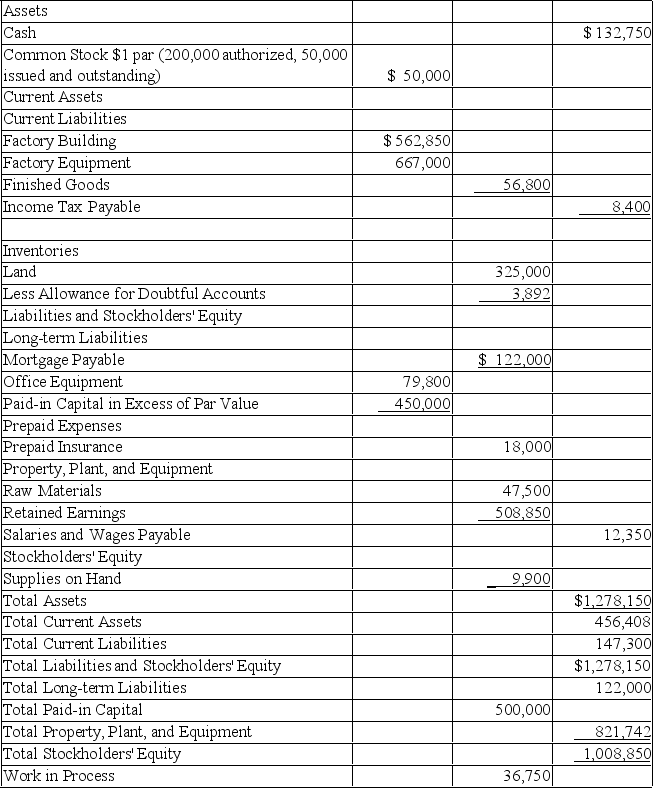 -Using the information given, prepare the Balance Sheet for Exemplar Manufacturing. Include correct indentations, underlines, dates, and capitalization where needed.
 (Essay)
4.9/5 (64)
(64) The accounts and the Adjusted Trial Balance section of Spencer Manufacturing's worksheet are given below.
ADJUSTED TRIAL BALANCE
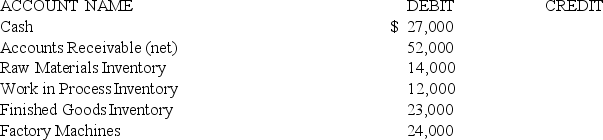
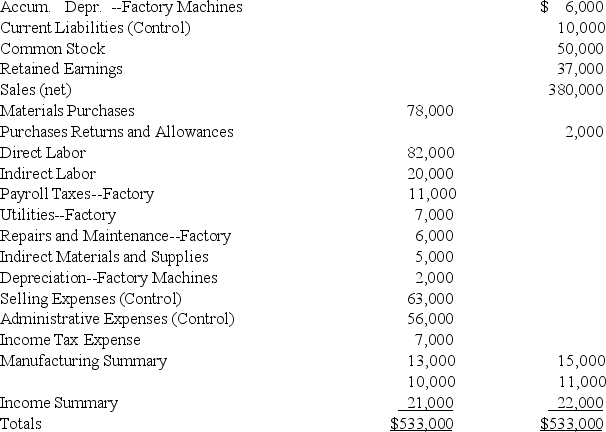 Instructions:
(1)Enter the account names in the Account Name column and the adjusted trial balance in the Adjusted Trial Balance columns of a 12-column manufacturing worksheet. Or use a 10-column worksheet and use the last four columns, changing the column headings as needed.
(2)Extend the balances to the appropriate columns and complete the worksheet for the year ended December 31, 2019.
(3)Record the closing entries for all revenue and expense accounts and the Manufacturing Summary account on page 9 of a general journal. Omit descriptions.
Instructions:
(1)Enter the account names in the Account Name column and the adjusted trial balance in the Adjusted Trial Balance columns of a 12-column manufacturing worksheet. Or use a 10-column worksheet and use the last four columns, changing the column headings as needed.
(2)Extend the balances to the appropriate columns and complete the worksheet for the year ended December 31, 2019.
(3)Record the closing entries for all revenue and expense accounts and the Manufacturing Summary account on page 9 of a general journal. Omit descriptions. (Essay)
4.9/5 (80)
(80) The cost of goods manufactured for a fiscal period is reported on:
(Multiple Choice)
4.8/5 (86)
(86) On a worksheet for a manufacturing firm, the beginning balance of the Finished Goods Inventory account is:
(Multiple Choice)
4.9/5 (88)
(88) The cost of labor that is not clearly associated with specific units of product is called:
(Multiple Choice)
4.9/5 (76)
(76) The beginning and ending----------- inventories appear in the Cost of Goods Sold section of the income statement of a manufacturing business.
(Short Answer)
4.7/5 (70)
(70) The balance of the Manufacturing Summary account is closed into the Income Summary account.
(True/False)
4.8/5 (83)
(83) The Cost of Goods Manufactured represents the cost of completed units that are transferred into Finished Goods and made available for sale.
(True/False)
4.9/5 (69)
(69) The beginning inventory of raw materials is shown in the Income Statement Credit column and the Balance Sheet Debit column of a worksheet for a manufacturing business.
(True/False)
4.7/5 (78)
(78) The ending inventory of raw materials is shown on the worksheet of a manufacturing business in the Cost of Goods Manufactured ----------column.
(Short Answer)
4.9/5 (82)
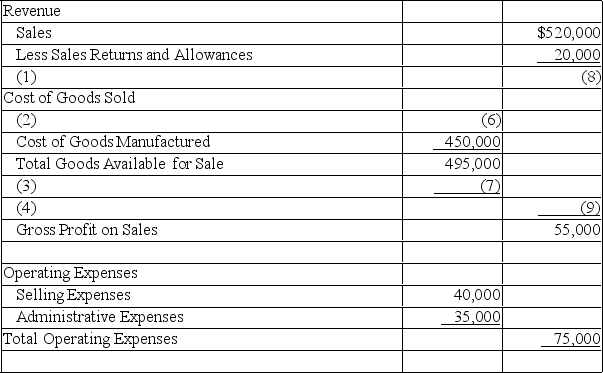
(82) Fill in the missing line items on the Income Statement given. Include correct indentations, underlines, dates, and capitalization when needed.
Bortz Manufacturing Income Statement
Year Ended June 31, 2019

(Essay)
4.7/5 (68)
(68) The adjusting entry to close out the beginning work in process inventory includes a debit to Income Summary and a credit to Work in Process Inventory.
(True/False)
4.9/5 (77)
(77) Other than the adjusting entries that are made to Manufacturing Summary and to Income Summary for inventory, there are several adjustments that are normally made. List at least three and discuss why they are made and what accounts are affected.
(Essay)
4.7/5 (77)
(77) The following information appears on the Statement of Cost of Goods Manufactured for the Poster Company at the end of the year.
Raw Materials Used \ 70,000 Direct Labor 90,000 Cost of Goods Manufactured 200,000 Work in Process Inventory, January 1 30,000 Work in Process Inventory, December 31 20,000
Manufacturing Overhead for the year was:
(Multiple Choice)
4.8/5 (83)
(83) Total manufacturing cost is the sum of beginning work in process, direct materials used, direct labor incurred and manufacturing overhead.
(True/False)
4.8/5 (87)
(87) 
Filters
- Essay(0)
- Multiple Choice(0)
- Short Answer(0)
- True False(0)
- Matching(0)