



 Chat with AI
Exam 30: Cost-Revenue Analysis for Decision Making

Exam 1: Accounting: The Language of Business84 Questions
Exam 2: Analyzing Business Transactions100 Questions
Exam 3: Analyzing Business Transactions Using T Accounts116 Questions
Exam 4: The General Journal and the General Ledger98 Questions
Exam 5: Adjustments and the Worksheet97 Questions
Exam 6: Closing Entries and Teh Postclosing Trial Balance97 Questions
Exam 7: Accounting for Sales and Accounts Receivable99 Questions
Exam 8: Accounting for Purchases and Accounts Payable111 Questions
Exam 9: Cash Receipts, Cash Payments, and Banking Procedures92 Questions
Exam 10: Payroll Computations, Records, and Payment89 Questions
Exam 11: Payroll Taxes, Deposits, and Reports88 Questions
Exam 12: Accruals, Deferrals, and the Worksheet94 Questions
Exam 13: Financial Statements and Closing Procedures92 Questions
Exam 14: Accounting Principles and Reporting Standards95 Questions
Exam 15: Accounts Receivable and Uncollectible Accounts93 Questions
Exam 16: Notes Payable and Notes Receivable101 Questions
Exam 17: Merchandise Inventory114 Questions
Exam 18: Property, Plant, and Equipment123 Questions
Exam 19: Accounting for Partnerships118 Questions
Exam 20: Corporations: Formation and Capital Stock Transactions104 Questions
Exam 21: Corporate Earnings and Capital Transactions118 Questions
Exam 22: Long-Term Bonds114 Questions
Exam 23: Financial Statement Analysis131 Questions
Exam 24: The Statement of Cash Flows154 Questions
Exam 25: Departmentalized Profit and Cost Centers121 Questions
Exam 26: Accounting for Manufacturing Activities114 Questions
Exam 27: Job Order Cost Accounting111 Questions
Exam 28: Process Cost Accounting99 Questions
Exam 29: Controlling Manufacturing Costs: Standard Costs126 Questions
Exam 30: Cost-Revenue Analysis for Decision Making126 Questions
Select questions type


Company A's inventory increased 525 units over the prior year end. Its variable manufacturing costs are $6 per unit and fixed costs for the period were $275,000. During the current year, Company A produced 12,500 units. Absorption costing net income will be:
(Multiple Choice)
4.9/5  (84)
(84) Timkon Manufacturing has provided the following operating results for its recent operations:
Beginning inventory of finished goods 4,500 Units produced (no work in process) 10,000 Units sold 12,500 Units in ending inventory of finished goods 2,000 Sales price \ 50 per unit Variable manufacturing costs \ 20 per unit manufactured Variable selling expenses \ 2 per unit sold Variable administrative expenses \ 1 per unit sold Fixed manufacturing costs for the year \ 100,000 Fixed selling expenses for the year \ 52,000 Fixed administrative expenses for the year \ 84,000
-
Assuming beginning inventory cost per unit is not different than ending inventory cost, the value of the ending inventory under absorption costing is:
(Multiple Choice)
4.8/5 (93)
(93) The difference in cost between two alternatives is called a(n)------------cost.
(Short Answer)
4.7/5 (74)
(74) Which of the following is not true of the direct costing procedure?
(Multiple Choice)
4.8/5 (94)
(94) Manufacturing margin less variable selling and administrative expenses equals marginal income.
(True/False)
4.9/5 (94)
(94) The excess of net sales over the cost of goods sold, based on variable costs only, is--------------- referred to as the .
(Short Answer)
4.7/5 (77)
(77) It is appropriate to consider nonfinancial factors in the decision-making process.
(True/False)
4.9/5 (89)
(89) Costmore Manufacturing has provided the following operating results for its first year operations:
Beginning inventory of finished goods 0 Units produced (no work in process) 22,000 Units sold 18,000 Units in ending inventory of finished goods 4,000 Sales price \5 5 per unit Variable manufacturing costs \2 5 per unit manufactured Variable selling and administrative expenses \ 7 per unit sold Fixed manufacturing costs for the year \ 110,000 Fixed selling and administrative expenses for the year \ 124,000
-
Using the absorption costing method, cost of goods manufactured for the year is:
(Multiple Choice)
4.9/5 (68)
(68) Which of the following is NOT a step in the decision-making process?
(Multiple Choice)
4.8/5 (70)
(70) The sum of unit variable and fixed costs is used as a basis for determining whether to accept or reject a special order.
(True/False)
4.7/5 (76)
(76) Opportunity costs are earnings or potential benefits foregone because a certain course of action is taken.
(True/False)
4.8/5 (70)
(70) The direct costing procedure is sometimes referred to as variable costing.
(True/False)
4.8/5 (90)
(90) Differential cost analysis emphasizes evaluating alternatives by calculating the differences in relevant costs.
(True/False)
4.8/5 (76)
(76) The data given below pertains to the operations of the Newton Products Corporation for the year ended December 31, 2019
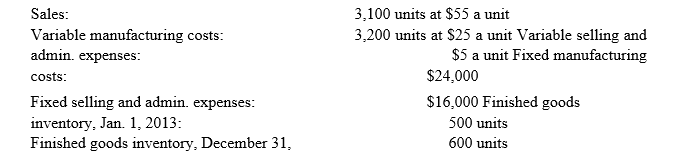 Based on the information given prepare an income statement for the year using the direct costing approach. Assume that the beginning finished goods inventory had a cost of $25 per unit.
 (Essay)
4.8/5 (74)
(74) In its first year of operations, a company has sales of $162,000, ending finished goods inventory of $9,000, variable manufacturing costs of $55,000, and fixed manufacturing costs of $32,000 for the year. The company pays 12% commission to its sales force and has fixed selling and administrative expenses of $25,000 annually. The company has no other variable expenses.
Assuming the company uses direct costing, the contribution margin for the year is
(Multiple Choice)
4.8/5 (82)
(82) In making a decision to replace a machine, which of the following would not be relevant?
(Multiple Choice)
4.9/5 (69)
(69) If the finished goods inventory decreases during the period, the reported net income will be larger under variable costing than under absorption costing.
(True/False)
4.9/5 (83)
(83) Using the given information, determine the income under both the absorption and the direct (variable)costing methods for CRL Company this year. Explain the difference, if any.
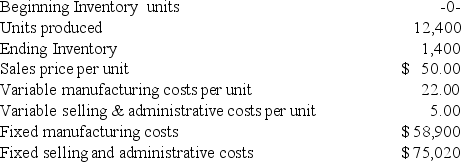
(Essay)
4.9/5 (95)
(95) Costmore Manufacturing has provided the following operating results for its first year operations:
Beginning inventory of finished goods 0 Units produced (no work in process) 22,000 Units sold 18,000 Units in ending inventory of finished goods 4,000 Sales price \5 5 per unit Variable manufacturing costs \2 5 per unit manufactured Variable selling and administrative expenses \ 7 per unit sold Fixed manufacturing costs for the year \ 110,000 Fixed selling and administrative expenses for the year \ 124,000
-
Using direct costing, the manufacturing margin is:
(Multiple Choice)
4.8/5 (60)
(60) GAAP requires the use of the absorption costing method for financial reporting.
(True/False)
4.9/5 (82)
(82) 
Filters
- Essay(0)
- Multiple Choice(0)
- Short Answer(0)
- True False(0)
- Matching(0)