



 Chat with AI
Exam 7: Risk Analysis, real Options, and Capital Budgeting

Exam 1: Introduction to Corporate Finance71 Questions
Exam 2: Financial Statements and Cash Flow106 Questions
Exam 3: Financial Statements and Cash Flow108 Questions
Exam 4: Discounted Cash Flow Valuation116 Questions
Exam 5: Net Present Value and Other Investment Rules98 Questions
Exam 6: Making Capital Investment Decisions98 Questions
Exam 7: Risk Analysis, real Options, and Capital Budgeting94 Questions
Exam 8: Interest Rates and Bond Valuation87 Questions
Exam 9: Stock Valuation87 Questions
Exam 10: Lessons From Market History77 Questions
Exam 11: Return, risk, and the Capital Asset Pricing Model Capm109 Questions
Exam 12: An Alternative View of Risk and Return: the Arbitrage Pricing Theory52 Questions
Exam 13: Risk, cost of Capital, and Valuation72 Questions
Exam 14: Efficient Capital Markets and Behavioral Challenges59 Questions
Exam 15: Long-Term Financing57 Questions
Exam 16: Capital Structure: Basic Concepts74 Questions
Exam 17: Capital Structure: Limits to the Use of Debt60 Questions
Exam 18: Valuation and Capital Budgeting for the Levered Firm54 Questions
Exam 19: Dividends and Other Payouts88 Questions
Exam 20: Raising Capital77 Questions
Exam 21: Leasing53 Questions
Exam 22: Options and Corporate Finance105 Questions
Exam 23: Options and Corporate Finance: Extensions and Applications43 Questions
Exam 24: Warrants and Convertibles63 Questions
Exam 25: Derivatives and Hedging Risk64 Questions
Exam 26: Short-Term Finance and Planning98 Questions
Exam 27: Cash Management63 Questions
Exam 28: Credit and Inventory Management66 Questions
Exam 29: Mergers,acquisitions,and Divestitures93 Questions
Exam 30: Financial Distress41 Questions
Exam 31: International Corporate Finance90 Questions
Select questions type


The Meldrum Co.expects to sell 3,000 units,± 15 percent,of a new product.The variable cost per unit is $8,± 5 percent; annual fixed costs are $12,500,± 5 percent; annual depreciation is $4,000; and the sale price is $18 a unit,± 2 percent.What is the amount of the fixed cost per unit under the pessimistic scenario?
(Multiple Choice)
4.9/5  (86)
(86) A project has a projected sales price of $99 a unit,variable costs per unit of $58,annual fixed costs of $238,000,and annual depreciation of $139,000.The tax rate is 22 percent.What is the contribution margin for an analysis using sales units of 12,800?
(Multiple Choice)
4.9/5 (74)
(74) Theoretically,the NPV is the most appropriate method to determine the acceptability of a project.A false sense of security can overcome the decision-maker when the procedure is applied properly but the positive NPV results are accepted blindly.Sensitivity and scenario analysis aid in the process by:
(Multiple Choice)
4.8/5 (77)
(77) Including the option to expand in your project analysis will tend to:
(Multiple Choice)
4.8/5 (79)
(79) The Quick-Start Company has the following pattern of potential cash flows for a new project. 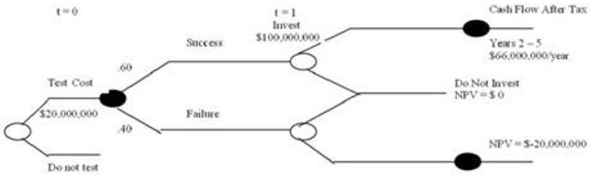 If the company has a discount rate of 17 percent,should it test the product? Why or why not?
 (Multiple Choice)
4.8/5 (65)
(65) Simulation analysis is based on assigning a ________ and analyzing the results.
(Multiple Choice)
4.9/5 (74)
(74) The type of analysis that is most dependent upon the use of a computer is ________ analysis.
(Multiple Choice)
4.8/5 (85)
(85) If you want the most detailed information possible about the potential outcome of a critical project you should conduct:
(Multiple Choice)
4.9/5 (88)
(88) A project has a contribution margin of $2.16 per unit.If the sales price per unit is $11 and the fixed costs are $24,700,what is the amount of total costs at a production level of 6,000 units? Ignore depreciation.
(Multiple Choice)
4.8/5 (76)
(76) A proposed 1-year project has a contribution margin of $5,fixed costs of $12,000,variable costs per unit of $12,depreciation of $30,000,an EAC of $41,185 and a tax rate of 21 percent.What is the present value break-even point in units?
(Multiple Choice)
4.9/5 (77)
(77) A project with a life of one year has earnings before interest and taxes of $5,750,fixed costs of $50,000,a selling price of $13 a unit,and a sales quantity of 11,500 units.Depreciation is $7,500.What is the variable cost per unit?
(Multiple Choice)
4.9/5 (99)
(99) What is the benefit of scenario analysis if it does not produce a definitive accept or reject decision for a proposed project?
(Essay)
4.7/5 (71)
(71) A proposed project has estimated sales of 3,300 units per year,± 4 percent; a sales price of $23 a unit,± 1 percent; variable costs per unit of $12.60,± 2 percent; annual fixed costs of $16,200; and annual depreciation of $3,100.What is the contribution margin under the expected scenario?
(Multiple Choice)
4.9/5 (76)
(76) Thompson's has determined that a new project has expected fixed costs of $132,378,a contribution margin of $36.20,and a tax rate of 21 percent.The investment has an initial cost of $548,000 that will be depreciated straight-line to zero over the 5-year life of the project.What is the expected present value break-even point in units per year if the discount rate is 15 percent?
(Multiple Choice)
4.9/5 (75)
(75) In a decision tree,caution should be used in the analysis because:
(Multiple Choice)
4.9/5 (84)
(84) Angie's expects annual sales of 2,400 units,± 3 percent,of a new product at a price of $59 a unit,± 2 percent.The expected variable cost per unit is $27.20,± 2 percent,annual fixed costs are $32,500,and depreciation is $4,400 per year.What is the total annual expense per unit under the pessimistic scenario? Ignore taxes.
(Multiple Choice)
4.8/5 (76)
(76) 
Filters
- Essay(0)
- Multiple Choice(0)
- Short Answer(0)
- True False(0)
- Matching(0)