



 Chat with AI
Exam 7: Risk Analysis, real Options, and Capital Budgeting

Exam 1: Introduction to Corporate Finance71 Questions
Exam 2: Financial Statements and Cash Flow106 Questions
Exam 3: Financial Statements and Cash Flow108 Questions
Exam 4: Discounted Cash Flow Valuation116 Questions
Exam 5: Net Present Value and Other Investment Rules98 Questions
Exam 6: Making Capital Investment Decisions98 Questions
Exam 7: Risk Analysis, real Options, and Capital Budgeting94 Questions
Exam 8: Interest Rates and Bond Valuation87 Questions
Exam 9: Stock Valuation87 Questions
Exam 10: Lessons From Market History77 Questions
Exam 11: Return, risk, and the Capital Asset Pricing Model Capm109 Questions
Exam 12: An Alternative View of Risk and Return: the Arbitrage Pricing Theory52 Questions
Exam 13: Risk, cost of Capital, and Valuation72 Questions
Exam 14: Efficient Capital Markets and Behavioral Challenges59 Questions
Exam 15: Long-Term Financing57 Questions
Exam 16: Capital Structure: Basic Concepts74 Questions
Exam 17: Capital Structure: Limits to the Use of Debt60 Questions
Exam 18: Valuation and Capital Budgeting for the Levered Firm54 Questions
Exam 19: Dividends and Other Payouts88 Questions
Exam 20: Raising Capital77 Questions
Exam 21: Leasing53 Questions
Exam 22: Options and Corporate Finance105 Questions
Exam 23: Options and Corporate Finance: Extensions and Applications43 Questions
Exam 24: Warrants and Convertibles63 Questions
Exam 25: Derivatives and Hedging Risk64 Questions
Exam 26: Short-Term Finance and Planning98 Questions
Exam 27: Cash Management63 Questions
Exam 28: Credit and Inventory Management66 Questions
Exam 29: Mergers,acquisitions,and Divestitures93 Questions
Exam 30: Financial Distress41 Questions
Exam 31: International Corporate Finance90 Questions
Select questions type


A project with a life of one year has an accounting break-even point of 2,962 units.The fixed costs are $46,308 and the depreciation expense is $22,147.The projected variable cost per unit is $23.10.What is the projected sales price?
(Multiple Choice)
4.9/5  (81)
(81) The Can-Do Co.is analyzing a project with anticipated sales of 12,000 units,± 4 percent; variable costs per unit of $7,± 6 percent; and annual fixed costs of $36,000,± 6 percent.Annual depreciation is $29,600 and the tax rate is 21 percent.The sale price is $14.99 a unit,± 1 percent.What is the operating cash flow under the optimistic scenario?
(Multiple Choice)
4.8/5 (96)
(96) All else constant,the accounting break-even level of sales will decrease when the:
(Multiple Choice)
4.8/5 (76)
(76) All else constant,as the variable cost per unit for a project increases,the:
(Multiple Choice)
4.8/5 (80)
(80) An analysis of what happens to the estimate of net present value when only one input variable is changed is called ________ analysis.
(Multiple Choice)
4.9/5 (72)
(72) The sales level that results in a project's net present value exactly equaling zero is called the ________ break-even.
(Multiple Choice)
4.8/5 (85)
(85) ABC Co.has compiled these estimates for a new 1-year project: Sales of 1,650 units,± 5 percent; sales price of $17 a unit,± 1 percent; variable costs per unit of $7.49,± 3 percent; fixed costs of $3,800,± 1 percent; and depreciation of $2,200.The company bases its sensitivity analysis on the expected case scenario.If the company conducts a sensitivity analysis at a sales price of $16.25,what will be the earnings before interest and taxes?
(Multiple Choice)
4.8/5 (68)
(68) The accounting break-even production quantity for a project is 5,799 units.The fixed costs are $92,640,the depreciation is $36,210,and the sales price per unit is $48.29.What is the variable cost per unit?
(Multiple Choice)
4.7/5 (89)
(89) A project has these estimated values: sales quantity of 4,600 units ± 2 percent; variable cost per unit of $17,± 3 percent; annual fixed costs of $46,900,± 1 percent; annual depreciation of $17,300; and a sales price of $39 a unit,± 10 percent.The company bases its sensitivity analysis on the expected scenario.What will be the operating cash flow for a sensitivity analysis based on a sales price of $35 a unit and a tax rate of 21 percent?
(Multiple Choice)
4.9/5 (60)
(60) Northern Woods is considering two methods of production for a new product.The first method will require fixed assets costing $450,000 that will be depreciated straight-line to zero over the product's 3-year life.Annual fixed costs are $316,000 and variable costs per unit are $8.64.The second method will require fixed assets costing $790,000,annual fixed costs of $211,000,and variable costs per unit of $6.57.The firm expects to sell 46,000 units per year at $20 a unit.The discount rate is 16 percent and the tax rate is 21 percent.Should the product be produced and if so,which method of production should be implemented and why?
(Multiple Choice)
4.8/5 (78)
(78) The sales level that results in a project's net income exactly equaling zero is called the ________ break-even.
(Multiple Choice)
4.9/5 (85)
(85) The market value of an investment project should be viewed as the sum of the standard NPV and the value of the managerial options.Identify three common project options available to management,when each might be employed,and how each of those options would influence a project's value.
(Essay)
4.9/5 (89)
(89) Brewster's is considering a project with a life of 5 years,an initial cost of $120,000,and a discount rate of 12 percent.The firm expects to sell 2,100 units a year at a cash flow per unit of $20.The firm will have the option to abandon this project after three years at which time it could sell the project for $50,000.At what level of sales should the firm be willing to abandon this project at the end of the third year?
(Multiple Choice)
4.9/5 (85)
(85) The Quick-Start Company has the following pattern of potential cash flows for a new project. 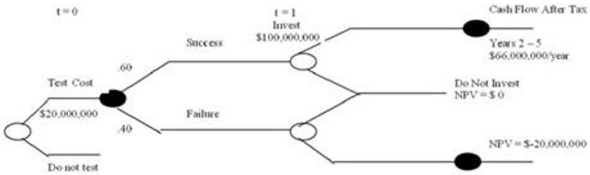 If the company has a discount rate of 16 percent,what is the Time 1 net present value?
 (Multiple Choice)
4.8/5 (75)
(75) The Quorum Company has a prospective 6-year project that requires initial fixed assets costing $962,000,annual fixed costs of $403,400,variable costs per unit of $123.60,a sales price per unit of $249,a discount rate of 14 percent,and a tax rate of 21 percent.What is the present value break-even point in units per year?
(Multiple Choice)
4.8/5 (73)
(73) 
Filters
- Essay(0)
- Multiple Choice(0)
- Short Answer(0)
- True False(0)
- Matching(0)