



 Chat with AI
Exam 16: Acid-Base Equilibria

Exam 1: Introduction: Matter and Measurement151 Questions
Exam 2: Atoms, Molecules, and Ions230 Questions
Exam 3: Stoichiometry: Calculations With Chemical Formulas and Equations170 Questions
Exam 4: Aqueous Reactions and Solution Stoichiometry177 Questions
Exam 5: Thermochemistry148 Questions
Exam 6: Electronic Structure of Atoms180 Questions
Exam 7: Periodic Properties of the Elements171 Questions
Exam 8: Basic Concepts of Chemical Bonding141 Questions
Exam 9: Molecular Geometry and Bonding Theories177 Questions
Exam 10: Gases172 Questions
Exam 11: Liquids and Intermolecular Forces119 Questions
Exam 12: Solids and Modern Materials78 Questions
Exam 13: Properties of Solutions151 Questions
Exam 14: Chemical Kinetics130 Questions
Exam 15: Chemical Equilibrium92 Questions
Exam 16: Acid-Base Equilibria134 Questions
Exam 17: Additional Aspects of Aqueous Equilibria111 Questions
Exam 18: Chemistry of the Environment121 Questions
Exam 19: Chemical Thermodynamics120 Questions
Exam 20: Electrochemistry110 Questions
Exam 21: Nuclear Chemistry158 Questions
Exam 22: Chemistry of the Nonmetals192 Questions
Exam 23: Transition Metals and Coordination Chemistry147 Questions
Exam 24: The Chemistry of Life: Organic and Biological Chemistry124 Questions
Select questions type


Kb for NH3 is 1.8 × 10⁻⁵. What is the pH of a 0.45 M aqueous solution of NH4Cl at 25.0 °C?
(Multiple Choice)
4.8/5  (78)
(78) What is the concentration (in M)of hydronium ions in a solution at 25.0 °C with pH = 4.153?
(Multiple Choice)
4.7/5 (63)
(63) Using the data in the table, which of the conjugate bases below is the strongest base? 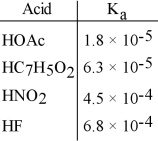
(Multiple Choice)
4.9/5 (78)
(78) The molar concentration of hydronium ion in pure water at 25°C is __________.
(Multiple Choice)
4.9/5 (87)
(87) Of the following substances, an aqueous solution of __________ will form basic solutions. NaHS Cu(NO3)2 KHCO3 NaF
(Multiple Choice)
4.9/5 (85)
(85) Calculate the concentration (in M)of hydroxide ions in a solution at 25.0°C with a pOH of 4.223.
(Multiple Choice)
4.7/5 (86)
(86) Calculate the pH of a solution at 25.0 °C that contains 1.94 × 10⁻¹⁰ M hydronium ions.
(Multiple Choice)
4.8/5 (77)
(77) The base-dissociation constant, Kb, for pyridine, C5H5N, is 1.4 × 10⁻⁹. The acid-dissociation constant, Ka, for the pyridinium ion, C5H5NH+, is __________.
(Multiple Choice)
5.0/5 (80)
(80) Calculate the pOH of 0.716 M anilinium hydrochloride (C6H5NH3Cl)solution in water, given that Kb for aniline is 3.83 × 10⁻⁴.
(Multiple Choice)
4.9/5 (74)
(74) Of the following substances, an aqueous solution of __________ will form basic solutions. NH4Cl Cu(NO3)2 K2CO3 NaF
(Multiple Choice)
4.9/5 (93)
(93) The Ka of hydrazoic acid (HN3)is 1.9 × 10⁻⁵ at 25.0°C. What is the pH of a 0.40 M aqueous solution of HN3?
(Multiple Choice)
4.8/5 (85)
(85) Which one of the following statements regarding Kw is false?
(Multiple Choice)
5.0/5 (68)
(68) What is the pOH of an aqueous solution at 25.0 °C that contains 3.98 × 10⁻⁹ M hydroxide ion?
(Multiple Choice)
4.9/5 (74)
(74) What is the pOH of an aqueous solution at 25.0°C in which [H+] is 0.0025 M?
(Multiple Choice)
4.8/5 (80)
(80) Which solution below has the highest concentration of hydroxide ions?
(Multiple Choice)
4.9/5 (86)
(86) The Ka for HCN is 4.9 × 10⁻¹⁰. What is the value of Kb for CN-?
(Multiple Choice)
4.9/5 (75)
(75) What is the pOH of an aqueous solution at 25.0 °C in which [OH-] is 0.0040 M?
(Multiple Choice)
4.8/5 (73)
(73) What is the pH of an aqueous solution at 25.0 °C that contains 3.98 × 10⁻⁹ M hydronium ion?
(Multiple Choice)
4.7/5 (72)
(72) 
Filters
- Essay(0)
- Multiple Choice(0)
- Short Answer(0)
- True False(0)
- Matching(0)