



 Chat with AI
Exam 14: Chemical Kinetics

Exam 1: Introduction: Matter and Measurement151 Questions
Exam 2: Atoms, Molecules, and Ions230 Questions
Exam 3: Stoichiometry: Calculations With Chemical Formulas and Equations170 Questions
Exam 4: Aqueous Reactions and Solution Stoichiometry177 Questions
Exam 5: Thermochemistry148 Questions
Exam 6: Electronic Structure of Atoms180 Questions
Exam 7: Periodic Properties of the Elements171 Questions
Exam 8: Basic Concepts of Chemical Bonding141 Questions
Exam 9: Molecular Geometry and Bonding Theories177 Questions
Exam 10: Gases172 Questions
Exam 11: Liquids and Intermolecular Forces119 Questions
Exam 12: Solids and Modern Materials78 Questions
Exam 13: Properties of Solutions151 Questions
Exam 14: Chemical Kinetics130 Questions
Exam 15: Chemical Equilibrium92 Questions
Exam 16: Acid-Base Equilibria134 Questions
Exam 17: Additional Aspects of Aqueous Equilibria111 Questions
Exam 18: Chemistry of the Environment121 Questions
Exam 19: Chemical Thermodynamics120 Questions
Exam 20: Electrochemistry110 Questions
Exam 21: Nuclear Chemistry158 Questions
Exam 22: Chemistry of the Nonmetals192 Questions
Exam 23: Transition Metals and Coordination Chemistry147 Questions
Exam 24: The Chemistry of Life: Organic and Biological Chemistry124 Questions
Select questions type


The concentration of S2O82- remaining at 400 s is __________ M.
(Multiple Choice)
4.8/5  (73)
(73) Reaction rates are affected by reactant concentrations and temperature. This is accounted for by the __________.
(Short Answer)
4.8/5 (91)
(91) The half-life of a first-order reaction is 13 min. If the initial concentration of reactant is 0.13 M, it takes __________ min for it to decrease to 0.085 M.
(Multiple Choice)
4.9/5 (73)
(73) The average rate of disappearance of A between 20 s and 40 s is __________ mol/s.
(Multiple Choice)
4.9/5 (86)
(86) The decomposition of N2O5 in solution in carbon tetrachloride proceeds via the reaction 2N2O5 (soln)→ 4NO2 (soln)+ O2 (soln)
The reaction is first order and has a rate constant of 4.82 × 10⁻³ s-1 at 64°C. The rate law for the reaction is rate = __________.
(Multiple Choice)
4.9/5 (92)
(92) The following reaction is second order in [A] and the rate constant is 0.039 M-1s-1: A → B
The concentration of A was 0.30 M at 23 s. The initial concentration of A was __________ M.
(Multiple Choice)
4.8/5 (83)
(83) Which energy difference in the energy profile below corresponds to the activation energy for the forward reaction? 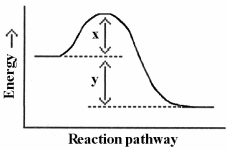
(Multiple Choice)
4.8/5 (77)
(77) The average rate of disappearance of I- in the initial 400.0 s is __________ M/s.
(Multiple Choice)
4.8/5 (78)
(78) The combustion of ethylene proceeds by the reaction C2H4 (g)+ 3O2 (g)→ 2CO2 (g)+ 2H2O (g)
When the rate of disappearance of O2 is 0.23 Ms-1, the rate of disappearance of C2H4 is __________ Ms-1.
(Multiple Choice)
4.7/5 (75)
(75) 
Filters
- Essay(0)
- Multiple Choice(0)
- Short Answer(0)
- True False(0)
- Matching(0)