



 Chat with AI
Exam 14: Chemical Kinetics

Exam 1: Introduction: Matter and Measurement151 Questions
Exam 2: Atoms, Molecules, and Ions230 Questions
Exam 3: Stoichiometry: Calculations With Chemical Formulas and Equations170 Questions
Exam 4: Aqueous Reactions and Solution Stoichiometry177 Questions
Exam 5: Thermochemistry148 Questions
Exam 6: Electronic Structure of Atoms180 Questions
Exam 7: Periodic Properties of the Elements171 Questions
Exam 8: Basic Concepts of Chemical Bonding141 Questions
Exam 9: Molecular Geometry and Bonding Theories177 Questions
Exam 10: Gases172 Questions
Exam 11: Liquids and Intermolecular Forces119 Questions
Exam 12: Solids and Modern Materials78 Questions
Exam 13: Properties of Solutions151 Questions
Exam 14: Chemical Kinetics130 Questions
Exam 15: Chemical Equilibrium92 Questions
Exam 16: Acid-Base Equilibria134 Questions
Exam 17: Additional Aspects of Aqueous Equilibria111 Questions
Exam 18: Chemistry of the Environment121 Questions
Exam 19: Chemical Thermodynamics120 Questions
Exam 20: Electrochemistry110 Questions
Exam 21: Nuclear Chemistry158 Questions
Exam 22: Chemistry of the Nonmetals192 Questions
Exam 23: Transition Metals and Coordination Chemistry147 Questions
Exam 24: The Chemistry of Life: Organic and Biological Chemistry124 Questions
Select questions type


If the rate law for the reaction 2A + 3B → products
Is second order in A and first order in B, then the rate law is rate = __________.
(Multiple Choice)
4.8/5  (97)
(97) In the energy profile of a reaction, the species that exists at the maximum on the curve is called the __________.
(Multiple Choice)
4.7/5 (91)
(91) The average rate of disappearance of A between 10 s and 20 s is __________ mol/s.
(Multiple Choice)
4.9/5 (67)
(67) Which one of the following is not a valid expression for the rate of the reaction below? 4NH3 + 7O2 → 4NO2 + 6H2O
(Multiple Choice)
4.9/5 (77)
(77) The number of molecules that participate as reactants defines the __________ of the reaction.
(Short Answer)
4.7/5 (85)
(85) A second-order reaction has a half-life of 12 s when the initial concentration of reactant is 0.98 M. The rate constant for this reaction is __________ M-1s-1.
(Multiple Choice)
4.8/5 (70)
(70) The following reaction occurs in aqueous solution: NH4+ (aq)+ NO2- → N2 (g)+ 2H2O (l)
The data below is obtained at 25°C. 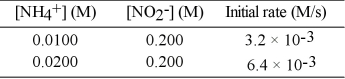 The order of the reaction in NH4+ is __________.
 (Multiple Choice)
4.7/5 (83)
(83) The minimum energy to initiate a chemical reaction is the __________.
(Short Answer)
4.8/5 (88)
(88) The primary source of the specificity of enzymes is __________.
(Multiple Choice)
4.8/5 (68)
(68) The rate limiting step in a reaction is the slowest step in the reaction sequence.
(True/False)
4.7/5 (89)
(89) Consider the following reaction: 3A → 2B
The average rate of appearance of B is given by Δ[B]/Δt. Comparing the rate of appearance of B and the rate of disappearance of A, we get Δ[B]/Δt = __________ × (-Δ[A]/Δt).
(Multiple Choice)
4.9/5 (70)
(70) A second-order reaction has a half-life of 18 s when the initial concentration of reactant is 0.71 M. The rate constant for this reaction is __________ M-1s-1.
(Multiple Choice)
4.8/5 (91)
(91) The following reaction is second order in [A] and the rate constant is 0.025 M-1s-1: A → B
The concentration of A was 0.65 M at 33 s. The initial concentration of A was __________ M.
(Multiple Choice)
4.8/5 (81)
(81) The average rate of disappearance of I- between 400.0 s and 800.0 s is __________ M/s.
(Multiple Choice)
4.8/5 (85)
(85) The rate law of the overall reaction A + B → C
Is rate = k[A]2. Which of the following will not increase the rate of the reaction?
(Multiple Choice)
4.8/5 (86)
(86) One difference between first- and second-order reactions is that __________.
(Multiple Choice)
4.9/5 (72)
(72) The rate law of a reaction is rate = k[D][X]. The units of the rate constant are __________.
(Multiple Choice)
4.8/5 (80)
(80) 
Filters
- Essay(0)
- Multiple Choice(0)
- Short Answer(0)
- True False(0)
- Matching(0)