



 Chat with AI
Exam 9: Molecular Geometry and Bonding Theories

Exam 1: Introduction: Matter and Measurement151 Questions
Exam 2: Atoms, Molecules, and Ions230 Questions
Exam 3: Stoichiometry: Calculations With Chemical Formulas and Equations170 Questions
Exam 4: Aqueous Reactions and Solution Stoichiometry177 Questions
Exam 5: Thermochemistry148 Questions
Exam 6: Electronic Structure of Atoms180 Questions
Exam 7: Periodic Properties of the Elements171 Questions
Exam 8: Basic Concepts of Chemical Bonding141 Questions
Exam 9: Molecular Geometry and Bonding Theories177 Questions
Exam 10: Gases172 Questions
Exam 11: Liquids and Intermolecular Forces119 Questions
Exam 12: Solids and Modern Materials78 Questions
Exam 13: Properties of Solutions151 Questions
Exam 14: Chemical Kinetics130 Questions
Exam 15: Chemical Equilibrium92 Questions
Exam 16: Acid-Base Equilibria134 Questions
Exam 17: Additional Aspects of Aqueous Equilibria111 Questions
Exam 18: Chemistry of the Environment121 Questions
Exam 19: Chemical Thermodynamics120 Questions
Exam 20: Electrochemistry110 Questions
Exam 21: Nuclear Chemistry158 Questions
Exam 22: Chemistry of the Nonmetals192 Questions
Exam 23: Transition Metals and Coordination Chemistry147 Questions
Exam 24: The Chemistry of Life: Organic and Biological Chemistry124 Questions
Select questions type


According to VSEPR theory, if there are six electron domains in the valence shell of an atom, they will be arranged in a(n)__________ geometry.
(Multiple Choice)
4.7/5  (84)
(84) An electron domain consists of __________.
(a)a nonbonding pair of electrons
(b)a single bond
(c)a multiple bond
(Multiple Choice)
4.8/5 (77)
(77) For which of the molecules is the molecular geometry (shape)the same as the VSEPR electron domain arrangement (electron domain geometry)?
(Multiple Choice)
4.9/5 (69)
(69) The blending of one s atomic orbital and two p atomic orbitals produces __________.
(Multiple Choice)
4.9/5 (70)
(70) In order to produce sp3 hybrid orbitals, __________ s atomic orbital(s)and __________ p atomic orbital(s)must be mixed.
(Multiple Choice)
4.9/5 (85)
(85) Based on molecular orbital theory, the bond order of the N-N bond in the N2 molecule is __________.
(Multiple Choice)
4.8/5 (88)
(88) The carbon-carbon σ bond in ethylene, H2C-CH2, results from the overlap of __________.
(Multiple Choice)
4.9/5 (84)
(84) According to MO theory, overlap of two s atomic orbitals produces __________.
(Multiple Choice)
4.9/5 (81)
(81) The electron-domain geometry and molecular geometry of boron trifluoride are __________ and __________, respectively.
(Multiple Choice)
4.9/5 (76)
(76) The sensation of vision results from a nerve impulse that is triggered by the separation of retinal from __________.
(Short Answer)
4.8/5 (80)
(80) The molecular geometry of the BCl3 molecule is __________, and this molecule is __________.
(Multiple Choice)
5.0/5 (79)
(79) The bond angles marked a, b, and c in the molecule below are about __________, __________, and __________, respectively. 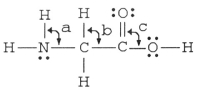
(Multiple Choice)
4.9/5 (86)
(86) Which of the following molecules or ions will exhibit delocalized bonding? NO2- NH4+ N3-
(Multiple Choice)
4.9/5 (70)
(70) In the valence shell of an atom there are six electron domains. They will be arranged in a (an)__________ geometry.
(Short Answer)
4.8/5 (72)
(72) Using the VSEPR model, the electron-domain geometry of the central atom in BrF4- is __________.
(Multiple Choice)
4.8/5 (82)
(82) According to MO theory, overlap of two p atomic orbitals produces __________.
(Multiple Choice)
4.9/5 (70)
(70) 
Filters
- Essay(0)
- Multiple Choice(0)
- Short Answer(0)
- True False(0)
- Matching(0)