



 Chat with AI
Exam 9: Molecular Geometry and Bonding Theories

Exam 1: Introduction: Matter and Measurement151 Questions
Exam 2: Atoms, Molecules, and Ions230 Questions
Exam 3: Stoichiometry: Calculations With Chemical Formulas and Equations170 Questions
Exam 4: Aqueous Reactions and Solution Stoichiometry177 Questions
Exam 5: Thermochemistry148 Questions
Exam 6: Electronic Structure of Atoms180 Questions
Exam 7: Periodic Properties of the Elements171 Questions
Exam 8: Basic Concepts of Chemical Bonding141 Questions
Exam 9: Molecular Geometry and Bonding Theories177 Questions
Exam 10: Gases172 Questions
Exam 11: Liquids and Intermolecular Forces119 Questions
Exam 12: Solids and Modern Materials78 Questions
Exam 13: Properties of Solutions151 Questions
Exam 14: Chemical Kinetics130 Questions
Exam 15: Chemical Equilibrium92 Questions
Exam 16: Acid-Base Equilibria134 Questions
Exam 17: Additional Aspects of Aqueous Equilibria111 Questions
Exam 18: Chemistry of the Environment121 Questions
Exam 19: Chemical Thermodynamics120 Questions
Exam 20: Electrochemistry110 Questions
Exam 21: Nuclear Chemistry158 Questions
Exam 22: Chemistry of the Nonmetals192 Questions
Exam 23: Transition Metals and Coordination Chemistry147 Questions
Exam 24: The Chemistry of Life: Organic and Biological Chemistry124 Questions
Select questions type


Based on molecular orbital theory, the only molecule in the list below that has unpaired electrons is __________.
(Multiple Choice)
4.9/5  (69)
(69) The electron-domain geometry of the AsF6- ion is octahedral. The hybrid orbitals used by the As atom for bonding are __________ orbitals.
(Multiple Choice)
4.9/5 (83)
(83) The electron-domain geometry and the molecular geometry of a molecule of the general formula ABn are __________.
(Multiple Choice)
4.9/5 (81)
(81) Based on molecular orbital theory, the bond order of the H-H bond in the H2+ ion is __________.
(Multiple Choice)
4.8/5 (95)
(95) Hybridization is the process of mixing atomic orbitals as atoms approach each other to form a bond.
(True/False)
5.0/5 (69)
(69) ClF3 has "T-shaped" geometry. There are __________ non-bonding domains in this molecule.
(Multiple Choice)
4.7/5 (91)
(91) The bond order of a homonuclear diatomic molecule can be decreased by __________.
(Multiple Choice)
4.8/5 (83)
(83) The hybridization of orbitals on the central atom in a molecule is sp2. The electron-domain geometry about this central atom is __________.
(Multiple Choice)
4.9/5 (77)
(77) A covalent bond in which overlap regions lie above and below an internuclear axis is called a(n)__________.
(Short Answer)
4.8/5 (87)
(87) The bond angles marked a, b, and c in the molecule below are about __________, __________, and __________, respectively. 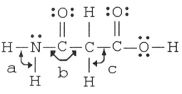
(Multiple Choice)
4.9/5 (76)
(76) The Lewis structure of carbon dioxide is given below. The hybridization of the carbon atom in carbon dioxide is __________. 
(Multiple Choice)
4.8/5 (78)
(78) PCl5 has __________ electron domains and a __________ molecular arrangement.
(Multiple Choice)
4.9/5 (90)
(90) The O-C-O bond angle in the CO32- ion is approximately __________.
(Multiple Choice)
4.9/5 (74)
(74) Nitrogen is colorless because the minimum energy to excite an electron is in the ultraviolet section of the spectrum.
(True/False)
4.9/5 (87)
(87) The hybridizations of nitrogen in NF3 and NH3 are __________ and __________, respectively.
(Multiple Choice)
4.9/5 (84)
(84) The hybridizations of bromine in BrF5 and of arsenic in AsF5 are __________ and __________, respectively.
(Multiple Choice)
4.8/5 (70)
(70) The hybridization of nitrogen in the H-CN: molecule is __________.
(Multiple Choice)
4.9/5 (70)
(70) The bond angles in a trigonal bipyramidal molecule are __________ degrees.
(Multiple Choice)
4.7/5 (86)
(86) 
Filters
- Essay(0)
- Multiple Choice(0)
- Short Answer(0)
- True False(0)
- Matching(0)